Lecture 10 - The Action Potential Part 2: Ionic permeability and channel conductance
 Call Kai
 Learn
 Practice Test
 Spaced Repetition
 Match
 Flashcards
 Knowt Play
1/14

There's no tags or description
Looks like no tags are added yet.
15 Terms
What happens to membrane potential when we inject negative current?
Set up an experiment with 2 probes that are inserted into an axon:
• The first injects current and measures the effect on Vm
• The second measures Vm a certain distance awa
When inject negative current at a constant rate, see the membrane potential becomes more negative at point a (the membrane is hyperpolarized)

Why don’t we detect change at point b?
Because was not enough of a stimulus to induce action potential
Also, because membrane is leaky to charge, no current arrives to change Em at point b
What happens to membrane potential when we inject positive current?
If the injected positive current is small, we see slight depolarization, but the same decay in current with distance
As a result, see no change in membrane potential at point b
YET! If depolarization is large enough current (that reaches a threshold membrane potential), then we see an action potential at both points a and b that occurs as a result of the change in ion conductance across the cell membrane
There is a time delay between the action potential at point a and its arrival at point b

Why do we have changes in ionic conductance during AP?
An action potential is the result of the rapid depolarization of the cell membrane. Following this:
During rising phase of action potential, see an increase in gNa
At peak of action potential, action potential fails to reach ENa
At action potential peak, gK is substantial, and so, K+ carries out most charge brought in by Na+.
Vm never reaches ENa
current based on conductance AND driving force (how far membrane is from ion eqm potential)

What causes the changes in ionic current across the cell membrane during an action potential?
Eion does not change magnitude of current —> because small number of ions lined up across membrane
Vm is needed for change in membrane potential
gion permeability is what causes change ??

What are permeabilities for resting cells?
*

What is the relation between sodium permeability and Vm?
Sodium is much less permeable across the cell membrane when compared to potassium in a cell at rest
This is why Vm in a cell at rest is closer to EK rather than ENa
At the start of an action potential PNa increases substantially
What can influence ion permeability?
Permeability of a channel is dependent on Vm
Eg: in this voltage-gated sodium channel
Monomeric protein
Organized into 4 homologous transmembrane domains (motifs)
Non-helical P loops between alpha helices 5&6 in each domain line the pore and make up the selectivity filter
Transmembrane alpha helix 4 in each domain serves as the voltage sensor
See similar architecture in other voltage-gated ion channel
Voltage-gated cation channels have homologous domain
Voltage-gated sodium and calcium channels consist of one large pore-forming subunit containing 4 domains
Voltage-gated potassium channels are made up of four pore-forming subunits
S4 segment is the voltage sensor that plays an important role in the voltage-gating of the channel
This is the region that transduces the depolarization of the cell membrane into a conformational change and opening of the ion channel
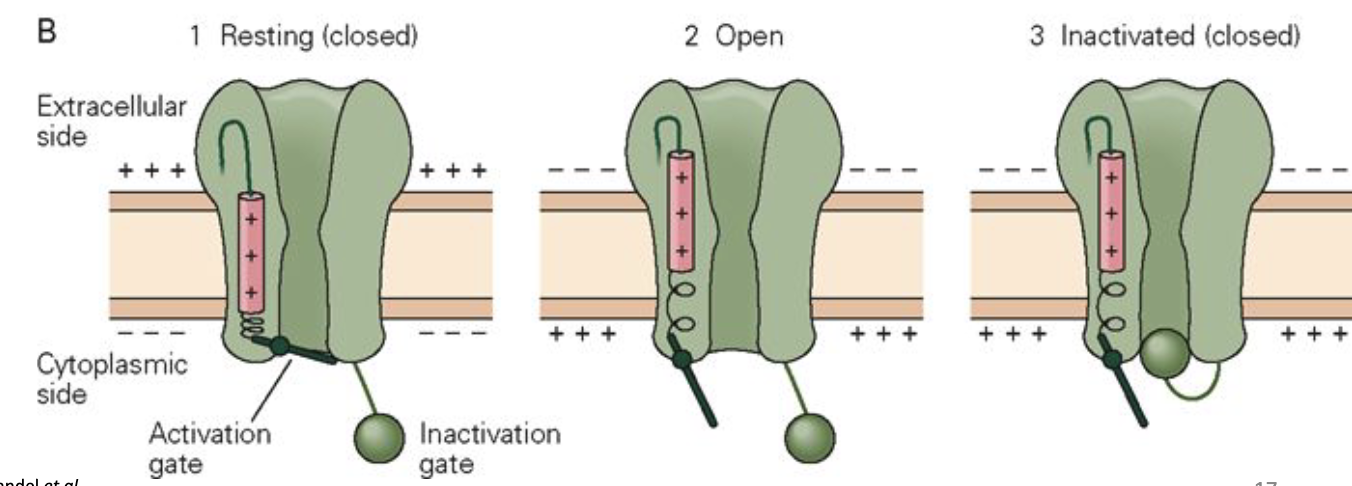
When do ion channels open and close?
they open and close when charge distribution changes within the ion channel
The red cylinder represents the positive charges in the S4 channel segments- this is the gating charge region
Depolarization of the cell membrane causes the gating charge region to move outward towards the extracellular side of the cell, and thus changes conformational state of ion channel

Conductance of ion channels is dependent on Vm, so explain Na+ channel conductance
Na+ channel conductance
Voltage-gated sodium channels have two gates
An activation gate (m-gate)
An inactivation gate (h-gate)
At resting Vm, m-gate is closed and h- gate is open
Both gates respond to depolarization, but with different speeds and in opposite directions
m-gates open immediately after depolarization
The delayed h-gates then close a short time later (still during depolarization, therefore= sodium channel inactivation)

Does sodium entry use positive or negative feedback loop during depolarization?
When the cell membrane is depolarized, PNa increases, allowing Na+ into the cell….
.... this depolarizes the cell further, causing a greater increase in PNa
This process continues until all sodium channels in the membrane are open and the membrane potential is closer to E 19

Explain the conductance of K+ channels.
Voltage-gated potassium channels are ALSO closed at resting Vm
These channels have an n-gate which also responds to changes in depolarization of membrane potential
In contrast to m-gate of sodium channels, there is a much slower response to depolarization, which causes PK to increase with a delay following depolarization
The timing of n-gate opening is pretty much at the same time as Na+channel h-gate closure
n-gates stay open until they respond to hyrepolarization

What are the voltage-gated ion channel changes during AP?
*

Explain the sequence of ion channel changes during AP.
Depolarization causes voltage-gated Na+ channel m-gates to open, setting off a cascade of Na+ channels to open and attempt to bring Vm towards ENa
Delayed voltage-gated Na+ channel h- gates close together with opening of n- gates of voltage-gated K+ channels, which brings Vm more towards EK
Repolarization causes h-gates to open and n-gates to close