Week 11a — Mental Lexicon, Priming & Ambiguity (Nov 16)
 Call Kai
 Learn
 Practice Test
 Spaced Repetition
 Match
 Flashcards
 Knowt Play
1/15

There's no tags or description
Looks like no tags are added yet.
16 Terms
What five kinds of information are stored in the mental lexicon?
Knowing a word includes its phonology (how it sounds), morphology (its meaningful parts, e.g. dogs = dog + plural -s), orthography (how it is spelled), syntax (how it combines with other words), and semantics (its meaning).
Why is the relation between a word's sound and its meaning arbitrary?
The sound–meaning link is an accident of history, so different languages and dialects use different sounds for the same thing (sneakers vs. gym shoes, bubbler vs. water fountain, chicken vs. Italian pollo).
What are familiar words, possible words, and impossible words in English?
Familiar words (sue, stew, strew) are already in the lexicon, possible words (glick, plub, vock) follow English sound rules and could be added, and **stlew violates English onset patterns so it cannot be a word — though Nahuatl allows tl-, as in tlacatl 'man'.
How is word knowledge organized in the mental lexicon — as a list or a network?
Words are organized as a network, not a dictionary list, with words related in sound or meaning interconnected so that activating one word spreads activation to related words.

What does the network model of word knowledge show? [Figure: network-model.png]
Each word is a node linked to related words, with closer nodes more strongly associated — rock links to sand, water, soil, ice, and earth on one side and to jazz, pop, music, film, and art on the other.
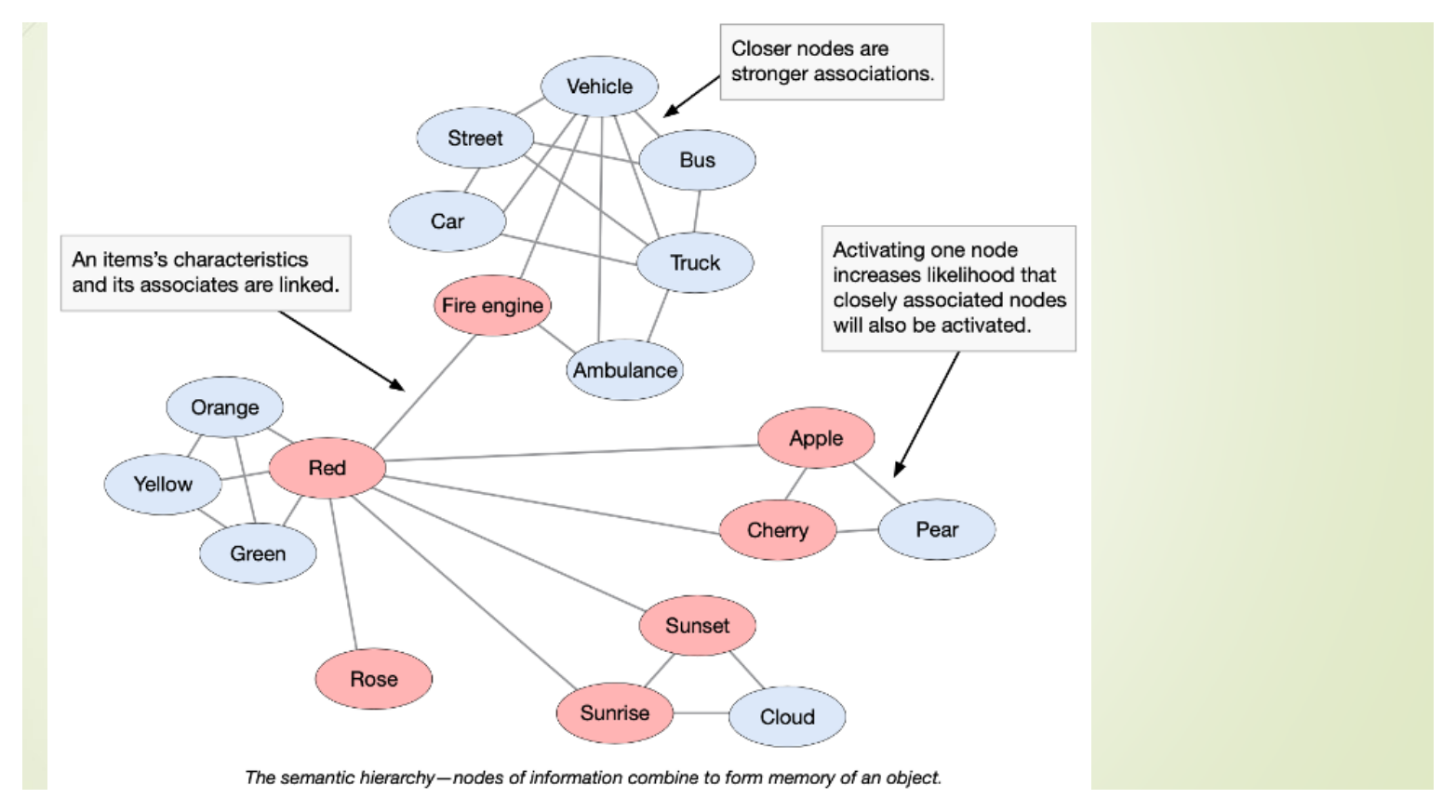
What does the semantic-priming network show about activation? [Figure: semantic-priming-network.png]
Activating one node increases the likelihood that closely associated nodes also become activated, since an item's characteristics and associates are linked (fire engine links to red and to vehicle).

What is the lexical decision task, and how is semantic priming measured with it? [Figure: lexical-decision-task.png]
Participants judge as fast as possible whether each item is a word or a nonword, and a prime word (dog) is shown before a target (cat) so reaction time to the target reveals whether the prime sped recognition.
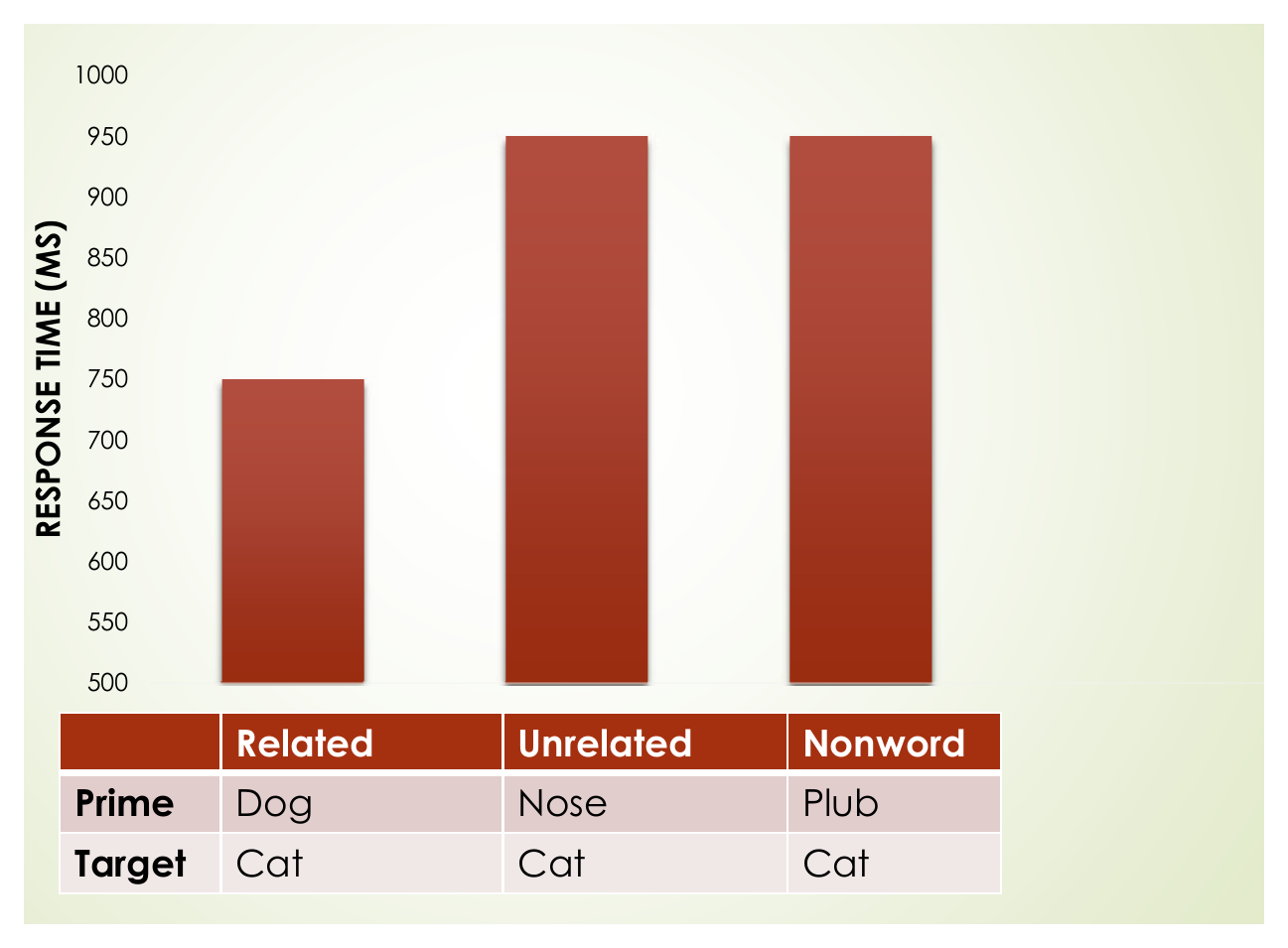
What did the related-primes experiment find? [Figure: priming-rt-graph.png]
Targets were recognized much faster after a related prime (~750 ms for dog → cat) than after an unrelated prime (~950 ms for nose → cat), and the nonword-prime condition (~950 ms) matched the unrelated condition, showing the effect is facilitation, not interference.
What is lexical ambiguity?
One word can have several meanings, e.g. bug (insect, surveillance device, glitch, to annoy), ball (a sphere, a dance, to curl up), and rose (a flower, stood up).
What is sentence ambiguity?
One sentence can have several readings, e.g. "The old men and women enjoyed the party," "They fed her dog biscuits," and "I watched her duck in the park."
What helps listeners disambiguate ambiguous sentences in speech?
Context disambiguates ambiguous sentences, along with pauses and prosody (vocal inflection) marking the intended grouping.
What are the serial and parallel accounts of accessing ambiguous word meanings?
The serial account says one meaning is accessed at a time, starting with the preferred meaning, while the parallel account says both meanings are activated automatically and context selects the appropriate one.

What is the cross-modal priming task? [Figure: cross-modal-priming.png]
Participants listen to a sentence through headphones while doing a visual lexical decision task, and the experiment manipulates whether the visual target is semantically related to the ambiguous word and when during the sentence it appears.

What was the "bugs" sentence in the cross-modal priming study? [Figure: cross-modal-bugs-table.png]
After hearing "…he found several spiders, roaches, and other bugs in the corner of his room," the visual targets were ANT (contextually related), SPY (contextually inappropriate), and SEW (unrelated).
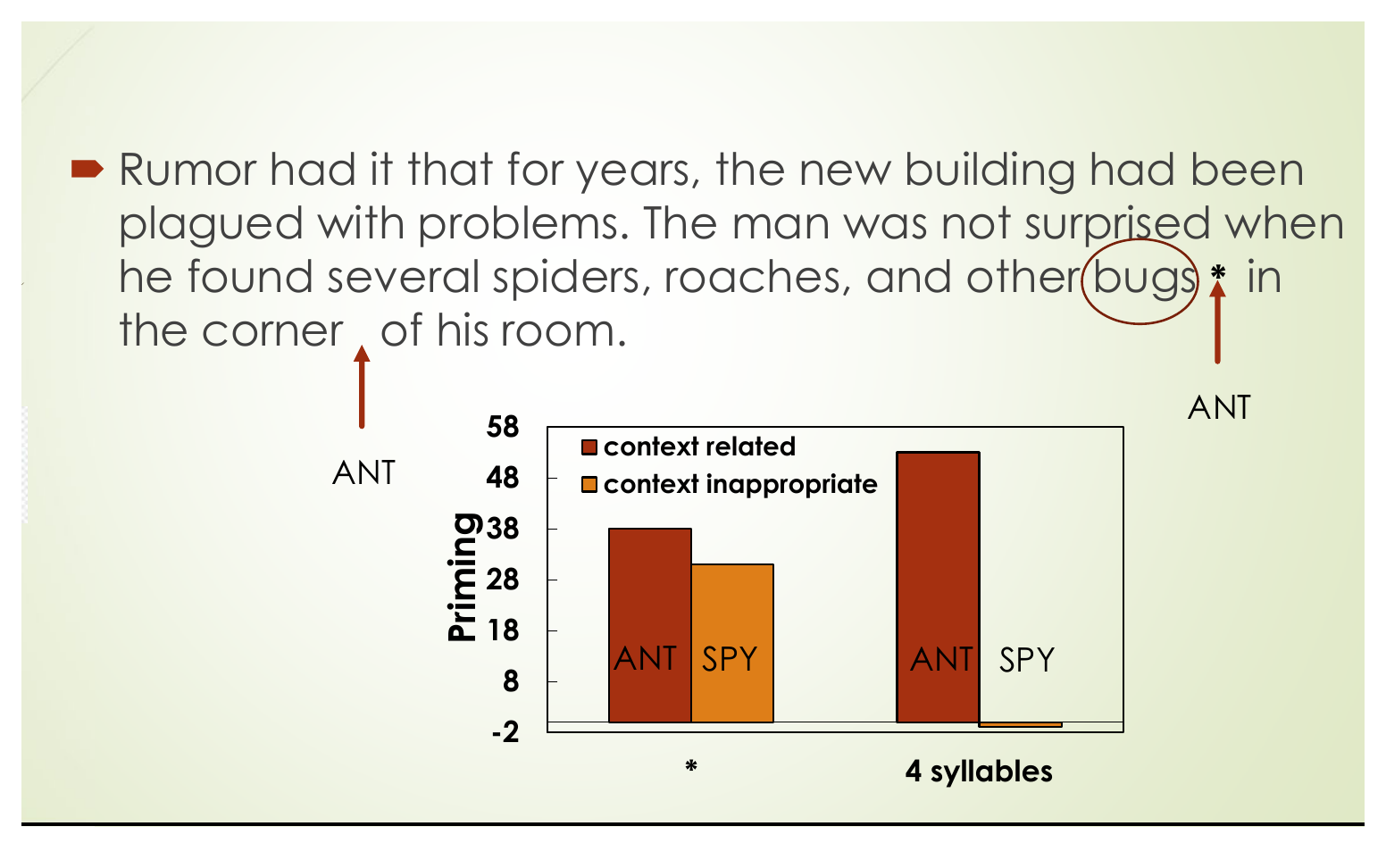
What did the cross-modal priming results show about meaning activation over time? [Figure: meaning-activation-graph.png]
Immediately after "bugs" (0 syllables) both meanings were primed (ANT ~38 ms, SPY ~30 ms), but 4 syllables later only the contextually appropriate meaning was primed (ANT ~52 ms, SPY ~0 ms).
What is the implication of early activation and later selection?
Initially both meanings of an ambiguous word are accessed in parallel, and only as the sentence unfolds does context select the appropriate meaning.