ASTRO EXAM 1
 Call Kai
 Learn
 Practice Test
 Spaced Repetition
 Match
 Flashcards
 Knowt Play
1/164

There's no tags or description
Looks like no tags are added yet.
165 Terms
Celestial Sphere
An imaginary, arbitrarily large sphere concentric with Earth on which all celestial objects appear to lie.
Celestial Poles
The two points (North and South) where Earth's rotational axis intersects the celestial sphere, around which the sky appears to rotate.
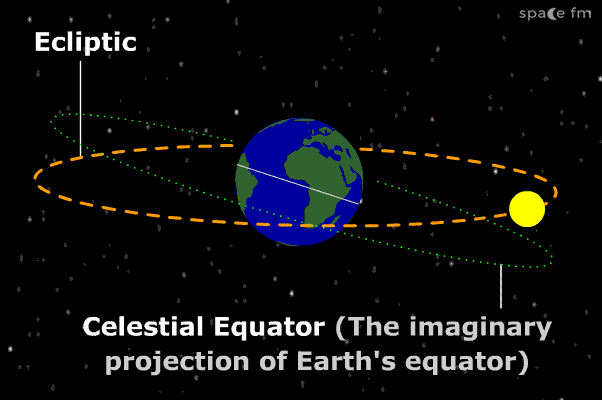
Celestial Equator
A great circle on the celestial sphere representing the projection of Earth's equator into space.

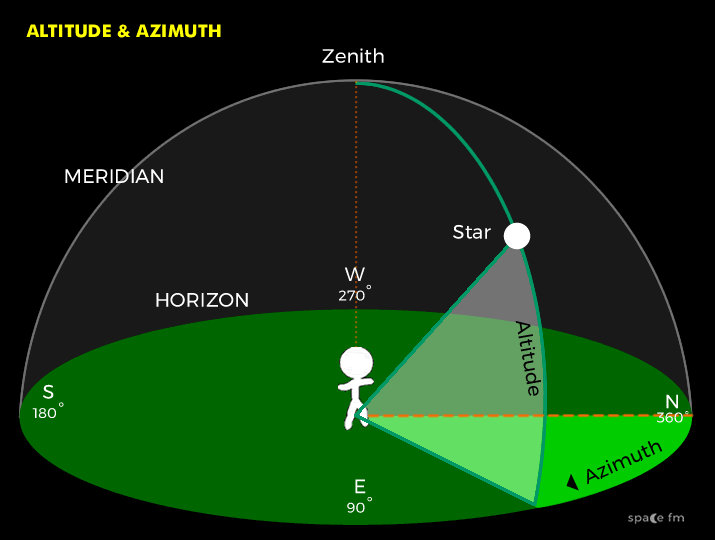
Zenith
The point on the celestial sphere directly overhead an observer at a given location.
Horizon
The circular boundary separating the visible upper half of the celestial sphere from the obscured lower half for a local observer.
Local Sky Coordinates
Altitude (angular height above the horizon from -90° to +90°) and azimuth (direction along the horizon measured clockwise from North from 0° to 360°).
Ecliptic
The apparent annual path of the Sun across the celestial sphere, tilted at 23.5° relative to the celestial equator.
Declination
The celestial coordinate analogous to latitude, measuring angular distance north (0° to +90°) or south (0° to -90°) of the celestial equator.
Right Ascension
The celestial coordinate analogous to longitude, measured eastward along the celestial equator from the vernal equinox in hours (0 to 24 hours, where 24 hours = 360°).
Circumpolar Star/Constellations
located near the celestial poles, remain continuously above the observers local horizon and never set during the sky's daily rotation
Constellation (Modern Definition)
One of the 88 officially recognized regions or sectors into which the International Astronomical Union divides the celestial sphere.
Asterism
A prominent, recognizable pattern of stars (such as the Big Dipper or the Summer Triangle) that is not an official standalone constellation.
Summer Triangle Stars
Vega (in Lyra), Altair (in Aquila), and Deneb (in Cygnus).
Zodiac
The ring of constellations (12-13) positioned along the ecliptic through which the Sun appears to pass over the course of a year.
Ancient Greek "Wandering Stars"
The celestial bodies observed to move against the background stars: the Sun, the Moon, Mercury, Venus, Mars, Jupiter, and Saturn.
Scientific Theory
explains why natural phenomena occur
Scientific Law
describes or predicts what occurs under specified conditions (often formulated as an equation).
Scientific Method
observation, research topic, form hypothesis, experiment, data analysis, report conclusions, repeat if needed.
Eratosthenes of Cyrene
The ancient scholar who calculated the circumference of the Earth (~4.2×10⁴ km) by comparing the Sun's shadow angles at noon on the summer solstice between Syene (0°) and Alexandria (7.0°) separated by 810 km (5000 stadia).
Aristotle's Evidence for a Spherical Earth
The consistently circular shadow cast by Earth on the Moon during a lunar eclipse and the changing visibility of constellations as an observer travels north or south.
Aristarchus of Samos
The ancient Greek astronomer who first proposed a heliocentric model of the solar system and identified the Sun as a star, though his ideas were rejected due to the unobserved stellar parallax.
Stellar Parallax
The apparent shift in position of a nearby star against background stars caused by the change in the Earth's position in its orbit around the Sun.
Precession of Earth's Axis
The slow conical wobble of Earth's rotational axis with a period of approximately 26,000 years, caused by gravitational torques from the Sun and Moon on Earth's equatorial bulge.
Apparent Magnitude Scale
An inverted brightness scale established by Hipparchus where smaller or more negative numbers represent brighter celestial objects.
Ptolemaic System
A geocentric astronomical model where each planet moves in a small circle called an epicycle, whose center orbits Earth along a larger circle called a deferent.
Retrograde Motion
The temporary apparent backward (westward) loop of a planet across background stars, caused by Earth lapping a slower, more distant outer planet in its orbit.
Nicolaus Copernicus
The Polish astronomer who published a heliocentric model of the solar system in 1543 in which the planets orbit the Sun, though he still retained uniform circular orbits requiring epicycles.
Tycho Brahe
The Danish astronomer whose precise pre-telescopic observations of planetary positions and the 1572 supernova refuted Aristotle's concept of an unchanging, immutable sky.
Galilean Moons
The four large moons of Jupiter (Io, Europa, Ganymede, Callisto) discovered by Galileo Galilei in 1610, proving that celestial bodies can orbit a body other than Earth.
Phases of Venus (Heliocentric Proof)
Galileo's telescopic observation that Venus exhibits a complete cycle of phases (including crescent and gibbous), which is impossible under the Ptolemaic geocentric model.
Ellipse
A geometric shape resembling a stretched circle defined by two foci, such that the sum of the distances from the foci to any point on the curve is constant.
Orbital Eccentricity (e)
A measure of how elongated an ellipse is, defined as the ratio of the distance between the foci (f) to the length of the major axis (2a): e = f / 2a. For a circle, e = 0.
Perihelion and Aphelion
The closest point and farthest point of an orbiting body relative to the Sun.
Perigee and Apogee
The closest point (perigee) and farthest point (apogee) of an orbiting body relative to the Earth.
Kepler's First Law
Each planet moves around the Sun in an orbit that is an ellipse, with the Sun located at one foci.
Kepler's Second Law
A straight line joining a planet and the Sun sweeps out equal areas in space in equal intervals of time, showing that planets travel faster near perihelion and slower near aphelion.
Kepler's Third Law
The square of a planet's orbital period (P in Earth years) is equal to the cube of the semi-major axis of its orbit (a in AU): P² = a³ for objects orbiting the Sun.
Newton's First Law of Motion
An object remains at rest or moves at a constant velocity in a straight line unless acted upon by a net external force.
Newton's Second Law of Motion
The acceleration of an object is directly proportional to the net force acting on it and inversely proportional to its mass: F = ma.
Newton's Third Law of Motion
When one body exerts a force on another body, the second body exerts an equal in magnitude and opposite in direction force on the first.
Newton's Universal Law of Gravitation
Every mass attracts every other mass with a force proportional to the product of their masses and inversely proportional to the square of the distance between their centers: F_g = G * m1 * m2 / r².
Centripetal Force in Orbits
The center-directed net force required to keep an astronomical body moving along a curved circular path of radius r, which is provided by gravity.
Surface Gravity Formula (g)
g = G * M / r², where G is the gravitational constant, M is the mass of the body, and r is its radius.
Circular Orbital Speed Formula
v = sqrt(G * M / r), expressing the speed required for a stable circular orbit at distance r from mass M.
Cause of Earth's Seasons
Earth's 23.5° axial tilt, which causes the altitude of the Sun and the duration of daylight hours to vary across the year in each hemisphere.
Solstice
The time of year when the Sun reaches its maximum northern or southern declination (±23.5°), yielding the longest or shortest day of the year.
Equinox
The time of year when the Sun crosses the celestial equator (declination 0°), resulting in approximately equal durations of day and night worldwide.
Altitude of the Sun Formula
Angle above horizon = 90° - latitude + declination of Sun.
Lunar Eclipse
An astronomical event that occurs when Earth passes directly between the Sun and the Moon, casting Earth's shadow across the Moon.
Solar Eclipse
An astronomical event that occurs when the new Moon passes directly between the Sun and Earth, blocking sunlight from reaching Earth along the path of totality.
Line of Nodes
The line of intersection between the Moon's orbital plane and the ecliptic plane; eclipses can occur only when this line points toward the Sun because the Moon's orbit is tilted by 5°.
Umbra and Penumbra
The umbra is the dark central part of a celestial shadow where light from the source is completely obscured; the penumbra is the lighter outer part where the source is only partially obscured.
Spring Tide
An ocean tide with the greatest tidal range, occurring when the Earth, Moon, and Sun align at new moon and full moon phases.
Neap Tide
An ocean tide with the minimum tidal range, occurring when the gravitational pulls of the Sun and Moon act at right angles (90°) during first and third quarter moons.
Sun-Earth-Moon Angle by Phase
0° at New Moon, 90° at First and Third Quarter moons, and 180° at Full Moon.
Astronomical Unit (AU)
The average distance between the Earth and the Sun, approximately equal to 1.50 × 10¹¹ m (150 million km).
Significant Figures Rule for Addition and Subtraction
The final answer is rounded to match the input value with the fewest decimal places (e.g., 2.485 + 10.2 = 12.7).
Significant Figures Rule for Multiplication and Division
The final answer is rounded to match the input value with the fewest significant figures (e.g., 1.3 × 13.7 = 18).
SI Base Units
Second (s) for time, meter (m) for length, kilogram (kg) for mass, and Kelvin (K) for temperature.
Converting a decimal to scientific notation
shift the decimal point until one non-zero digit remains to the left. The number of shifts is the exponent n (positive if the original number 10, negative if <1). To convert back to decimal, shift the decimal point n places to the right (if positive) or left (if negative).
Base Unit for Mass
kilogram (kg)
Determining the correct number of significant figures in calculations
Multiplication / Division - Round the final answer to match the fewest number of significant figures present in any input value. Addition / Subtraction- Round the final answer to match the fewest decimal places present in any input value.
Using ratios to solve for an unknown quantity in problems involving "keeping scale"
Set up a proportion equation scaledimension/actualdimension = unknownscalevalue/ actualvalue and solve algebraically for the unknown variable.

At the North Pole (90°N), stars…
move in horizontal circles parallel to the horizon and never set (all visible stars are circumpolar).
At the Equator (0°), stars…
rise straight up in the east and set straight down in the west.
At intermediate latitudes, star paths rise and set at an angle equal to (90°- their latitude)
Rotation
Drives short-term daily rising, crossing (transiting), and setting of objects.
Orbit
Drives long-term seasonal shifts in visible nighttime constellations and the Sun's changing position along the zodiac.
Angular distance of an object measured vertically above the horizon (0 at horizon to 90 at zenith (above observer).

Declination (Dec)
Celestial latitude measured in degrees north (+) or south (-) of the celestial equator (-90° to +90°).