mb w6 (viral infects)

0.0(0)
Studied by 0 people
call kaiCall Kai
learnLearn
examPractice Test
spaced repetitionSpaced Repetition
heart puzzleMatch
flashcardsFlashcards
GameKnowt Play
Card Sorting

1/16

flashcard set

Earn XP

Description and Tags

prophy

17 Terms

1
New cards

Viruses and Viral Infections

• Viral structure, classification, and replication

• Bacteriophages and viral life cycles

• Viral transmission, tissue specificity, and latency

• Common viral infections relevant to healthcare

• Hepatitis characteristics (see comparison chart),

herpesviruses, and influenza

• Vaccines and immune protection

• Viral changes and pandemic potential

virus characters

  • acellular (not true living org)

  • ultramicroscopic (need electron microscope)

  • contain either DNA (linear or circular) or RNA


  • lack organelles & metabolic machinery

  • cant gen. E or synth prots


  • obligate intracellular parasites (rep only in host cell)

  • simpler struct than bact


2
New cards
<p><strong><mark data-color="purple" style="background-color: purple; color: inherit;">virus structure</mark></strong></p><ul><li><p>surround by <u>capsid (protein coat)</u> + <u>lipid envelope</u></p></li><li><p>nucleocapsid = <u>nucleic acid</u> + <u>capsid</u></p></li></ul><p></p><ul><li><p><mark data-color="yellow" style="background-color: yellow; color: inherit;">naked OR enveloped</mark> (in lipoprot sheath from host cell mem)</p></li><li><p><mark data-color="yellow" style="background-color: yellow; color: inherit;">capsomere</mark> = protein unit making up capsid (in some)</p></li></ul><p></p><ul><li><p><mark data-color="yellow" style="background-color: yellow; color: inherit;">peplomers (SPIKES)</mark> = protein units in enveloped virus that comprise the envelopes</p></li></ul><div data-type="horizontalRule"><hr></div><p><strong><mark data-color="green" style="background-color: green; color: inherit;">classif of viruses</mark></strong> - still evolving</p><ol><li><p>nucleic acid type (DNA or RNA)</p></li><li><p>genome struct (single or double stranded - polarity)</p></li><li><p>capsid symmetry / morphology</p></li><li><p>presence of envelope</p></li></ol><p></p><p><mark data-color="yellow" style="background-color: yellow; color: inherit;">taxonomy</mark> = classif into families, genera, species</p><p></p><p><mark data-color="yellow" style="background-color: yellow; color: inherit;">other features</mark> = size &amp; shape, replic strategy</p><p></p>

virus structure

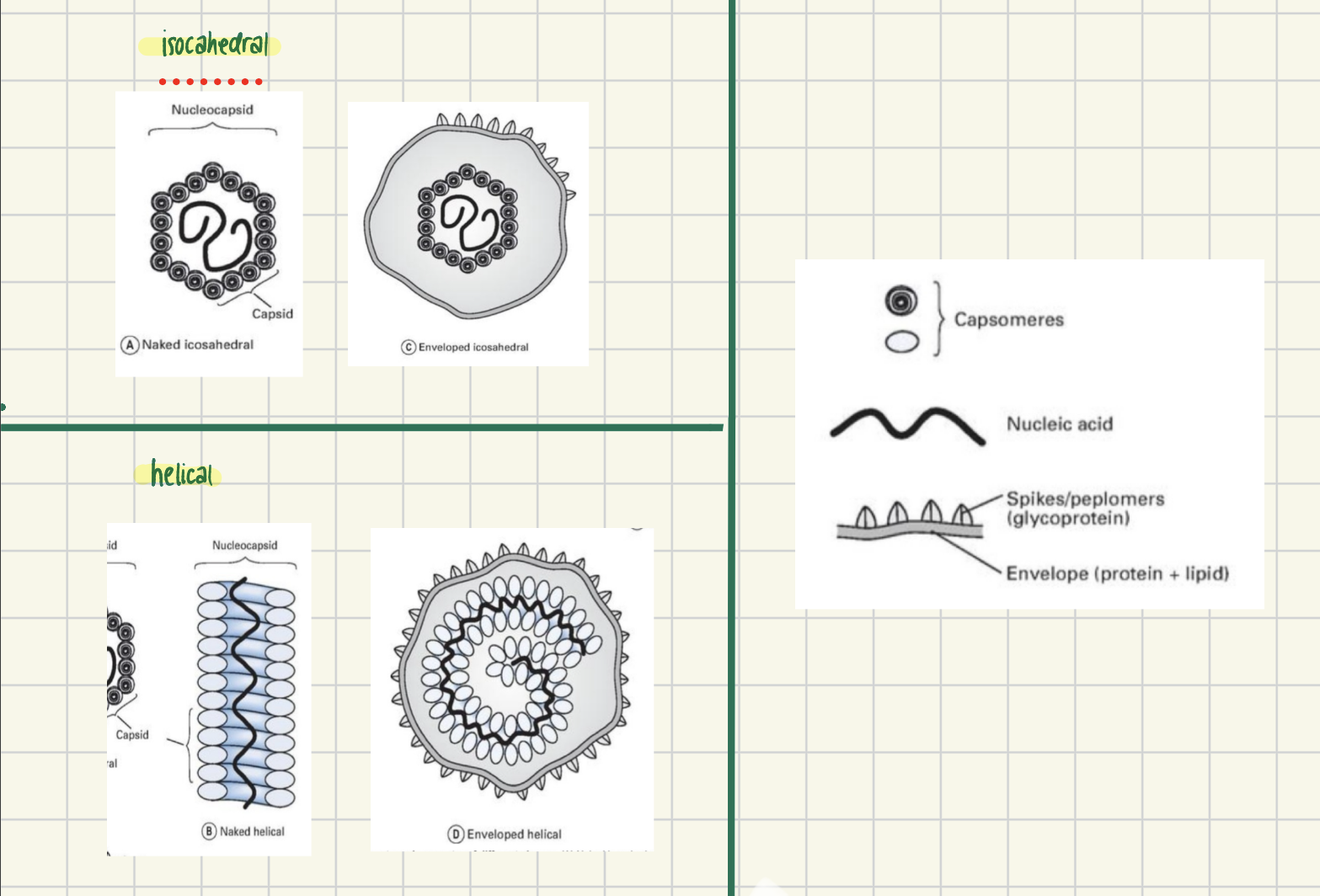
  • surround by capsid (protein coat) + lipid envelope

  • nucleocapsid = nucleic acid + capsid


  • naked OR enveloped (in lipoprot sheath from host cell mem)

  • capsomere = protein unit making up capsid (in some)


  • peplomers (SPIKES) = protein units in enveloped virus that comprise the envelopes


classif of viruses - still evolving

  1. nucleic acid type (DNA or RNA)

  2. genome struct (single or double stranded - polarity)

  3. capsid symmetry / morphology

  4. presence of envelope


taxonomy = classif into families, genera, species


other features = size & shape, replic strategy


virus symmetry

  • their nucleocapsids (nucl acid + capsid) arranged highly symm


  1. isocahedral symm

  • protein molecs symmetrical arrange in isocahedron shape

  • ex: herpes

  • 20-sided geometric shapes


  1. helical symm

  • capsomeres surround nucleic acid in helix/spiral to form tubular nucleocapsid

  • mamallian RnA

  • nucleocapsid arranged in form of coil & enclosed w lipoprot envelope

  • Rod-shaped structures with spiral arrangement


  1. complex symm

  • exhibited by few fams

  • ex: retoviruses, poxviruses


<p><strong><mark data-color="blue" style="background-color: blue; color: inherit;">virus symmetry</mark></strong></p><ul><li><p>their nucleocapsids (nucl acid + capsid) arranged highly symm</p></li></ul><p></p><ol><li><p><strong><mark data-color="yellow" style="background-color: yellow; color: inherit;">isocahedral symm</mark></strong></p></li></ol><ul><li><p><u>protein molecs</u> symmetrical arrange in <u>isocahedron shape</u></p></li><li><p>ex: herpes</p></li><li><p>20-sided geometric shapes</p></li></ul><p></p><ol start="2"><li><p><strong><mark data-color="yellow" style="background-color: yellow; color: inherit;">helical symm</mark></strong></p></li></ol><ul><li><p><u>capsomeres surround nucleic acid in helix/spiral</u> to <u>form tubular nucleocapsid</u></p></li><li><p>mamallian RnA</p></li><li><p>nucleocapsid arranged in form of coil &amp; enclosed w lipoprot envelope</p></li><li><p>Rod-shaped structures with spiral arrangement</p></li></ul><p></p><ol start="3"><li><p><strong><mark data-color="yellow" style="background-color: yellow; color: inherit;">complex symm</mark></strong></p></li></ol><ul><li><p>exhibited by few fams</p></li><li><p>ex: retoviruses, poxviruses</p></li></ul><p></p>
3
New cards
<p><strong><mark data-color="green" style="background-color: green; color: inherit;">virions &amp; viroids</mark></strong></p><p></p><p><strong><mark data-color="yellow" style="background-color: yellow; color: inherit;">virion</mark></strong></p><ul><li><p>complete, infectious, virus particle</p></li><li><p><span style="color: red;">COMPLETE</span></p></li></ul><p></p><p><strong><mark data-color="yellow" style="background-color: yellow; color: inherit;">viroid</mark></strong></p><ul><li><p>cause disease in plants</p></li><li><p>comprise naked, covalently linked closed circles of ssRNA</p></li><li><p>replic using host cell enzymes</p></li><li><p>NOT assoc w human disease</p></li><li><p>simpler infectious agent w essentially naked dna</p></li><li><p><span style="color: red;">PLANT</span></p></li></ul><p></p><p><mark data-color="purple" style="background-color: purple; color: inherit;">prions</mark><strong> </strong>= proteinaceous infectious particles <span style="color: red;">(NOT A VIRUS)</span></p><ul><li><p>essentially misfolded protein lead &gt; neuro issues</p></li><li><p>agents of a group of chron diseases “prion diseases” or <u>“transmissible spongiform encephalopathies”</u></p></li></ul><p></p><ul><li><p>infect nerve tissue of human + animal</p></li><li><p>NO DNA/RNA</p></li><li><p>highly resistant</p></li></ul><p></p><p>ex: CJD &amp; vCJD <span style="color: red;">(left out details)</span></p><p></p><p></p>

virions & viroids


virion

  • complete, infectious, virus particle

  • COMPLETE


viroid

  • cause disease in plants

  • comprise naked, covalently linked closed circles of ssRNA

  • replic using host cell enzymes

  • NOT assoc w human disease

  • simpler infectious agent w essentially naked dna

  • PLANT


prions = proteinaceous infectious particles (NOT A VIRUS)

  • essentially misfolded protein lead > neuro issues

  • agents of a group of chron diseases “prion diseases” or “transmissible spongiform encephalopathies”


  • infect nerve tissue of human + animal

  • NO DNA/RNA

  • highly resistant


ex: CJD & vCJD (left out details)


virus vs bact

  • bact = light microscope

  • virus = electron microscope


review


Which of the following is TRUE regarding viruses?

A. They contain both DNA and RNA

B. They have their own metabolic machinery

C. They are obligate intracellular parasites

D. They can synthesize proteins independently


Viruses contain:

A. Both DNA and RNA simultaneously

B. Either DNA or RNA, but not both

C. Only double-stranded DNA

D. Only single-stranded RNA


The capsid is best described as:

A. A lipid membrane surrounding the virus

B. The genetic material of the virus

C. A protein coat surrounding nucleic acid

D. A host-derived enzyme


The nucleocapsid consists of:

A. Envelope + spikes

B. DNA only

C. RNA only

D. Nucleic acid + capsid


Which symmetry is most common in animal viruses?

A. Helical

B. Icosahedral

C. Cuboidal

D. Spiral only


Helical viruses are best described as:

A. Spherical structures

B. 20-sided geometric shapes

C. Rod-shaped structures with spiral arrangement

D. Irregular in shape


Which of the following is TRUE about viroids?

A. They infect humans

B. They contain a protein capsid

C. They are small circular RNA molecules

D. They contain DNA


Which statement about prions is correct?

A. They contain RNA

B. They are a type of virus

C. They lack nucleic acids

D. They infect only plants


Which of the following distinguishes viruses from bacteria?

A. Viruses have ribosomes

B. Viruses reproduce by binary fission

C. Viruses lack metabolism

D. Viruses are larger than bacteria


<p><strong><mark data-color="purple" style="background-color: purple; color: inherit;">virus vs bact</mark></strong></p><ul><li><p>bact = light microscope</p></li><li><p>virus = electron microscope</p></li></ul><p></p><div data-type="horizontalRule"><hr></div><p><mark data-color="yellow" style="background-color: yellow; color: inherit;">review</mark></p><p></p><p><strong><u>Which of the following is TRUE regarding viruses?</u> </strong></p><p>A. They contain both DNA and RNA </p><p>B. They have their own metabolic machinery </p><p><mark data-color="blue" style="background-color: blue; color: inherit;">C</mark>. They are obligate intracellular parasites </p><p>D. They can synthesize proteins independently </p><p></p><p><strong><u>Viruses contain: </u></strong></p><p>A. Both DNA and RNA simultaneously </p><p><mark data-color="blue" style="background-color: blue; color: inherit;">B</mark>. Either DNA or RNA, but not both </p><p>C. Only double-stranded DNA </p><p>D. Only single-stranded RNA </p><p></p><p><strong><u>The capsid is best described as: </u></strong></p><p>A. A lipid membrane surrounding the virus </p><p>B. The genetic material of the virus </p><p><mark data-color="blue" style="background-color: blue; color: inherit;">C</mark>. A protein coat surrounding nucleic acid </p><p>D. A host-derived enzyme</p><p></p><p><strong><u>The nucleocapsid consists of: </u></strong></p><p>A. Envelope + spikes </p><p>B. DNA only </p><p>C. RNA only </p><p><mark data-color="blue" style="background-color: blue; color: inherit;">D.</mark> Nucleic acid + capsid </p><p></p><p><strong><u>Which symmetry is most common in animal viruses?</u></strong> </p><p>A. Helical </p><p><mark data-color="blue" style="background-color: blue; color: inherit;">B</mark>. Icosahedral </p><p>C. Cuboidal </p><p>D. Spiral only </p><p></p><p><strong><u>Helical viruses are best described as:</u></strong> </p><p>A. Spherical structures </p><p>B. 20-sided geometric shapes </p><p><mark data-color="blue" style="background-color: blue; color: inherit;">C</mark>. Rod-shaped structures with spiral arrangement </p><p>D. Irregular in shape</p><p></p><p><strong><u>Which of the following is TRUE about viroids? </u></strong></p><p>A. They infect humans </p><p>B. They contain a protein capsid </p><p><mark data-color="blue" style="background-color: blue; color: inherit;">C.</mark> They are small circular RNA molecules </p><p>D. They contain DNA </p><p></p><p><strong><u>Which statement about prions is correct? </u></strong></p><p>A. They contain RNA </p><p>B. They are a type of virus </p><p><mark data-color="blue" style="background-color: blue; color: inherit;">C.</mark> They lack nucleic acids </p><p>D. They infect only plants </p><p></p><p><strong><u>Which of the following distinguishes viruses from bacteria? </u></strong></p><p>A. Viruses have ribosomes </p><p>B. Viruses reproduce by binary fission </p><p><span style="color: rgb(246, 242, 242);"><mark data-color="blue" style="background-color: blue; color: inherit;">C. </mark></span>Viruses lack metabolism </p><p>D. Viruses are larger than bacteria</p><p></p>
4
New cards
<p><span style="color: rgb(247, 234, 234);"><strong><mark data-color="purple" style="background-color: purple; color: inherit;">viral impact on dev + preg</mark></strong></span></p><p><span style="color: rgb(235, 221, 221);">*image of HIV</span></p><p></p><p><mark data-color="yellow" style="background-color: yellow; color: inherit;">HIV = Human Immunodeficiency Virus</mark></p><ul><li><p>A virus that attacks the immune system, <span style="color: red;">especially CD4 T-helper cells</span>.</p></li><li><p>Weakens the body's ability to fight infections.</p></li><li><p>Can progress to AIDS if untreated.</p></li></ul><p></p><p><mark data-color="yellow" style="background-color: yellow; color: inherit;">AIDS = Acquired Immunodeficiency Syndrome</mark></p><ul><li><p>The <mark data-color="green" style="background-color: green; color: inherit;">most advanced stage of HIV infection.</mark></p></li><li><p>Occurs when the immune system is severely weakened.</p></li><li><p>Increases the risk of opportunistic infections and certain cancers.</p></li></ul><p></p><div data-type="horizontalRule"><hr></div><ul><li><p>HIV &gt; AIDS = major global health burden</p></li><li><p>some early life viral infections impact dev &gt; target of global vax programs</p></li></ul><p></p>

viral impact on dev + preg

*image of HIV


HIV = Human Immunodeficiency Virus

  • A virus that attacks the immune system, especially CD4 T-helper cells.

  • Weakens the body's ability to fight infections.

  • Can progress to AIDS if untreated.


AIDS = Acquired Immunodeficiency Syndrome

  • The most advanced stage of HIV infection.

  • Occurs when the immune system is severely weakened.

  • Increases the risk of opportunistic infections and certain cancers.


  • HIV > AIDS = major global health burden

  • some early life viral infections impact dev > target of global vax programs


viral states = extracellular vs. intracellular


  1. extracellular state = VIRION

  • complete infectious particle (nuc acid + nucleocapsid + some lipid env w potential spikes)

  • if envelope present = aid protect + attach to host cell


  1. intracellular state

  • virus enter host cell

  • capsid removed (uncoating)

  • viral gen material direct replication in host cell

  • ex: BACTERIOPHAGE (image of phages attacking e.coli)


<p><strong><mark data-color="purple" style="background-color: purple; color: inherit;">viral states</mark></strong> = extracellular vs. intracellular</p><p></p><ol><li><p><mark data-color="green" style="background-color: green; color: inherit;">extracellular state = VIRION</mark></p></li></ol><ul><li><p>complete infectious particle (nuc acid + nucleocapsid + some lipid env w potential spikes)</p></li><li><p>if envelope present = aid protect + attach to host cell</p></li></ul><p></p><ol start="2"><li><p><mark data-color="green" style="background-color: green; color: inherit;">intracellular state</mark></p></li></ol><ul><li><p>virus enter host cell</p></li><li><p>capsid removed (uncoating)</p></li><li><p>viral gen material direct replication in host cell</p></li><li><p>ex: <span style="color: red;">BACTERIOPHAGE (image of phages attacking e.coli)</span></p></li></ul><p></p>
5
New cards
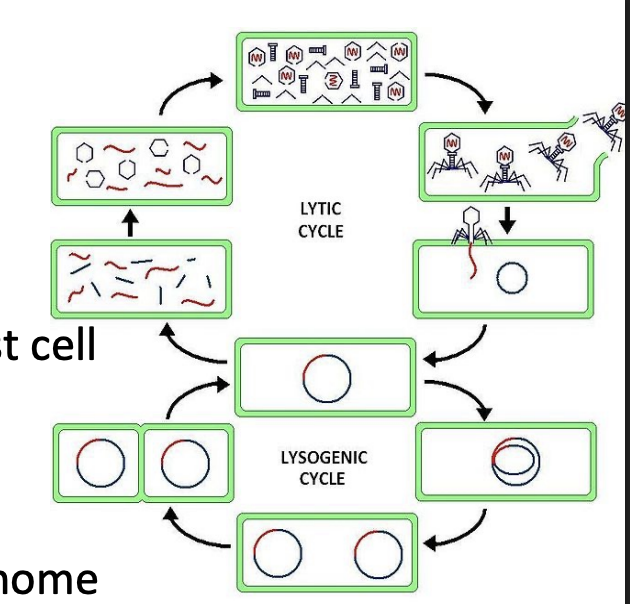
<p><strong><mark data-color="red" style="background-color: red; color: inherit;">Bacteriophage (bacterial viruses)</mark></strong></p><ul><li><p>viruses that infect bacterial cells</p></li><li><p>also called phages</p></li><li><p>typically <u>complex structure</u> (head + tail)</p></li></ul><p></p><ul><li><p>inject gen mat &gt; host cell</p></li><li><p>usually <u>contain DNA</u> (some have rna)</p></li></ul><p></p><p><mark data-color="yellow" style="background-color: yellow; color: inherit;">types of infection</mark></p><ol><li><p><strong><mark data-color="green" style="background-color: green; color: inherit;">lytic (virulent) cycle</mark></strong> = replic &amp; host cell <strong>destruction</strong></p></li></ol><p></p><ol start="2"><li><p><strong><mark data-color="green" style="background-color: green; color: inherit;">lysogenic (temperate) cycle</mark></strong> =viral DNA integ into host genome</p></li></ol><p></p>

Bacteriophage (bacterial viruses)

  • viruses that infect bacterial cells

  • also called phages

  • typically complex structure (head + tail)


  • inject gen mat > host cell

  • usually contain DNA (some have rna)


types of infection

  1. lytic (virulent) cycle = replic & host cell destruction


  1. lysogenic (temperate) cycle =viral DNA integ into host genome


stages of viral replication (A.P.U.T.S.A.R)

  • infective particles of some animal viruses form at cell surf & released by budding process


  1. Adsorption/Attachment

  • virus particles bind to receptor sites (prots) on host cell mem

  • tail fibers of phage & spikes of enveloped viruses adapted for attach


  1. Penetration = active or passive


1) endocytosis = most virions taken by endocytosis appear to be degraded by lysozomal enzymes

  • so fail to initiate infect, but this is normal route to successful infect

  • active


2) fusion = direct fusion of viral envelope w/ plasma mem

  • generally passive


3) translocation = some no-envelop virs have capacity to pass directly thru plasma mem

  • depend


  1. Uncoating / Eclipse

  • after penetration, there’s period of no intact infectious virus can be detected (eclipse phase)

  • start w/ uncoating of lipid mem + protein capsid surrounding nucleic viral core

  • as uncoating proceed > viral nucl acid become free > act as template for synth of virus mRNA


  1. Transcription

  • viral gen mat direct prod of viral RNA + proteins need for replic & assembly

  • proc depend on if virus has DNA or RNA


  1. Synth of viral compents = viral prots are of 2 types

  • structural = prots making up virus particle

  • nonstructural = enzymes req for virus genome rep


  1. Assembly

  • incorporation of viral nucl acid > putative capsomeres (procapsid aka immature capsid)


  1. Releaseoccur either thru…

  • gradual budding (for enveloped viruses)

  • lysis (sudden rupture) (lysis = lytic cycle, NOT lysogenic)

  • image of lyse


<p><strong><mark data-color="green" style="background-color: green; color: inherit;">stages of viral replication (A.P.U.T.S.A.R)</mark></strong></p><ul><li><p>infective particles of some animal viruses form at cell surf &amp; released by budding process</p></li></ul><p></p><ol><li><p><strong><mark data-color="purple" style="background-color: purple; color: inherit;">Adsorption/Attachment</mark></strong></p></li></ol><ul><li><p>virus particles bind to receptor sites (prots) on host cell mem</p></li><li><p><u>tail fibers of phage</u> &amp; <u>spikes of enveloped viruses</u> adapted for attach</p></li></ul><p></p><ol start="2"><li><p><strong><mark data-color="purple" style="background-color: purple; color: inherit;">Penetration</mark></strong> = active or passive</p></li></ol><p></p><p><mark data-color="yellow" style="background-color: yellow; color: inherit;">1) endocytosis</mark> = most virions taken by endocytosis appear to be degraded by lysozomal enzymes</p><ul><li><p>so fail to initiate infect, but this is normal route to successful infect</p></li><li><p>active</p></li></ul><p></p><p><mark data-color="yellow" style="background-color: yellow; color: inherit;">2) fusion</mark> = direct fusion of viral envelope w/ plasma mem</p><ul><li><p>generally passive</p></li></ul><p></p><p><mark data-color="yellow" style="background-color: yellow; color: inherit;">3) translocation</mark> = some no-envelop virs have capacity to pass directly thru plasma mem</p><ul><li><p>depend</p></li></ul><p></p><p></p><ol start="3"><li><p><strong><mark data-color="purple" style="background-color: purple; color: inherit;">Uncoating / Eclipse</mark></strong></p></li></ol><ul><li><p>after penetration, there’s period of no intact infectious virus can be detected (eclipse phase)</p></li><li><p>start w/ uncoating of <u>lipid mem</u> + <u>protein capsid surrounding nucleic viral core</u></p></li><li><p>as uncoating proceed &gt; viral nucl acid become free &gt; act as template for synth of virus mRNA</p></li></ul><p></p><ol start="4"><li><p><strong><mark data-color="purple" style="background-color: purple; color: inherit;">Transcription</mark></strong></p></li></ol><ul><li><p>viral gen mat direct prod of <u>viral RNA</u> + <u>proteins need for replic &amp; assembly</u></p></li><li><p>proc depend on if virus has DNA or RNA</p></li></ul><p></p><ol start="5"><li><p><strong><mark data-color="purple" style="background-color: purple; color: inherit;">Synth of viral compents</mark></strong> = viral prots are of 2 types</p></li></ol><ul><li><p><mark data-color="yellow" style="background-color: yellow; color: inherit;">structural</mark> = prots making up virus particle</p></li><li><p><mark data-color="yellow" style="background-color: yellow; color: inherit;">nonstructural </mark>= enzymes req for virus genome rep</p></li></ul><p></p><ol start="6"><li><p><strong><mark data-color="purple" style="background-color: purple; color: inherit;">Assembly</mark></strong></p></li></ol><ul><li><p>incorporation of viral nucl acid &gt; putative capsomeres (<strong>procapsid</strong> aka immature capsid)</p></li></ul><p></p><ol start="7"><li><p><strong><mark data-color="purple" style="background-color: purple; color: inherit;">Release</mark></strong>occur either thru…</p></li></ol><ul><li><p><mark data-color="yellow" style="background-color: yellow; color: inherit;">gradual budding</mark> (for enveloped viruses)</p></li><li><p><mark data-color="yellow" style="background-color: yellow; color: inherit;">lysis</mark> (sudden rupture) <span style="color: red;">(lysis = lytic cycle, NOT lysogenic)</span></p></li><li><p><span style="color: red;">image of lyse</span></p></li></ul><p></p>
6
New cards
<p><strong><mark data-color="#4a4545" style="background-color: rgb(74, 69, 69); color: inherit;">bacterial viruses cycles</mark></strong></p><p></p><p><strong><mark data-color="yellow" style="background-color: yellow; color: inherit;">lytic (virulent) cycle</mark></strong></p><ul><li><p>replication &gt; assembly &gt; lysis &amp; host cell death</p></li><li><p>produces infectious phage immediately</p></li><li><p>ex: E.coli</p></li></ul><p></p><p><strong><mark data-color="blue" style="background-color: blue; color: inherit;">lysogenic (temperate cycle)</mark></strong></p><ul><li><p>prophage = viral DNA integrated &gt; host genome</p></li><li><p>lysogenic cell = bacterial cell containing prophage</p></li><li><p>viral DNA replic along w/ host cell (can stay dormant long)</p></li><li><p>inducing event (ex: UV light) can switch it &gt; lytic</p></li></ul><p></p><p><strong>lysogenic conversion</strong> = prophage alters host cell props</p><ul><li><p>this is how diptheria, pyogenes, &amp; botulism acquire their toxic genes</p></li></ul><p></p>

bacterial viruses cycles


lytic (virulent) cycle

  • replication > assembly > lysis & host cell death

  • produces infectious phage immediately

  • ex: E.coli


lysogenic (temperate cycle)

  • prophage = viral DNA integrated > host genome

  • lysogenic cell = bacterial cell containing prophage

  • viral DNA replic along w/ host cell (can stay dormant long)

  • inducing event (ex: UV light) can switch it > lytic


lysogenic conversion = prophage alters host cell props

  • this is how diptheria, pyogenes, & botulism acquire their toxic genes


viral attachments & antigens


antigens = viral surface proteins

  • bind > host cell receptors

  • located on capsid (for non envel) or envelope spikes (evelop)

  • determine TROPISM (host specificity)

  • major targets for immune sys & vax

  • infection begin when virus enter cell


viral tropism

  • specificity of a virus for a partic host tissue

  • determed in part by the interact of viral surf structs w/ receptors on surface of host cell

  • correct receptor absent = virus cant attach


ex: HIV target immune cells (partic CD4 cells)

Hep virus target liver

Influenza target resp tract


<p><strong><mark data-color="blue" style="background-color: blue; color: inherit;">viral attachments &amp; antigens</mark></strong></p><p></p><p><mark data-color="purple" style="background-color: purple; color: inherit;">antigens = viral surface proteins</mark></p><ul><li><p>bind &gt; host cell receptors</p></li><li><p>located on capsid (for non envel) or envelope spikes (evelop)</p></li><li><p>determine <strong><u>TROPISM (host specificity)</u></strong></p></li><li><p>major targets for immune sys &amp; vax</p></li><li><p>infection begin when virus enter cell</p></li></ul><p></p><p><mark data-color="purple" style="background-color: purple; color: inherit;">viral tropism</mark></p><ul><li><p>specificity of a virus for a <u>partic host tissue</u></p></li><li><p>determed in part by the interact of viral surf structs w/ receptors on surface of host cell</p></li><li><p>correct receptor absent = virus cant attach</p></li></ul><p></p><p>ex: HIV target immune cells (partic CD4 cells)</p><p>Hep virus target liver</p><p>Influenza target resp tract</p><p></p><p></p><p></p>
7
New cards

review


Which of the following best describes viral tropism?

A. The ability of a virus to mutate over time

B. The specificity of a virus for a particular host tissue

C. The immune response to a viral infection

D. The ability of a virus to survive outside the host


Which of the following best describes a bacteriophage?

A. A virus that infects human epithelial cells

B. A virus that infects bacteria and injects its genetic material into the host

C. A bacterium that produces toxins to kill viruses

D. A virus that replicates independently outside a host cell


A bacteriophage attaches to a bacterial cell and injects its DNA. The viral genome integrates into the host chromosome and replicates passively without destroying the host cell. Which phase of the viral lifecycle is being described?

A. Lytic cycle

B. Lysogenic cycle

C. Budding phase

D. Uncoating phase


cultivation of virus (lightly cover)

  • more complex than bact

  • require living host cells for rep

  • cant use standard artif culture media, need living cell


  1. embryonated eggs = good for influenza + mumps

  2. cell culture (common) = for study virus-host interact

  3. lab animals = for isolation & identif of some virus


8
New cards

manufacture of vaccines

antigenicity = ability of sub to be recog by immune sys & bind to immune components


immunogenicity = ability to stim an immune response


proteins are highly immunogenic (stim immune resp)

  • conjugation of carbs>protein can enhance resp

  • principle used in vax design to stim immunity w/o cause disease

  • vax (ex: influenza) target viral surface antigens (not whole org)


difficult to treat viral infects = diff with…

  • understand host cell-virus relationship

  • find drug capable of inhib virus while leaving host alive (dies)

  • culture of virus within approp incubation time

  • particle count of infective virus


  • virus have ability to become integ within host cell chroms as a carrier state (HIDES)

  • antiviral drugs must target a step that’s unique to the virus (ex: entry, uncoating, nuc acid synth ect…)


vaccine for disease prev = thru administer of…

  • killed/attenuated (weakened) microorgs

  • their parts

  • inactivated products in vaccines


  1. attenuated

  • vax prepared from live microorg OR virus cultured under adverse conds

  • leads to loss of their virulence BUT retention of ability to induce protective immunity

  • NOT suitable for immunocompromised

  • ex: measles, mumps, rubella


  1. killed

  • virus deactivated by kill with heat or chem (formalin)

  • it cant reprod

  • presence of dead virus in body still stim response > prod antibodies & a memory record

  • safe for ppl w weak immune sys but take several vax for long lasting immunity

  • ex: polio, infuenza, hep A, rabies


  1. genetically engineered

  • biotech of industrial synth of medically useful vax

  • safe bc virus/bact used dont contain live disease causing org


All work in same way: antigen > B cells > antibodies + memory > immunity without the disease


<p><strong><mark data-color="blue" style="background-color: blue; color: inherit;">vaccine for disease prev = thru administer of…</mark></strong></p><ul><li><p>killed/attenuated (weakened) microorgs</p></li><li><p>their parts</p></li><li><p>inactivated products in vaccines</p></li></ul><p></p><ol><li><p><strong><mark data-color="yellow" style="background-color: yellow; color: inherit;">attenuated</mark></strong></p></li></ol><ul><li><p>vax prepared from live microorg OR virus cultured under adverse conds</p></li><li><p>leads to <mark data-color="green" style="background-color: green; color: inherit;">loss of their virulence</mark> <mark data-color="green" style="background-color: green; color: inherit;">BUT retention of ability to induce protective immunity</mark></p></li><li><p><mark data-color="green" style="background-color: green; color: inherit;">NOT suitable for immunocompromised</mark></p></li><li><p>ex: measles, mumps, rubella</p></li></ul><p></p><ol start="2"><li><p><strong><mark data-color="yellow" style="background-color: yellow; color: inherit;">killed</mark></strong></p></li></ol><ul><li><p>virus deactivated by kill with heat or chem (formalin)</p></li><li><p>it <mark data-color="green" style="background-color: green; color: inherit;">cant reprod</mark></p></li><li><p>presence of <mark data-color="green" style="background-color: green; color: inherit;">dead virus in body still stim response &gt; prod antibodies &amp; a memory record</mark></p></li><li><p><mark data-color="green" style="background-color: green; color: inherit;">safe for ppl w weak immune sys but take several vax for long lasting immunity</mark></p></li><li><p>ex: polio, infuenza, hep A, rabies</p></li></ul><p></p><p></p><ol start="3"><li><p><strong><mark data-color="yellow" style="background-color: yellow; color: inherit;">genetically engineered</mark></strong></p></li></ol><ul><li><p>biotech of industrial synth of medically useful vax</p></li><li><p>safe bc virus/bact used dont contain live disease causing org</p></li></ul><p></p><p></p><p>All work in same way: antigen &gt; B cells &gt; antibodies + memory &gt; immunity without the disease</p><p></p>
9
New cards

review

A patient receives a vaccine containing purified viral surface proteins that stimulate an immune response without containing any live or whole virus. Which of the following best describes this vaccine type?


A. Live attenuated vaccine

B. Inactivated (killed) vaccine

C. Subunit (recombinant) vaccine

D. Toxoid vaccine inactivated toxin


  • Contains only specific viral proteins (antigens).

  • Does NOT contain the whole virus.

  • Stimulates an immune response without causing infection.


A 32-year-old immunocompromised patient requires vaccination against influenza. Which vaccine type should be avoided?


A. Inactivated influenza vaccine (intramuscular)

B. Subunit vaccine

C. Live attenuated intranasal influenza vaccine

D. Recombinant protein vaccine


transmission

  • infectious disease (inclu virus) may be transmit direct or indirect

  • contact w indiv, infected animal/insect, infected food/water or carrier

  • pathogen survival depend on transfer to susceptible human/anim host


ex of direct

  • cold sore contact, droplets,


ex of indirect

  • vehicle borne (thru needle poke), contam object


10
New cards

types of viral infects


Latency

  • Herpes simplex virus (HSV)

  • Varicella-zoster virus (chicken pox>shingles)

  • HIV (chronic infection w/ latent phases)


Oncogenic = cancer cause

  • HPV > cervical cancer

  • Epstein-barr virus (EBV) > burkitt’s lymphoma

  • Hep B&C > liver cancer

  • HTLV-1 > T-cell leukemia


in some cancers virus act as risk factor rather than direct causes


common cold vs. infuenza

common

  • caused mainly by rhinoviruses (also corona & adenoviruses)

  • mild

  • may lead to 2ndary bacterial infect


influenza

  • caused by orthomyxoviruses

  • more severe infect

  • antivirals may be used early (48-72 hr)

  • vax available


key difs

  • antibiotics DONT treat viral infect

  • rapid test available but not always accurate


<p><strong><mark data-color="blue" style="background-color: blue; color: inherit;">common cold vs. infuenza</mark></strong></p><p><mark data-color="red" style="background-color: red; color: inherit;">common </mark></p><ul><li><p>caused mainly by <strong><u>rhinoviruses</u></strong> (also corona &amp; adenoviruses)</p></li><li><p><strong><u>mild</u></strong></p></li><li><p>may lead to 2ndary bacterial infect</p></li></ul><p></p><p><mark data-color="red" style="background-color: red; color: inherit;">influenza</mark></p><ul><li><p>caused by <strong><u>orthomyxoviruses</u></strong></p></li><li><p><strong><u>more severe infect</u></strong></p></li><li><p>antivirals may be used early (48-72 hr)</p></li><li><p>vax available </p></li></ul><p></p><p>key difs</p><ul><li><p>antibiotics DONT treat viral infect</p></li><li><p>rapid test available but not always accurate</p></li></ul><p></p>
11
New cards

Influenza type viruses


changes in H & N proteins create new influ strains

Hemagglutinin (H) = help influ virus attach to host cell

Neuraminidase (N) = help release new virus from infected cell


influ A B C belong to family Orthomyxoviridae & cause flu

antigenic drift = changes in viral surface proteins

^allow new strains to emerge freq

  • each sznal vax contain 2 influ A strains + 1 B strain (for winter)

  • injected infu vax = inactivated (killed) virus

  • nasal-spray influ vax = live attenuated for children/young adult


photo wont ask but know gist

  • over time, sub types change


<p>photo wont ask but know gist</p><ul><li><p>over time, sub types change</p></li></ul><p></p>
12
New cards

WHO phases of pandemics


  1. Interpandemic

  • period betw influenza pandemics

  • no new influ pandemics occuring


  1. Alert

  • new influ subtype identified in human

  • inc surveillance & risk assessment


  1. Pandemic

  • global spread of human influ caused by new subtype

  • sustained transmission in pops worldwide


  1. Transition

  • global risk decreasing

  • response activities reduces & recovery begin


ex: new influ subtype affecting humans? Alert


dental implics

  • evidence of higher antibody prevalence to influ A & B, resp synctical virus & adenovirus among dentists compared to controls

  • ^suggests increased occupational exposure

  • annual influ vax rec for dental


13
New cards

Avian Flu

  • zoonotic viral infect (pathogen cause illness that jump around)

  • affect all species of bird (occasionally human)

  • spread among bird thru feces, contam water, dust


  • highly pathogenic avian influ (HPAI) strains cause severe disease & high mortality

  • transmit to human by contact w infected bird, feces, contam environ

  • theres prototype vaxxes prod using inactivated virus/viral prots to stim immunity


Antigenic Drift vs. Shift


Antigenic Drift = gradual changes in viral RNA (due to mutate over time)

  • accum of small mutations in viral genes

  • affect surface proteins (Hemagglutinin & Neuraminidase)

  • lead to new strain/year = seasonal flu

  • change in surface antigen resulting in new subtype


small changes > seasonal epidemics


Antigenic Shift = sudden major change in influenza virus

  • specif to influenza (in other viral sys its viral shift)

  • occur when 2 diff influ strains infect same cell

  • lead to reassortment of RNA segments > new subtype

  • can result in pandemics (little/no pop immunity)


big change > pandemics


14
New cards

vaccine - preventable diseases


• According to the World Health Organization (WHO)

  • vaccines significantly reduce diseases such as:

  • – Measles

  • – Mumps

  • – Rubella

  • – Pertussis

  • – Haemophilus influenzae type b (Hib)

  • • Maintaining consistent immunization programs is essential for disease control


review


A new influenza strain emerges gradually over several seasons due to small mutations in hemagglutinin and neuraminidase genes, leading to reduced vaccine effectiveness. Which process is responsible?


A. Antigenic shift

B. Genetic reassortment

C. Antigenic drift

D. Recombination between species


A previously healthy population develops widespread severe influenza after the sudden emergence of a novel viral subtype containing gene segments from both avian and human strains. What is the MOST likely mechanism?


A. Antigenic drift

B. Antigenic shift via reassortment

C. Spontaneous mutation

D. Viral latency


Which of the following statements correctly distinguishes antigenic drift from antigenic shift?


A. Drift results in pandemics; shift causes seasonal epidemics

B. Drift involves reassortment of viral genome segments

C. Shift occurs only in influenza A and leads to major antigenic change

D. Drift produces entirely new viral subtypes


A new influenza subtype has been identified in humans, and increased surveillance and risk assessment are underway, but there is not yet sustained global transmission. Which WHO phase is this?


A. Interpandemic phase

B. Alert phase

C. Pandemic phase

D. Transition phase

15
New cards

Herpesviridae = family of DNA viruses cause disease in human/animal

  • 8 human herpesviruses (HHV-1 to HHV-8)


HHV-1 (HSV-1): oral herpes (cold sores)

HHV-2 (HSV-2): genital herpes

HHV-3 (VZV): chickenpox & shingles


HHV-4 (EBV): infectious mononucleosis, Burkitt’s lymphoma, nasopharyngeal carcinoma

HHV-5 (CMV): mononucleosis-like illness, retinitis (immunocompromised) HHV-6: roseola (sixth disease)


HHV-7: roseola-like illness

HHV-8 (KSHV): Kaposi’s sarcoma

  • rhadinovirus = KSHV = Kaposi's sarcoma herpesvirus (not be confused with Kaposi's varicelliform eruption


Herpes Viruses - Type 1 (HSV-1) & Type 2 (HSV-2)

  • etiology = herpes simplex virus^

  • large enveloped DNA virus

  • infect mouth/skin/eye/genital

  • may cause severe disease in immunocomp


  • one of most common human viral infect

  • lifelong latency w/ periodic activation


primary infection & reactivation/reccurent infection

  • prim = 2-20 day incubation period

  • recurrent = activation of non-infectious form of latent virus reside in sensory nerve ganglia

  • HSV-1 = trigeminal ganglion

  • HSV-2 = sacral ganglia


pathogenesis

  • transmit via direct contact w/ saliva or lesion

  • virus still present in saliva even if apparent good health

  • infects epith cells > cause cold sore (herpes labialis)

  • UV light, heat, cold, horm balance, stress > induce viral mult


HSV-1 = commonly aqcuired in early childhood

HSV-2 = common cause of genital lesion (transmit thru sex)

  • most ppl w this experience intermittent viral shedding even wo symptom

  • asymptomatic viral shed allow transmission even w/o visible lesion


reduce = condom, daily antiviral therapy, disclosure of HSV-2 status (screen)


<p><strong><mark data-color="green" style="background-color: green; color: inherit;">Herpes Viruses </mark></strong>- <u>Type 1 (HSV-1)</u> &amp; <u>Type 2 (HSV-2)</u></p><ul><li><p>etiology = herpes simplex virus^</p></li><li><p><mark data-color="yellow" style="background-color: yellow; color: inherit;">large enveloped DNA virus</mark></p></li><li><p>infect mouth/skin/eye/genital</p></li><li><p>may cause severe disease in immunocomp</p></li></ul><p></p><ul><li><p>one of most common human viral infect</p></li><li><p>lifelong latency w/ periodic activation</p></li></ul><p></p><p><u>primary infection &amp; reactivation/reccurent infection</u></p><ul><li><p><mark data-color="yellow" style="background-color: yellow; color: inherit;">prim</mark> = 2-20 day incubation period</p></li><li><p><mark data-color="yellow" style="background-color: yellow; color: inherit;">recurrent</mark> = activation of non-infectious form of latent virus reside in <mark data-color="blue" style="background-color: blue; color: inherit;">sensory nerve ganglia</mark></p></li><li><p>HSV-1 = trigeminal ganglion</p></li><li><p>HSV-2 = sacral ganglia</p></li></ul><p></p><p><u>pathogenesis</u></p><ul><li><p>transmit via direct contact w/ saliva or lesion</p></li><li><p>virus still present in saliva even if apparent good health</p></li><li><p>infects epith cells &gt; cause cold sore (herpes labialis)</p></li><li><p>UV light, heat, cold, horm balance, stress &gt; induce viral mult</p></li></ul><p></p><p><mark data-color="red" style="background-color: red; color: inherit;">HSV-1</mark> = commonly aqcuired in <strong>early childhood</strong></p><p><mark data-color="red" style="background-color: red; color: inherit;">HSV-2 </mark>= common cause of <strong>genital lesion (transmit thru sex)</strong></p><ul><li><p>most ppl w this experience intermittent viral shedding even wo symptom</p></li><li><p>asymptomatic viral shed allow transmission even w/o visible lesion</p></li></ul><p></p><p>reduce = condom, daily antiviral therapy, disclosure of HSV-2 status (screen)</p><p></p><p></p>
16
New cards
<p>HSV-1/2 can cause <strong><u>herpetic whitlow </u></strong></p><ul><li><p>finger infection</p></li><li><p>acquired by dentist/nurse as result of contam of hands by viral-laced saliva/other secretions</p></li></ul><p></p>

HSV-1/2 can cause herpetic whitlow

  • finger infection

  • acquired by dentist/nurse as result of contam of hands by viral-laced saliva/other secretions


Herpes Virus Treatment

  • NO VACCINE AVAIL

  • drug of choice = Acyclovir (for HSV 1&2)

  • administer early best result

  • no affect on ability of virus to establish latency or freq of reccurent infection


clinical

  • DONT treat client (2 weeks)

  • from time of tingling (indic onset)

  • virus active & potentially dangerous this time

  • EXCEPTION = emergency treatment & treating herpetic lesions themselves


dental

  • transmit risk = thru direct contact w/ lesion, saliva, contam instrument

  • prevent = PPE, sterilize, infect control, hand hygiene


17
New cards

A patient presents with recurrent cold sores on the lip that are triggered by stress and sunlight exposure. The virus remains dormant between episodes in which location?


A. Bloodstream

B. Liver hepatocytes

C. Sensory nerve ganglia

D. Salivary glands


A patient with no visible lesions transmits HSV-2 to their partner. Which of the following best explains this?


A. Viral replication occurs only during symptomatic outbreaks

B. HSV is only infectious during vesicle formation

C. Asymptomatic viral shedding can occur

D. Transmission requires blood contact


A patient presents to the dental clinic with an active cold sore on the lip and reports tingling and blister formation that started 2 days ago. What is the most appropriate management?


A. Proceed with routine dental treatment

B. Prescribe antibiotics and continue treatment

C. Apply a topical anesthetic and proceed

D. Defer treatment and rebook after ~2 weeks