Chapter 7 - Microbial Metabolism
 Call Kai
 Learn
Learn Practice Test
 Spaced Repetition
 Match
Match Flashcards
 Knowt Play
1/17

There's no tags or description
Looks like no tags are added yet.
Name | Mastery | Learn | Test | Matching | Spaced | Call with Kai | Chat |
|---|
No analytics yet
Send a link to your students to track their progress
18 Terms
Metabolism
Pertains to all chemical reactions & physical workings of a cell
Anabolism
Any process that results in synthesis of cell molecules & structures
A building & bond-making process that forms larger macromolecules from smaller ones
Requires the input of energy (Endergonic)
Catabolism
Breaks the bonds of larger molecules into smaller molecules
Releases energy (Exergonic)
Energy
Stored in the bonds of ATP
Energy will always be stored in chemical bonds
Breaking bonds releases energy

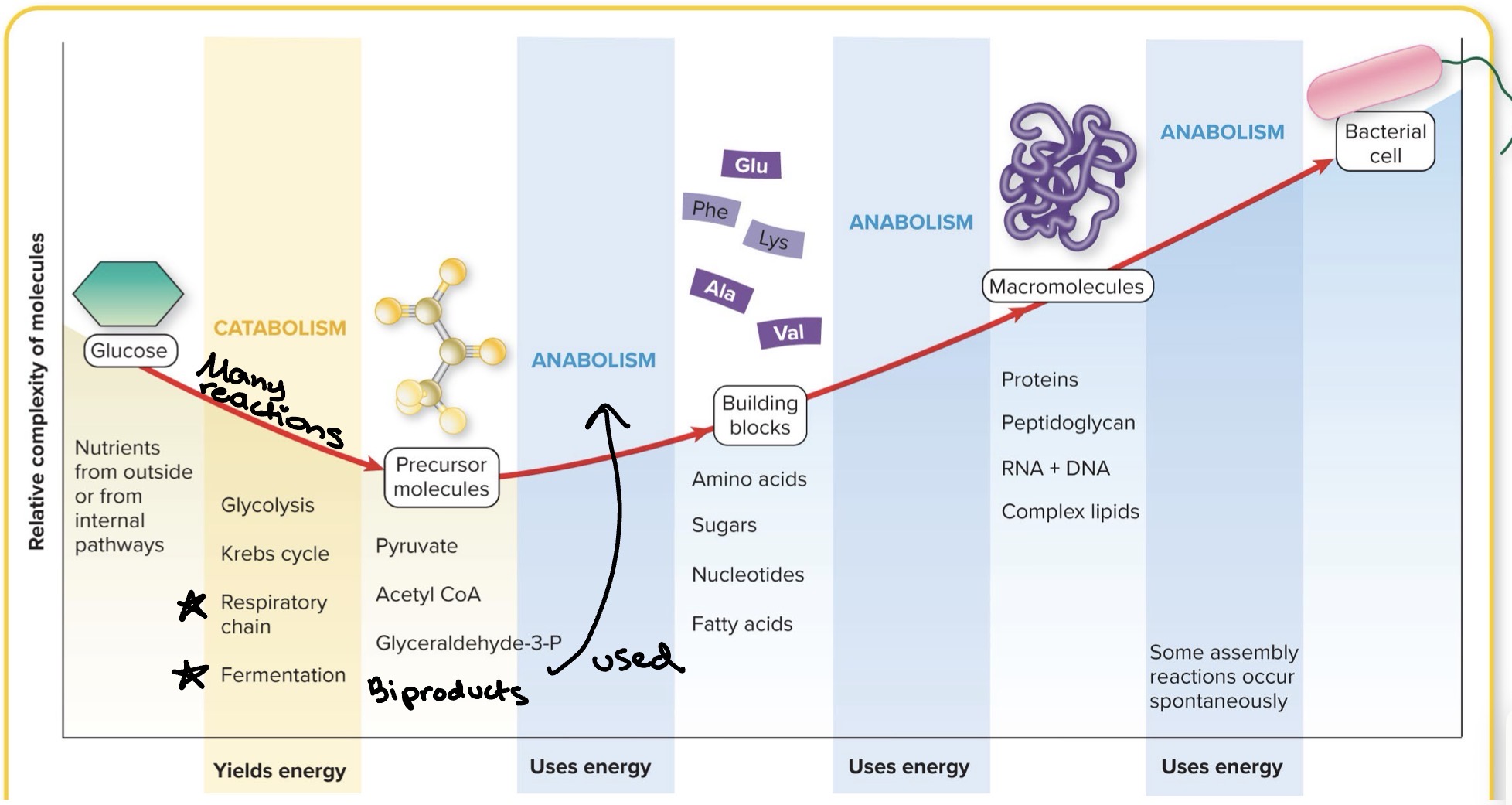
Simplified model of metabolism
Figure represents how catabolism and anabolism are linked together
1. Glucose catabolized (broken down) by respiration or fermentation (slowly)
Glycolysis & Krebs Cycle are processes that help break down
2. Precursor molecules are biproducts
3. Biproducts are used in anabolism (synthesis)
**So, biproducts of catabolism are used for anabolism**
Redox reactions - oxidation vs. reduction
Oxidation: loss of electrons
When a compound loses electrons, it is oxidized
Reduction: gain of electrons
When a compound gains electrons, it is reduced
Oxidation-reduction (redox) reactions are common in the cell & are indispensable to the required energy transformations
Oxidation & reduction happen simultaneously
Redox reactions
Oxidoreductases: enzymes that remove electrons from one substance & add them to another
Their coenzyme carriers are nicotinamide adenine dinucleotide (NAD) & flavin adenine dinucleotide (FAD)
Reducing power
Reducing power: electrons available in NADH & FADH2
Produced when NAD & FAD gain an electron
Won’t allow the enzyme to function in this form
Produced during glycolysis or Kreb’s cycle
Produced during catabolism & needed in large quantities for anabolism

Reaction of respiration
Ends with Electron Transport Chain

3 main metabolism pathways (big picture)
Pathways for bacteria to harvest energy from organic chemical compounds
1. Aerobic respiration: most amount of growth (fastest)
Yields 36-38 ATPs
Uses O2 as electron acceptor
2. Anaerobic respiration: middle
Yields 2-36 ATPs
Uses non-O2 (inorganic) compound as electron acceptor
Only in bacterial cells, NOT human cells
3. Fermentation: least amount of growth (slowest)
Yields 2 ATPs
Human cells do this instead of anaerobic respiration
**Know not only difference b/w aerobic & anaerobic, but also similarities**

Aerobic Respiration
A series of reactions that convert glucose to CO2 & allows the cell to recover significant amounts of energy
Utilizes glycolysis, Krebs Cycle, & electron transport chain (ETC)
Relies on free oxygen as the final electron & hydrogen accetpor
Characteristic of many bacteria, fungi, protozoa, & animals
Anaerobic Respiration
Used by strictly anaerobic organisms & others who are able to metabolize with or without oxygen (so eukaryotic cells can’t)
Involves the same 3 pathways as aerobic respiration (glycolysis, Krebs Cycle, & ETC)
Uses NO-3, SO42-, CO33- (Nitrate, Sulfate, Carbonate) & other oxidized inorganic compounds as terminal electron acceptors
Fermentation
Incomplete oxidation of glucose
Oxygen is not required
Organic compounds are terminal electron acceptors
All 3 metabolic pathways begin with…
Glycolysis (identical in each pathway)

Glycolysis
All 3 metabolic pathways start w/ this
Turns glucose into 2 copies of pyruvic acid
Glucose is NOT completely broken down (b/c end product of glucose breakdown is CO2)
Total energy yield:
2 ATPs, 2 NADHs, 2 Pyruvic Acids

Kreb’s Cycle - conversion of Pyruvic acid
2 Pyruvic acids produced at the end of glycolysis are converted to 2 Acetyl CoA
It participates in additional chemical transformations while producing NADH & FADH2
Sometimes Krebs Cycle is called the “carbon and energy wheel”

Kreb’s Cycle - yield
Total yield per 2 pyruvate (intermediate phase):
2 CO2, 2 NADH
Total yield per 2 acetyl CoAs:
4 CO2, 2 ATPs, 6 NADHs, 2 FADHs
Total yield of complete glucose breakdown:
6 CO2, 4 ATPs (from glycolysis & Kreb’s)
