Physics CT1 Year 10
 Call Kai
 Learn
 Practice Test
 Spaced Repetition
 Match
 Flashcards
 Knowt Play
1/41

Earn XP
Description and Tags
2.7 explain why a series or parallel circuit is more appropriate for particular applications, including domestic lighting 2.8 understand that the current in a series circuit depends on the applied voltage and the number and nature of other components 2.9 describe how current varies with voltage in wires, resistors, metal filament lamps (and diodes – in next test) and how this can be investigated experimentally 2.10 describe the qualitative effect of changing resistance on the current in a circuit (2.11 describe the qualitative variation of resistance of light-dependent resistors (LDRS) with illumination and thermistors with temperature – for next test) (2.12 know that lamps and LEDs can be used to indicate the presence of a current in a Circuit – for next test) 2.13 know and use the relationship between voltage, current and resistance: voltage = current x resistance V=I x R 2.14 know that current is the rate of flow of charge 2.15 know and use the relationship between charge, current and time: charge = current x time Q = I x t 2.16 know that electric current in solid metallic conductors is a flow of negatively charged electrons 2.17 understand why current is conserved at a junction in a circuit 2.18 know that the voltage across two components connected in parallel is the same 2.19 calculate the currents, voltages and resistances of two resistive components connected in a series circuit 2.20 know that: • voltage is the energy transferred per unit charge passed • the volt is a joule per coulomb. 2.21 know and use the relationship between energy transferred, charge and voltage: energy transferred = charge x voltage E=Q x V
42 Terms
Simple definition for charge
The amount of energy ‘stored’ in electrons, which pushes and pulls other electrons
GCSE definition for charge
A fundamental property of matter, measured in coulombs (C), that is carried by a flow of delocalised electrons in a circuit.
Unit for charge
Coulombs (C)
Symbol for charge
Q
Simple definition for current
The flow of electric charge moving through a path like water flowing through a pipe, measuring the amount of electrical charge flowing through a circuit every second
GCSE definition for current
The rate of flow of electric charge
Unit for charge
Amps (A)
Symbol for current
I
Equation using Time Current and Charge (both word and symbol)
Current = Charge/Time or I = Q/T
Simple definition for Voltage
The ‘push’ that makes the electrons move in a circuit
GCSE definition for voltage
Voltage (Potential Difference) is the energy transferred per coulomb of charge
Unit for voltage
Volts (V)
Symbol for voltage
V
Equation using Energy, Charge, and Voltage (word and symbol)
Voltage = Energy/Charge or V = E/Q
When you add more bulbs to a series circuit what happens to them
They get dimmer
When you add more bulbs to a parallel circuit what happens to them
They stay the same brightness
When you add switches to a series circuit what happens to the bulbs (say there are 2 bulbs in this circuit)
The bulbs are both on when the switch is closed and both off when the switch is open. They cannot be operated separately
When you add switches to a series circuit what happens to them (say there are 2 bulbs on this circuit with each one on a different path of the wire as well as a switch on each path too - so there are two switches)
The bulbs can be operated separately because there is more than one path for the electrons to travel around
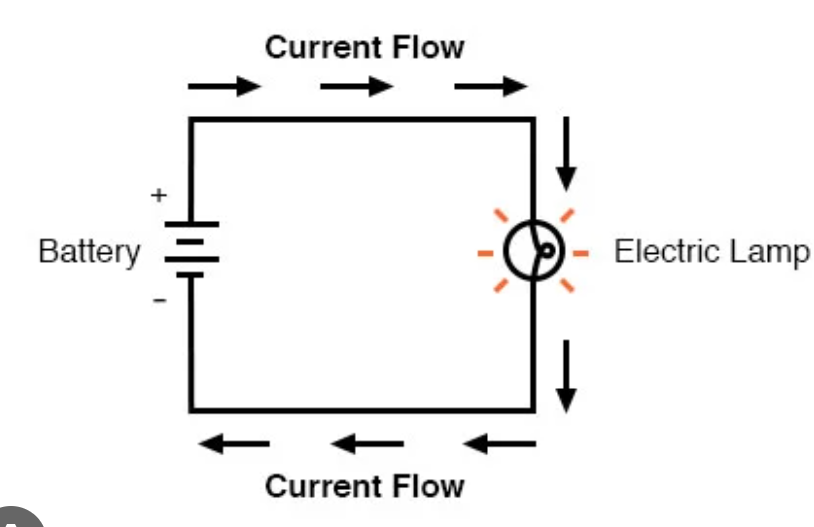
Does the current stay the same or have different currents at different points in this series circuit
It stays the same because there is only one path for the electrons

Does the current stay the same or have different currents at different points in this parallel circuit
1 = 2+4 or 3=2+4
The current is not the same everywhere because there is more than one path for the electrons

Does the voltage stay the same or have different voltages at different points in this series circuit if the battery voltage is 12V
Vˢ = V₁ + V₂ + V₃
The voltage is not the same everywhere in a series circuit but the sum of the voltages across every component equals the battery voltage


Does the voltage stay the same or have different voltages at different points in this parallel circuit if the battery voltage is 12V
Vˢ = V₁ = V₂ = V₃
In parallel the voltage across each branch is the same as the battery voltage

What particular applications are a series circuit suitable for
1. Switches and Safety Devices
In any electrical appliance, the on/off switch is always connected in series with the component it controls.
Why it works: If the switch is open (off), it breaks the entire circuit and stops the current from reaching the appliance.
Fuses and Circuit Breakers: These safety devices are also placed in series. If the current gets dangerously high, the fuse melts or the breaker trips, breaking the single path and instantly shutting down the power to keep you safe.
2. Simple Decorative Lights (Old Christmas Lights)
Older strings of fairy lights are a classic example of a series circuit.
Why it works: Connecting dozens of bulbs in a single loop is cheap and simple to manufacture.
The Downside: If one bulb burns out or is removed, it breaks the entire circuit, and all the lights go out. (Modern Christmas lights usually use parallel circuits or special bypass bulbs to avoid this).
3. Low-Power Warning Lights and Indicator Panels
Some simple electronics use a series circuit to light up a warning lamp.
Why it works: If you want a light to turn on only when a specific sensor detects a complete loop (like a door being fully closed), a series circuit ensures that if any part of the system is disconnected, the light won't work.
4. High-Voltage Industrial Systems (Streetlights in the past)
Historically, some street lighting systems used a type of series circuit because it allowed a very high voltage to push current through miles of wire to light up thousands of lamps efficiently.
What particular applications are a parallel circuit suitable for
1. Domestic Home Lighting and Sockets
The lights and electrical sockets in your house are always wired in parallel.
Why it works: If you switch off the light in your bedroom, the lights in the living room and kitchen stay on.
The advantage: Every appliance or light bulb gets the full voltage from the mains power supply (230V in the UK), meaning they all shine at their maximum brightness or work at full power.
2. Car Headlights
The headlights on a car use a parallel circuit design.
Why it works: If a stone chips one of the headlights and breaks the bulb while you are driving at night, the other headlight will stay completely lit.
The advantage: This is a vital safety feature that ensures the driver is never left completely in the dark if a single component fails.
3. Street Lights
The rows of lamps that light up public roads and pavements are connected in parallel.
Why it works: If one street light burns out, the rest of the street remains safely lit.
The advantage: Maintenance workers can easily spot the single broken bulb and replace it without having to guess which bulb caused a whole street to go dark.
4. School Science Lab Desks
The electrical sockets on your school science benches are wired in parallel.
Why it works: Multiple student groups can plug in their power packs or equipment at the exact same time.
The advantage: One group turning off their switch or unplugging their equipment won't accidentally cut the power to everyone else's experiments.
What does the current in a series circuit depend on
It depends on the applied voltage and the number and nature of other components
In a circuit with a filament bulb when the current increases what happens to the voltage and why
As the current increases the bulb gets hotter which makes the particles in the filament (wire) in the bulb vibrate more. These vibrating particles get in the way of flowing electrons which is why the resistance is increasing.
In a circuit with a wire when the current increases what happens to the voltage and why
The voltage is directly proportional to the current meaning that if the voltage is doubled than the current is doubled. Conductors for which voltage and current are directly proportional are known as ohmic conductors.
What does resistance of something tell us
The resistance of something tells us how difficult it is for electricity to flow through it; the higher the resistance, the more difficult it is and the smaller the current.
Good conductors vs bad conductors - resistance
Good conductors have very low resistance; insulators have extremely high resistance.
What is resistance caused by
Resistance is caused by the vibrating atoms of the substance getting in the way of the flowing charges
Longer wires have more or less resistance than shorter wires
more
thinner wires have more or less resistance than thicker wires
more
Equation for resistance (word equation and symbol equation)
Resistance = Voltage/Current or R = V/I
Symbol for Resistance
R
What is resistance measured in
Ohms Ω
As the resistance increases in a circuit (but the number of batteries stays the same) the current…
Decreases
electric current in solid metallic conductors is a flow of positively or negatively charged electrons
negatively
Why is current conserved at a junction
Because electric charge cannot vanish into thin air or pile up at a single point.

Total resistance = (and formula)
The Rule: Total Resistance = Resistor 1 + Resistor 2
The Formula: Rtotal = R1 + R2
What is voltage
The energy transferred per unit charge passed
What is the volt
The volt is a joule per coulomb
Equation for energy transferred (word and symbol)
Energy transferred = charge x voltage or E=Q x V