Rangeland Management Exam 2
 Call Kai
 Learn
 Practice Test
 Spaced Repetition
 Match
 Flashcards
 Knowt Play
1/116

There's no tags or description
Looks like no tags are added yet.
117 Terms
Types of Fires (3):
1) Wildfire: uncontrolled and unplanned fire.
2) Fire-use fires or let-burn fire: fire that is allowed to burn with monitoring (unlikely to cause human harm)
3) Prescibed Fire: a planned and implemented fire that is used to meet management objectives.
Fire-return intervals differs between...
Virable fire-return intervals differs between systems
- 3 to 5 years through >100 years.
- Differs between systems (*insert how when you know*)
List the different Fire Era according to (Twidwell et al. 2021)
Twidwell et al. 2021:
1) Coexistence era (indigenous peoples fire use)
2) Suppression era (putting out wildland fires as fast as possible)
3) Shadow area* (localized prescribed burning)
4) Emerging wildfire era (current-future with global change)
How are fire eras viewed differently between (McNew et al. 2023) and (Twidwell et al. 2021):
McNew et al. 2023 differed bc they didnt have the shadow and emerging wildfire eras and instead had the Contemporary era (today).
1) Coexistence era (indigenous peoples fire use)
2) Suppression era (putting out wildland fires as fast as possible)
3) Contemporary Era (where we are today-prescribed burning common)
Fires can influence both _________ and ________ components.
(provide examples of each)
- Abiotic (air, water, soil)
- Biotic (plants, animals, fungi)
Fire regimes are Characterized by 3 Components:
(List them and provide examples of each)
1) Time (seasonality/frequency)
2) Space (size/patchiness)
3) Intensity (magnitude/severity/type)
When are prescribed fires likely to take place?
Early spring and mid-fall.
When are wildfires likely to take place?
Early summer
Be able to explain how our historic burn periods and prescription burns may be mismatched and what ramifications that can have for the ecosystem.
Wildfires: Early Summer
Prescribed fires: Early Spring and Mid-fall
- Phenology of plants: burned too soon before seeds set which hinder development & growth of plants
- Hindering active nests sites or young wildlife less able to flee
- Selecting between burning windows, possible to miss those windows & settle for spring and/or fall burns
After a fire, where are ungulates most likely to graze?
a) area with longest time since burn
b) previously-burned area
c) most-recently burned area
c) most recently burned area
You need to know ___________ _____________ to understand intensity.
We need to know fire behavior to understand intensity
Fire Behavior triangle includes: weather, topography, fuel
Fire triangle
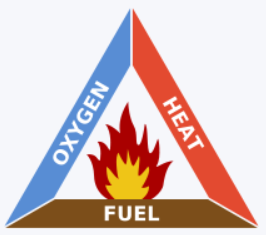
Fire behavior triangle

Fire intensity depends on....
Fire Behavior
- available fuel and composition
- moisture and temperature
- wind
- topography
Fire intensity definition
Rate at which fire produces thermal energy; energy released.
Patch-burn grazing:
Burning and grazing rotationally to mimic the natural interaction between fire and native grazers:
Burn a portion of the pasture each year, usually one-third, on a three-year rotation.
Grazing animals prefer to feed in the recently burned areas because the new plant growth is more palatable
Be able to describe if you think fire and grazing are ecological equivalents and why or why not.
No, they are not ecologically equivalent.
- Soil is impacted differently
- Vegetation is impacted differently
- Nutrients are different
They are similar in...Removal of vegetation/fuels
Know potential pros and cons to having fire on the landscape and how that relates to our management actions across systems.
1) Use prescribed burning in our management to help improve negative impacts
Fire can be used to manage fuels and reduce wildfire risk
Fire removes accumulated litter (i.e., fuels) and improves forage quality
Fire can reduce or eliminate unwanted species -> used as herbicide
Fire can be used with grazing to accomplish management objectives
Fire can be used with herbicide
What is a Riparian Area?
The transition zone between aquatic and upland habitat (Aquatic -> Riparian -> Upland)
Riparian areas are areas that are alongside and affected by streams, rivers, bogs, springs, and wetlands.
Upland vs Riparian:
Riparian = water through overland flow, subsurface flow, and groundwater recharge. S
Upland = water from precipitation
What are the Abiotic reasons why managing riparian areas is important?
- Water Quality Improvement
- Flood Mitigation
- Groundwater Recharge: maintaining base flows in rivers and streams
- Soil Stabilization: The root systems of riparian vegetation prevent erosion
Causes of riparian degradation:
(1) Agricultural Runoff: Pesticides, fertilizers, and livestock waste from nearby farms can wash into riparian zones
(2) Urban Development: Construction, paving, and deforestation for buildings or infrastructure
(3) Livestock Grazing: Overgrazing near water bodies
(4) Invasive Species: Non-native plant and animal species present
What are the Biotic reasons why managing riparian areas is important?
- Habitat for diverse wildlife (biodiversity hotspots)
- Water for wildlife
- Vegetation Diversity
- Wildlife Corridors
Consequences of riparian degradation:
1) Erosion (incised banks)
2) Decrease in Groundwater recharge
3) Loss of species habitat (wildlife and veg)
4) Decrease in Water Quality
5) Water temperature changes
6) Seasonal Hydrology changes
What are the Common Types of Water Erosion we discussed?
1) Sheets
2) Rills
3) Gullies
4) Headcuts
5) Cutbanks
6) Channelization
Sheet erosion
peeling of thin layers of soil from the surface due to water.
Rill erosion
Channels less than than 0.3m deep
Gully erosion
Channels greater than 0.3m deep
Headcuts
Headcuts or knickpoint occurs at the head (upstream extent) of a channel or side of a wet meadow, and advances backwards with continued erosion. - the roots arent able to hold it together.
Cut banks
The water moves pretty fast, thus eroding the cutbank more than anything.
Dispersed Flow vs. Channelized Flow:
Over time the flow is concentrated, and creates downcutting, and forms a channel.
What does this cause -> Loss of groundwater, water table decreased, plants have less acess to water.
What Riparian area Management Actions can we take?
1) Grazing methods (stocking rates)
2) Erosion Mitigation
3) Replant Vegetation
4) Wildlife Management -> Beaver management (BDAs)
5) Physically Fix it
Low-tech restoration methods increased vegetation productivity by _______% and the impacts of riparian and meadow management.
25
- plants greener longer
- greater resiliency against impacts of drought and climate variability.
Rangeland health definition
"the degree to which the integrity of the soil,vegetation, water, air and ecological processes of therangeland ecosystem are balanced and sustained"
Just like plants, rangeland health has....
Structure and Function
Structure or Pattern:
"What is there?"
Can be described from a "picture"
- Abiotic components
- Biotic components
Example: "there are woody shrubs there"
Function or Process:
" What happens"
- Cycles
- Interactions
Mechanisms of Change
- Rates or Transformations
Example: Fire, Grazing
Structure can be described by a ____________.
picture
Function can be described as _______________.
rates or transformations
Structure in a rangeland is represented by...
a. cover
b. density of plants
c. frequency of plants you hit over a gridded landscape
d. all of the above
d. all of the above
Function in a rangeland is represented by...
a. dust movement
b. precipitation to the roots
c. solar radiation and evaporation
d. all of the above
d. all of the above
Rangeland health assessment uses are meant to....
- Provide preliminary evaluation of rangeland health
- Identify early warning locations at risk
- Be tools for communication
Rangeland health assessment uses are not meant to....
- Independently make grazing or management decisions
- Single way of measuring and monitoring
- Identify the causes of resource problems
Rangeland health assessment uses are built around...
qualitative assessment of three biological and physical components or attributes
3 Attributes of Rangeland Health:
1) Soil/site stability
2) Hydrologic function
3) Biotic integrity
3 with 17 indicators to identify areas at risk of a threshold change
Rangeland Health Assessments are Qualitative assessments of these attributes.
____ attributes and _____ indicators are determined and evaluated in rangeland health.
- 3
- 17
Invasive species:
1) Non-native (or alien) to the ecosystem under consideration
2) Whose introduction causes, or is likely to cause economic or environmental harm or harm to human health
Invasive species can be plants, animals and other organisms (e.g., microbes) and human actions are the primary means of invasive species introductions
Rangeland invasive plant species impacts are both _________ and _____________.
- ecological
- economic
Things that reduce rangeland biodiversity:
- climate change
- energy development
- land conversion & fragmentation
- invasive species
- alteration of disturbance regimes.
3 main phases of the Invasion Process
(1) Arrival and Establishment
(2) Spread
(3) Equilibrium and Effects:
Invasive species are introduced by....
dispersal vectors.
Invasion process Step 1:
1) Arrival and Establishment
The Invasive species has to get there and become established.
The invasive is introduced by dispersal vectors (e.g., livestock, lumber trucks, wind). The invasive species then has to establish to persist.
This involves the the "Tens Hypothesis"
Tens Hypothesis
- 1 in 10 appear in the wild
- 1 in 10 establish
- 1 in 10 become an invasive pest
Invasion process Step 2:
2) Spread
Rate of spread depends on:
- Species characteristics
- Ecosystem characteristics (e.g., cheatgrass can easily establish)
-Spatial distribution of individuals or populations
This involves the "Biotic Resistance Hypothesis"
Biotic resistance hypothesis:
Ability of resident species or a community to reduce invasion success.
The biotic resistance of the species or community is what determines what will happen. For example, if a community is diverse, it is less likely to become invaded.
This has to do with the "Spread" step of the invasion process.
Enemy Release hypothesis:
"The ERH states that plant species, on introduction to an exotic region, should experience a decrease in regulation by herbivores and other natural enemies, increasing in distribution and abundance" -> Invasives arent regulated the same way natives are (e.g., there are no natural predators in the area)
1) Natural enemies regulate populations
2) Enemies greater influence on nativethat exotics
3) Exotic plants can capitalize on reduction of enemy regulation
This has to do with the "Spread" step of the Inasvion Hypothesis
Enemy release hypothesis key components (3 of them)
1) natural enemies regulate populations.
2) enemies greater influence on native than exotics
3) exotic plants can capitalize on reduction of enemy regulation.
Invasion process Step 3:
3) Equilibrium and Effects
Magnitude of the problem?
Eradication possible?
Overall consequences?
This is when it is definitely a problem.
Broad invasive species Management Approaches:
(List all 3)
1. Prevention & education
2. Eradication
3. Control
Prevention & Education:
(broad management approach #1)
Includes education.
Coordinated weed management planning if invasives arrive.
Prevention examples: quarantining, hay regulations, check stations
Education examples: social media, let people know they are transporting invasives
Define the Eradication Curve
- early detection of new species.
- aggressive eradication activities.
Control (broad management approach #3)
Reduce the impact of noxious plants to an "acceptable" level
Eradication often not possible
*Choosing a control method requires understanding biological & ecological characteristics*
Successful Weed Management Programs (Attributes):
- Get beyond the symtoms
- Define management objectives
- There is rarely one answer
- Multilevel Approach: (IWM or IPM)
Looking at the Noxious Weed List (Priorities) how does it relate to broad management approaches? How does it relate to the three phases of the invasion process?
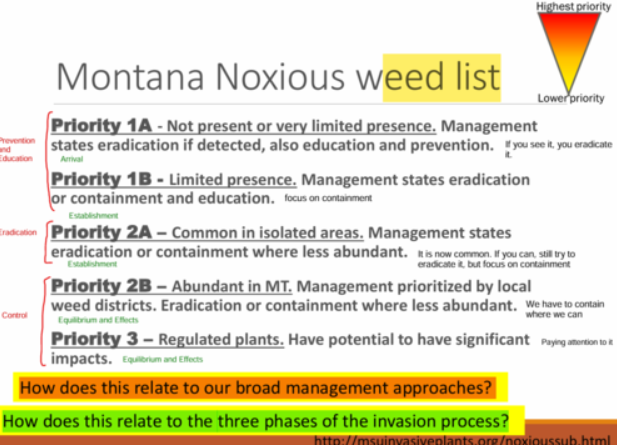
Priority 1A
Priority 1A: Not present or very limited presence.
Management: eradication if detected, also education and prevention.
Invasion Process: Arrival & Establishment
Priority 1B
Priority 1B: Limited presence.
Management: eradication or containment and education.
Invasion Process: Spread
Priority 2A
Priority 2A: Common in isolated areas.
Management: eradication or containment where less abundant
Invasion Process: Spread
Priority 2B
Priority 2b: Abundant in MT.
Management: prioritize by local weed districts (Control), eradication or containment where less abundant.
Invasion Process: Equilibrium & Effects
Priority 3
Priority 3: Regulated plants, have potential to have significant impacts.
Management: Control
Invasion Process: Equilibrium & Effects
Methods for Managing Unwanted Plants
Biological control
Prescribed fire
Mechanical control
Chemical control
Invasive reading
List the Methods we use to Manage Invasive Species: (IWM & IPM)
1) Chemical Control
2) Mechanical Control
3) Biological Control
4) Prescribed Fire
5) Invasive Reading
Pesticide Definition:
any chemical used to "control" some living substance
(Insecticide, Rodenticide, Fungicide, Herbicide)
Fundamental Principles of Herbicide Use
The herbicide must:
(1) Contact plant when the plant is susceptible
(2) Remain in contact long enough to be absorbed
(3) Reach a living cellular site at a concentration sufficient (toxicity) to disrupt a vital process or damage vital structures to kill the plant.
Why Choose Herbicide?
1. Can be _____ expensive than resource heavy approaches
2. Terrain has ______ of an impact (e.g., Aerial)
3. Can provide selective control
4. _____for releasing in situ desirable plants
5. Low labor requirement
6. Generally safe when following proper safeguards
1. Can be _LESS_ expensive than resource heavy approaches
2. Terrain has _LESS_ of an impact (e.g., Aerial)
3. Can provide selective control
4. _Good_ for releasing in situ desirable plants
5. Low labor requirement
6. Generally safe when following proper safeguards
Why - maybe don't- choose herbicides?
1. Requires _______ timing and rates
2. May ____ non-target, desirable plants
3. May _____ plant toxicity
4. Social/economic concerns about pesticides
5. Potential danger to applicator or environment
6. Unknown or ________ health hazards
1. Requires _KNOWLEDGE OF_ timing and rates
2. May _KILL_ non-target, desirable plants
3. May _INCSREAE_ plant toxicity
4. Social/economic concerns about pesticides
5. Potential danger to applicator or environment
6. Unknown or _UNSAFE_ health hazards
List the 3 Primary Modes of Action for Herbicides
1) Growth Regulating
2) Amino Acid Synthesis Inhibitors
3) Photosynthesis Inhibitors
#1 Primary mode of Herbicide action: Growth Regulating
Chemical mimics auxin, a plant hormone that regulatesgrowth and development
Most widely used group of herbicides on rangelands
Selective against broad leaf plants
#2 Primary mode of Herbicide action: Amino Acid Synthesis Inhibitors
Prevent key amino acid synthesis
-Blocks protein and enzyme production
-Slow acting but effective
#3 Primary mode of Herbicide action: Photosynthesis Inhibitors
Blocks photosynthesis
Build-up of free radicals destroys cell membranes
Mostly used for perennial weeds
Often long soil residence
Prevents underground shoot and sprout production
Herbicide Methods of Application
1) Aerial
2) Ground
3) Individual plant (Location on plant or proximity to plant)
4) Soil application (Can be Aerial or Ground)
Aerial Herbicide Application
(Advantages)
Faster coverage over large areas
Terrain doesn't matter
Lower cost per acre on large areas
No mechanical disturbance of soils or vegetation
Aerial Herbicide Application
(Disadvantages)
More expensive
Requires specialized equipment
Susceptible to weather (e.g., wind and fog)
Drift from direct target areas very possible
Ground Herbicide Application
(Advantages)
Adapted to small acreages
Less drift
Fewer climate limitations
No runways or launch pads required
Applicator safety often higher
Ground Herbicide Application
(Disadvantages)
Desirable plants in understory may be susceptible to herbicides that control salt cedar
Individual plant herbicide treatment:
Common on a small scale: portable sprayers
Targeted efforts of species of interest
Different parts of a plant can be targeted such as Foliar or the Stem
Factors Affecting Foliar Effectiveness of Herbicides:
1) Translocation: plant phenology - applied during rapid growth or storage
2) Life cycle of plant: Newer growth more susceptible
3) Leaf damage: Physical damage to leaves inhibits vascular translocation
Stem Herbicide Application
The target is the stem
- Primary application methods: Cut Stump, Peeled Bark, Stem injections/drilling (application targeted in the incision)
Soil Herbicide Application
Soil surface is the target
- Ground or aerial applied
- Usually in dry form (pellets or granules)
What is "mechanical control"?
Physically (or mechanically) removing unwanted species most commonly through cutting or pulling.
The use of a tool to remove or destroy above or below ground plant material.
When should we implement Mechanical Control?
Depends on:
- Characteristics of the plants
- The scope of the infestation
- Availability of the equipment
- Soil characteristics
- Topography
- Current and intended land use
Disadvantages of mechanical control:
Disadvantages:
- specialized equipment.
- may not kill the plant
- higher disturbance potential.
Mechanical is often used in ____________ with other treatments. Such as, ____________ removal with herbicide and ____________ and ______________.
Mechanical is often used in conjunction with other treatments. Such as, invasive species* removal with herbicide and chaining and seeding.
Utilization Rate is also known as what from the reading?
Utilization rate refers to grazing intensity and is a term often used to describe how heavily an area is grazed.
For example, if a plant is grazed as close to the ground as possible, the utilization rate would be 100 percent, whereas if the same plant was not grazed, its utilization rate would be 0 percent.
Ideally, grazing (utilization rate) shouldn't go above 50%
Define Biological Control:
Using the natural enemies of weeds such as insects, pathogens, or nematodes to control infestations.
What are the two main approaches to Biological Control?
1) Classical biological control
2) Targeted grazing
What is the key principle of All Biological Control?
Both kinds use Selective Herbivory.
Define selective herbivores:
Animals that have different food preferences (they are selective)
Classical Biological Control:
(Definition)
Using the natural enemies of weeds such as insects, pathogens (e.g. bacteria and fungi), or nematodes to control infestation.
Invasion Hypothesis Tied to this: Enemy Release Hypothesis
Classical Biological Control Principles:
(Biocontrol agent must be...)
1) Destructive to the noxious pest plant
2) Specific to host plant, harmless to others
3) Able to survive and reproduce in new environment.