Lab Concepts 1: Assist level, bed mobility, transfers, weightbearing
 Call Kai
 Learn
Learn Practice Test
 Spaced Repetition
 Match
Match Flashcards
 Knowt Play
1/20

There's no tags or description
Looks like no tags are added yet.
Name | Mastery | Learn | Test | Matching | Spaced | Call with Kai | Chat |
|---|
No analytics yet
Send a link to your students to track their progress
21 Terms
Levels of Assist are in relation to
what the patient can do versus what the PT does for the patient
• Total Assistance • Max Assistance • Moderate Assistance • Minimal Assistance • CGA/SBA/Supervision • Modified Independent • Independent
total assist
Patient performs less than 25% of the activity
• Requires Hoyer/other lift to reposition in bed
• Requires Hoyer/other lift to transfer to a chair
• Non-ambulatory (*typially)
• Requires multiple people to assist with daily cares (*to stand, pivot)
max assist
Patient performs 25-49% of the activity
• Patient may require 2 people to assist with bed mobility, transfers, gait especially for safety purposes
• Requires cueing/assistance at multiple body parts to complete mobility tasks
• Ambulation distance is limited (5-10 feet)
moderate assist
Patient performs 50-74% of the activity (*can do at least half the work)
• Patient typically only requires one person’s assistance, especially if a rehab professional
• Significant assistance at one area of the body, or minimal assistance at multiple areas
• Ambulation distance can vary, but unlikely >20-30 feet
minimal assist
Patient performs 75%-99% of the activity
*not 100%; includes contact guard + standby assist
• Only requires assistance of one person
• Usually some assistance at one body part (ie at the trunk or at the leg for getting out of bed, or assistance weight-shifting at the pelvis with gait, etc)
• Ambulation distance can vary greatly
CGA/SBA/Supervision
under mid-assist; the 1-2%
-CGA (Contact Guard Assist): PT feels that they need to place their hand(s) on the patient to help maintain balance if it were to be lost, but no assistance provided
-SBA (Stand By Assist): Examples – PT feels they need to be closely guarding/near the patient, but does not put any hands/contact points on the patient
-Supervision: PT is there for verbal cueing/reminders, but no physical assistance provided
modified independent/indepdent
-Mod Independent= Patient uses assistive/adaptive equipment to complete activity, or requires increased time, but completes task without another human’s help
Mod I includes the use of a walker, cane, etc. to ambulate. Can also include the use of a leg lifter, bedrails to assist getting out of bed.
*if use any assistive device OR need more time; don’t need us to assist or supervise
-Independent= Patient can perform task in normal timeframe without help
• The level of assist is based on what percentage of
• A PT/OT classification of assist level will not necessarily match/correlate with
a specific task the patient can complete
-In theory, a mod assist patient could walk 100 feet, but a contact guard assist patient could only walk 50 feet due to poor endurance
a nursing determination of assist
-Remember: YOU are the rehab professional trained in how to get the patient moving! • A patient whose PT determines they are mod assist may equal a RN determination of max assist of 2 → keep this in mind in acute care!
*dont use how far they can walk! allow pt to do it! see how much they can do
bed mobility: generel
• The act of getting into/out of bed
• Three techniques
-Sequential Roll
-Log Roll
-Long Sit
• Sequential and Log Rolls are broken up into 2 parts
• Supine <-> Sidelying
• Sidelying <-> Sitting
sequential roll
• Used with general medical diagnosis without precautions
-CVA, PD, COPD, UTI, etc
• “Easiest” way for most people to get out of bed
• Patient in supine, knees bent
• Initiate roll to side at trunk OR legs (then follow with the other)
• From sidelying, bring legs forwards off edge of bed, push up with arms and come into sitting position
log roll
• Used with diagnosis that have lumbar/spinal precautions OR when you want to avoid twisting of trunk/abdomen
-Lumbar fusion, CABG, abdominal incision, etc.
• Patient in supine, knees bent
• Initiates roll to side at trunk and legs simultaneously, keeping trunk straight
• From sidelying, brings legs off edge and pushes up from arms simultaneously, keep trunk straight
long sit
• Used with lower extremity orthopedic diagnosis
-TKA, THA, LE fractures/ORIFs, amputations
• Patient begins in supine, knees straight, angled closed to edge of bed
• Patient first pushes up onto elbows, brings legs over the edge of the bend and bends knee(s) as able.
• Once knee(s) are bent, patient then pushes up onto hands, and continues pivoting until seated at the edge of the bed
weightbeariing statuses: generel
-Weightbearing: The amount of weight placed through an extremity (upper or lower) by a patient.
-Weightbearing Status: Medical designation of the amount of weight permitted to be placed through a patient’s affected extremity
Determined, modified and updated by the physician
Based on the safety of the structures in that extremity to bear weight
Found in physician’s notes or orders for physical therapy
-Common diagnosis with weightbearing designations: THA/TKA, ORIF, Amputations, LE/UE fractures, tendon/muscle repairs
weightbearing terminology
-FWB/Full Weight Bearing *no restrictions
-WBAT/Weightbearing as tolerated *up to pt
Patient can place as much weight as tolerated (by pain, weakness, etc) through the extremity. It is orthopedically stable, will not damage the affected extremity.
Common Diagnosis: TKA, THA
-PWB/Partial Weightbearing *wide variety
Patient can place a specific percentage or force (i.e. weight) through the extremity. Going above that amount could cause damage to the affected extremity.
Common diagnosis: ORIF
*education and maintence trickest, teach them how to offload in other areas
-TTWB/Toe touch weightbearing
Patient can place the extremity lightly on the ground to facilitate balance/proprioception, however NO force may go through the affected extremity.
Common diagnosis: ORIF
-NWB/Non-weightbearing
Patient cannot place the affected extremity on the ground at all, no force may go through it.
Common diagnosis: ORIF, bunionectomy, rotator cuff repair
posterior hip precautions
-No affected hip flexion past 90 degrees
-No affected hip adduction past midline
-No affected hip internal rotation past neutral
• “Don’t bend forwards past 90 degrees, don’t twist over your surgical hip, and don’t cross over your legs.”
• “These precautions are designed to protect the integrity of your surgery, and will be lifted at the discretion of your surgeon.”
lumbar/spinal preautions
• No twisting, side bending, or flexion/extension at the lumbar spine
• “These precautions are designed to protect the integrity of your surgery, and will be lifted at the discretion of your surgeon.”
thoracic/abdominal preautions
-Varies on diagnosis, but highly recommended to follow vs. an absolute requirement, might not be in PT order
• Lumbar Fusion: Risk of impacting surgical integrity if not following precautions
• CABG: Painful for patient to rotate through chest, risk aggravating incision
-Done to facilitate patient comfort with mobility
-No twisting/rotation through spine
knee blocking
• Use of therapist’s lower extremities during a transfer or gait to provide additional external support to one or both of patient’s knees to prevent buckling.
• Cannot be done on a leg that recently had surgery, nor on an amputated LE
• Requires different positioning for therapist based on PT and patient heights.
*1 block: use inside so tibial tuberosity in between
*2 block: same but both knees inbetween
squat pivot
• No device utilized • Requires single or double knee block • Patient is facilitated to stand up straight, weight bear through LE’s as tolerated/permitted • Used with all types of diagnoses
slideboard
• Uses slide board underneath buttocks • Requires gentle double knee block to prevent forwards sliding on board • Non -weightbearing transfer through LE’s • Used with amputees, patient with significant difficulty weightbearing through LE’s
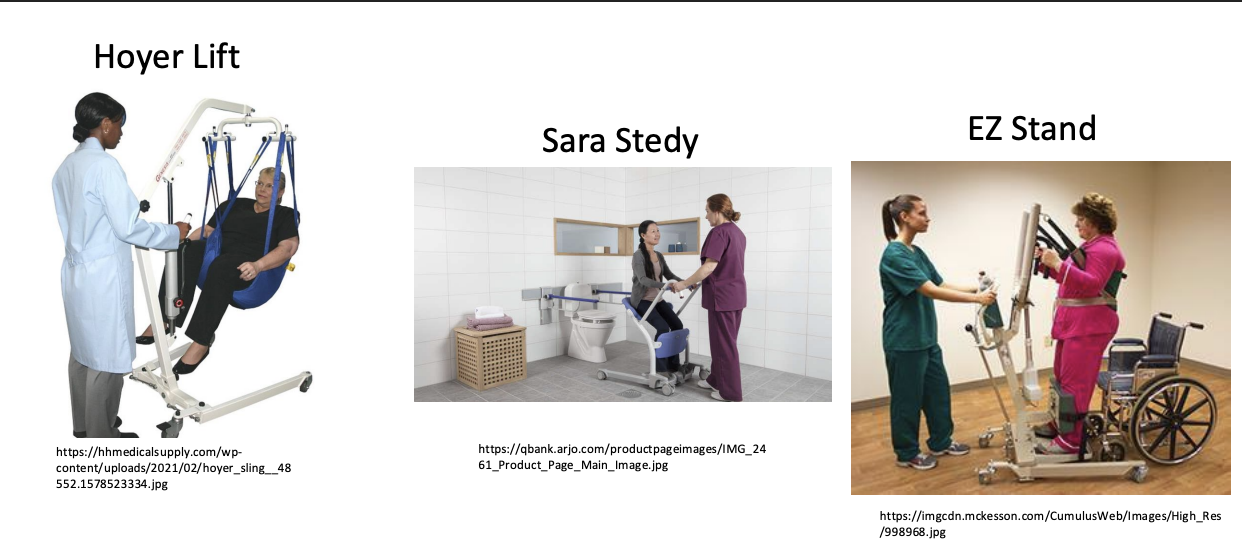
mechanical lifts
• Used when patients need higher levels of assist and it is not safe for the patient and/or the caregiver to physically transfer the patient
• Use of mechanical lifts could be due to weakness, severe deconditioning, line management, time, patient’s cognitive presentation, etc
• The use of a mechanical lift is NOT based on the patient’s weight!
Types
-Hoyer: sling/hammock, from sit or laying, past shoulders and crosses under each leg
-Sara steady and EZ stand: sit → stand higher level (not for total assist), good for nursing staff, pivot though