Special Populations Midterm
 Call Kai
 Learn
 Practice Test
 Spaced Repetition
 Match
 Flashcards
 Knowt Play
1/67

There's no tags or description
Looks like no tags are added yet.
68 Terms
Cultural Relativism Theory
There are no universal standards or rules by which we can judge behaviour, cognitions, and emotions to be atypical or abnormal
Anxious shyness
Fear and anxiety in social situations
Regulated shyness
Self-conscious avoidance of public attention and social restraint in behaviour
What did the study by Kong et al. (2023) reveal about regulated shyness in Canada and China?
In Canada, regulated shyness relates to social anxiety
In China, regulated shyness does not result in psychopathology (may be adaptive)
What did the study by Kong et al. (2023) reveal about anxious shyness in Canada and China?
Anxious shyness resulted in social anxiety in both Canadian and Chinese children
Examples of externalizing problems
Aggressive behaviour, rule breaking, and other conduct problems
What did the study by Weisz et al. (1995) reveal about externalizing problems in North America and Thailand?
Thai teachers reported many more externalizing problems compared to North American teachers
When researchers went into the classrooms, they saw that North American children were displaying many more externalizing problems compared to Thai children
Psychological constructs
The intangible aspects of one’s psychology which can’t be measured directly
Systematic observation
Watching children and recording what they say or do
Naturalistic observation
Behaviours observed in real-life situation
Time sampling
Assessing whether a behaviour occurred or not during a specific time frame (epoch)
Event sampling
Counting how many times the child engaged in the behaviour of interest during the entire time session
Structured observation
Researcher creates setting likely to elicit behaviour of interest
Coding scheme
A document that contains all the rules for coding a set of behaviours for a given task or set up
Observer influence (Hawthorne Effect)
Participant changes their behaviour because they are being observed
Habituation
Allows participant to get used to researcher’s presence
How can we limit observer influence?
By using habituation
Observer bias
Expectations influence decisions
May notice behaviours that support hypothesis and discount those that don’t
May interpret behaviours in such a way that they support the hypothesis
Inter-rater reliability
Are behaviours coded in a consistent way across independent coders?
What are 3 ways to calculate inter-rater reliability
1) Percent agreement
2) Intraclass correlation
3) Kappa statistic
Kappa statistic
Actual agreement as a proportion of the potential agreement following correction for chance agreement
Ranges from -1 (less agreement than can be expected by chance) to +1 (perfect agreement)
Researchers generally aim for a Kappa of 0.7 or higher
Correlational study
Relations between variables as they exist naturally in the world
Correlation coefficient (r)
Direction and strength of a relation between two variable
What is the major problem with correlational design?
We can’t always know which variable is driving which other variable. Or there could be a third variable explaining both
What are the two types of experimental research?
Randomized and quasi-experimental
Randomized
Participants assigned to different groups using random assignment
Quasi-experimental
Subjects are not randomly assigned
Case study
Intervention or experimental manipulation with a single participant
When are case studies used?
Can be used when participants are unique or present with unique symptoms
Or when intervention is unique or expensive
Cross sectional design
Testing children of different ages at one particular point of development
What is a problem with cross sectional designs?
Cohort effects - different developmental environments based on when you were born
Longitudinal design
Same individuals are observed or tested repeatedly at different points in their lives
What are some problems with longitudinal designs?
Practice effects - improvement over time might be attributed to practice with a particular test
Selective attrition - those who drop out of the study may be significantly different from participants who remain
Cohort effects - developmental change may be particular to a specific generation of people
Accelerated longitudinal design
Sequences of samples that are studied longitudinally OR
Cross-sections are collected simultaneously to a longitudinal group
What is the benefit of an accelerated longitudinal design?
It can account for practice and cohort effects while maintaining continuity
Temperament
Core emotional, cognitive, and behavioural characteristics around which personality traits develop
Biologically-based behavioural styles that are stable across situations
Individual difference in emotional reactivity and self-regulation
Reactivity
Excitability, responsivity, and arousability of behavioural and physiological systems
Threshold for some sort of response (size of thermometer)
Self-regulation
Neural and behavioural processes functioning to modulate underlying reactivity
The degree to which we can bring the arousal within our thermometer down
Co-regulation of emotion
Parents help teach children how to regulate their emotions
Early on, touch and comfort is effective
Later, parents will use distraction
Behavioural inhibition
Responding to new objects, situations, and people with wariness
Higher arousal in response to novel stimuli
What is the relationship between reactivity and behavioural inhibition?
Higher reactivity = higher behavioural inhibition
Shyness
Higher arousal around novel people or social situations
Sociability
Preference for being around others
Effortful control
The ability to inhibit a dominant response and/or to activate a subdominant response, to plan ahead, and to detect errors (i.e. not about how much effort we’re putting in but how well we’re able to control our effort)
Not considered to be under voluntary control
What is a dominant response?
Anything that is easy or fun for a child (e.g. playing)
What is a subdominant response?
Something that is hard for the child and they should be doing (e.g. doing their chores or homework)
Risk
Variables that precede and increase the chance of psychological impairment
What 3 factors can increase risk?
Intensity, duration, and timing
Adaptation
Fitting into the circumstances of your life
Vulnerability
The tendency to respond maladaptively to life circumstances
Resilience
Relatively positive outcome in the face of significantly adverse or traumatic experiences
Indirect effect
Impact of a mediating variable between an independent variable and a dependent variable (e.g. marital conflict causes parenting difficulties and it’s the parenting difficulties that are causing the child’s adjustment problems)
Necessary cause
Must be present for the disorder to occur (e.g. brain dysfunction is necessary for schizophrenia to emerge but not necessarily sufficient)
Sufficient cause
In itself responsible for the disorder (e.g. trisomy 21 in down syndrome)
Contributing causes
Factors that are not necessary or sufficient (e.g. stress, impulsivity, lack of inhibition)
Development
Involving progressive adaptations or maladaptation to changing circumstances
Transactional
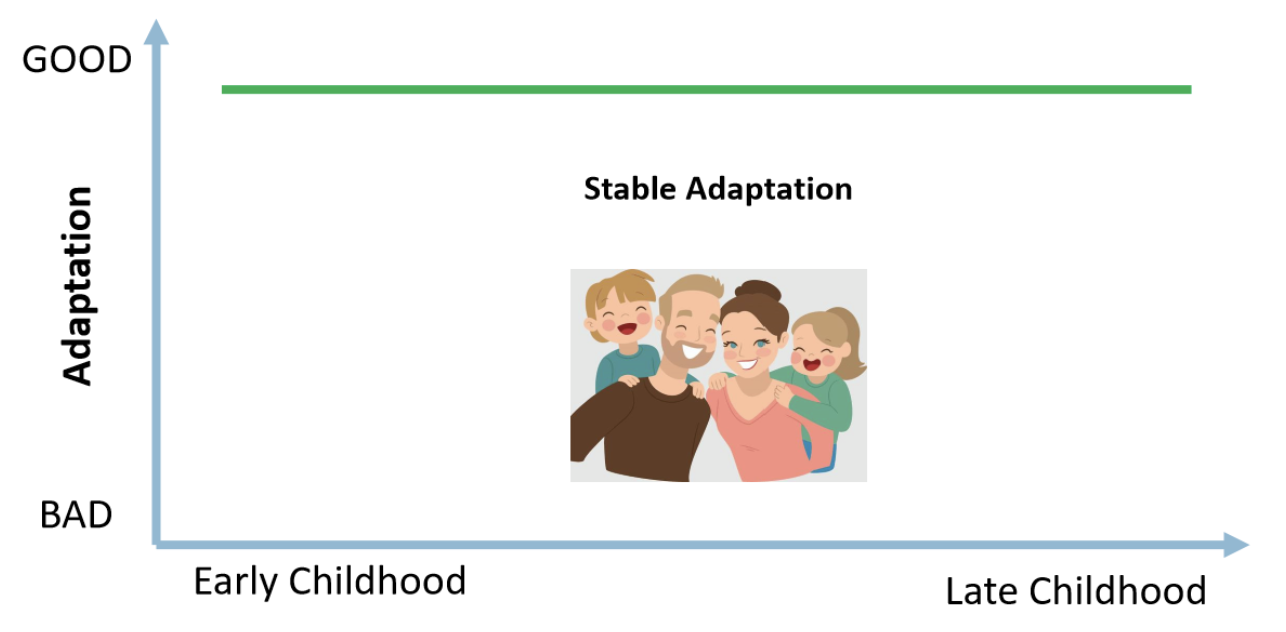
Stable adaptation
When a child has relatively few risks or adversities and is well-adjusted
Stable maladaptation
When a child has a difficult time fitting into the circumstances of their life in early childhood and this continues over time

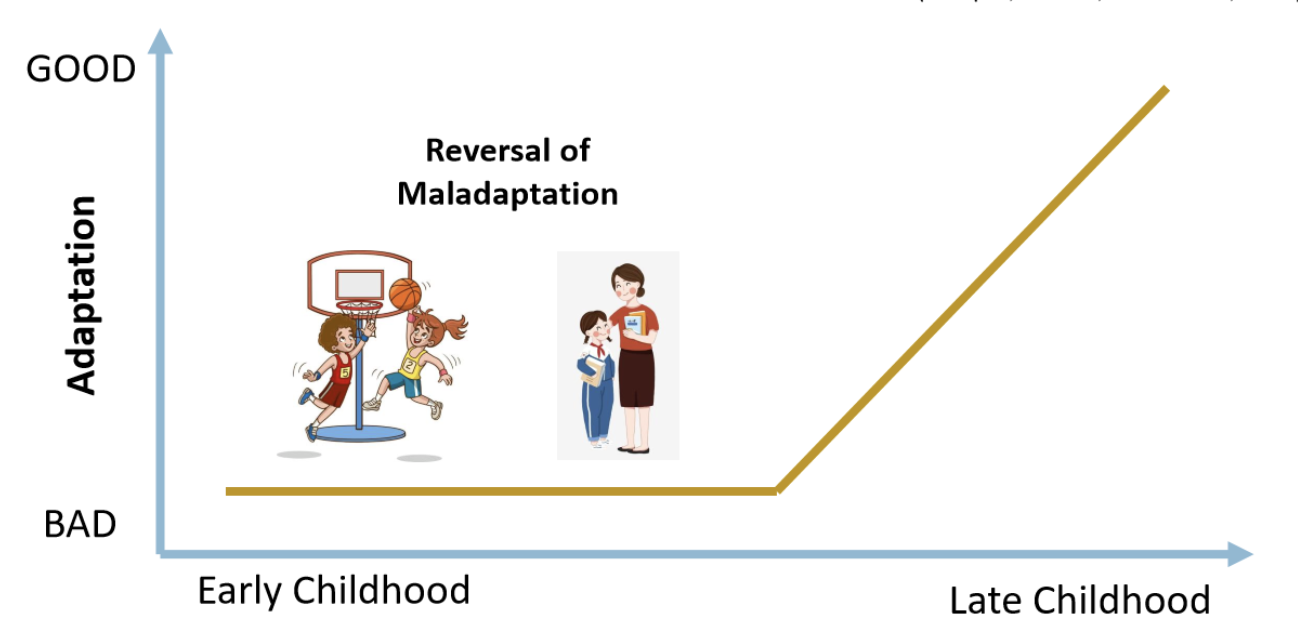
Reversal of maladaptation
When a child experiences maladaptation in early childhood but something shifts for them to start fitting into the circumstances of their life as they get older ( e.g. maybe they find social support in a team they join)
Decline of adaptation
When a child is initially adapting quite well to the circumstances of their life but something happens at some point in their development causing a shift (e.g. disruption in family)

Temporal maladaptation
E.g. child has been bullying at school but receives the support they need to get back on track

Equifinality
Diverse factors can be associated with the same outcome

Multifinality
An experience may lead to different outcomes

Interactional model
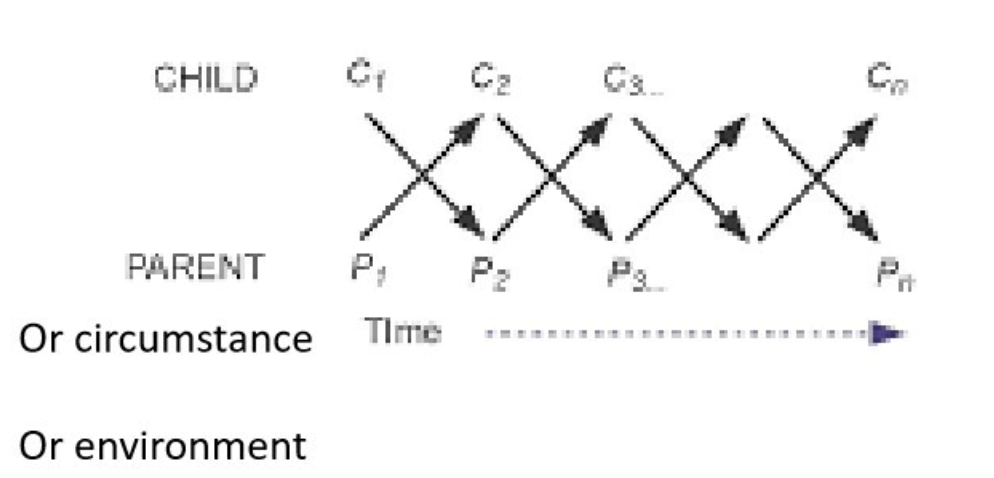
Transactional model
Development is the result of an ongoing reciprocal transaction between the individual themself and the environment they’re in
Behavioural genetics
The study of the manner in which genetic variation affects psychological traits
What are the three laws of behavioural genetics?
All human behavioural traits are heritable
The effect of being raised in the same family is smaller than the effect of genes
A substantial portion of the variation in complex human behavioural traits is not accounted for by the effects of genes or families