Wk 11 Lab - Animal Evolution: Homology
 Call Kai
 Learn
 Practice Test
 Spaced Repetition
 Match
 Flashcards
 Knowt Play
1/25

There's no tags or description
Looks like no tags are added yet.
26 Terms
What are the two mechanisms by which different species can have similar traits?
Convergent evolution and homology.
What is homology?
Homology occurs when two species share similar traits due to a common ancestor.

Give an example of homologous traits in plants.
Angiosperm flowers have diverse appearances but share basic anatomy like pistils and stamens.
What is convergent evolution?
Convergent evolution is when unrelated species evolve similar traits independently due to similar adaptations.
Provide an example of convergent evolution in plants.
Palm trees and oak trees have similar shapes despite being distantly related.
What is a dichotomous key?
Tool used for identifying organisms based on a series of classifying choices
What should the traits in a dichotomous key be based on?
Morphological characteristics of the organisms themselves
How are dichotomous keys and cladograms similar?
Both use traits to separate taxa; couplets in a key are analogous to nodes in a cladogram.
What is the significance of the cladogram in evolutionary studies?
Cladograms illustrate the evolutionary relationships between different species based on shared traits.
What advantages does a worm-like shape provide to animals?
Advantages include reduced surface area, smaller profile, increased hydrodynamic body, and less need for extra appendages.
Where can worm-shaped animals be found?
Worm-shaped animals can be found in oceans, land sediments, trees, open oceans, lakes, and fast-flowing water sources.
What is the first step in identifying animals using a dichotomous key?
Identify the animals based on their traits.
What is the second step in identifying animals using a dichotomous key?
Compare their ancestry to determine if traits are homologous or a result of convergent evolution.
What does MRCA stand for in evolutionary biology?
Most Recent Common Ancestor.
Which animal groups have orders that evolved worminess through convergent evolution?
Both Arthropoda and Chordata have orders with convergent evolution of worminess.
Which animal groups have orders that have homologous worminess from common ancestors?
Both Nematoda and Annelida have orders with homologous worminess.

What are some examples of animals that exhibit worm-like characteristics?
snakes, roundworms, hagfish, tapeworms, and earthworms.

What are Echinodermata?
Marine invertebrate with ‘Spiny Skin’ (Starfish/Sea Urchins)
What is the relationship between age and symmetry in Echinodermata?
Exhibit BILATERAL symmetry during larvae stage and display RADIAL symmetry as adults
What is True Tissue?
Group of cells that work together to perform a specialized function in the body
What is the Mesoderm & what is the term for an organism that has one?
Middle embryonic germ layer that develops into other organs & TRIPOBLASTIC

What is the True Coelom?
a fluid-filled body cavity that is completely surrounded by tissue from the mesoderm that protects organs and allows for vessel dilation

What is a Chitinous Exoskeleton & what is the term for shedding it?
Crunchy, hard external shell found in insects & nematodes/ ECDYSIS
What is body segmentation?
Repeated body segments/ structures attached to these segments
Is the Coelom a synapomorphy?
No
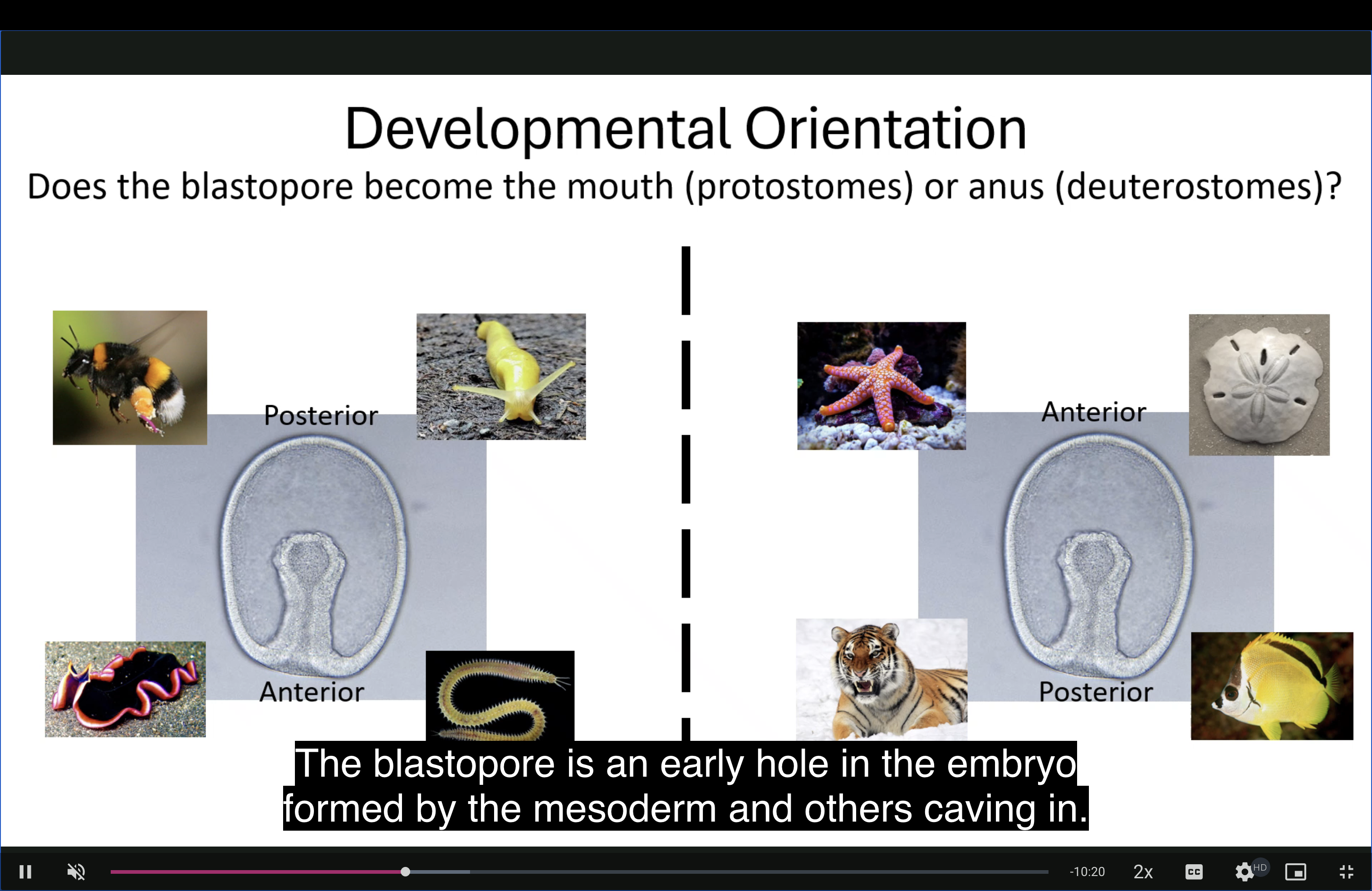
What is the difference between a Protostome vs Deuterostome?
Protostome: Blastopore —→ MOUTH
Deuterostome: Blastopore —→ ANUS