Genetics Exam 1 Lecture 6
 Call Kai
 Learn
Learn Practice Test
 Spaced Repetition
 Match
Match Flashcards
 Knowt Play
1/17

There's no tags or description
Looks like no tags are added yet.
Name | Mastery | Learn | Test | Matching | Spaced | Call with Kai | Chat |
|---|
No analytics yet
Send a link to your students to track their progress
18 Terms
Genetic Linkage
phenomenon that genes close together on a chromosomes tend to be transmitted together
called linkage groups
violates Mendel’s law of independent assortment
Synteny
two or more genes next to each other
What happens if genes are far apart from each other on the chromosome
they can cross over during meiosis and then independently assort
produces recombinant/nonparental genotypes (a new combination of genotypes not seen in the parents)
Single Crossover
An exchange of DNA segments happens at just one specific point along the non-sister chromatids
Breaks up parental ditype linearly

Double Crossover
Two separate crossover events occur simultaneously along the same chromosome length
Produces banding-like pattern of parental ditypes
outer genes still look parental, while middle gene is recombinant

Parental Ditype Double Crossover
2 double crossovers, 2 parental
Same chromatids cross over twice
2 chromatids

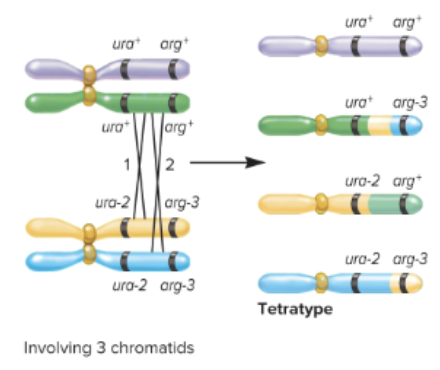
Tetratype Double Crossover
1 double crossover, 2 single crossovers, 1 parental
One chromatid crosses over with both homologous chromatids
3 chromatids
Nonparental Ditype Doble Crossover
all 4 products are nonparental (recombined)
4 chromatids

Genetic Mapping
determines where the locus of each gene is on a chromosome
To place a new gene, cross the trait you are studying with one or more already-mapped traits and use linkage tests to see where it falls
Map Units
Distance units are map units (mu), also called centiMorgans (cM)
1 mu = 1% recombination frequency (RF)
Correlation b/w distance & % of recombinant offspring
Genes far apart give many recombinants; close genes give very few
Map Distance Equation
(# of recombinant offspring) / (total # of offspring) x 100
Testcross
Cross an individual heterozygous for two or more genes to one homozygous recessive for the same genes
Because the recessive parent contributes only recessive alleles, every offspring phenotype tells you which gamete the heterozygote produced
Three Factor Crosses
a genetic mapping technique that uses three linked genes to determine gene order and the distances between them on a chromosome
Three Factor Cross Steps
Find the parental classes
offspring w/ highest numbers
Find double crossovers
2 offspring w/ least numbers
Compare one parental w/ the double crossover that differs from it in just one trait
trait that differs is middle gene
Write the order
Calculate each pair’s distance
Draw the map
Probability of Double Crossover
The probability of a double crossover equals the probability of two single crossovers happening together
P(double crossover) = P (map distance of gene 1 & 2) x P(map distance of gene 2 & 3)
Expected DCO = Total # of offspring x P(double crossover)
Positive Interference (I)
the first crossover decreases the probability that a second crossover will occur nearby. The molecular mechanism is not understood
I = 1 - C (coefficient of coincidence)
Coefficient of Coincidence
C = observed # of double crossovers ÷ expected DCO