Amino Acids
 Call Kai
 Learn
Learn Practice Test
 Spaced Repetition
 Match
Match Flashcards
 Knowt Play
1/25

There's no tags or description
Looks like no tags are added yet.
Name | Mastery | Learn | Test | Matching | Spaced | Call with Kai | Chat |
|---|
No analytics yet
Send a link to your students to track their progress
26 Terms
Basic Amino Acid Structure
Must know:
1) Names
2) 3 and 1 letter abbreviations
3) Side Chain Structure and Characteristics
4) Charge/ Behavior at Different pH Levels


Glycine
3-letter: Gly
1-letter: G
Side chain: R group = H
Characteristics: Smallest and simplest amino acid; achiral because the R group is H, the same as the other H attached to Cα. The slideshow also groups glycine with the polar amino acids, even though it cannot hydrogen bond because of its backbone.
Charge/pH behavior: Side chain stays uncharged. The amino and carboxyl groups still change with pH.

Alanine
3-letter: Ala
1-letter: A
Side chain/structure: –CH₃
Characteristics: Small, nonpolar, hydrophobic.
Charge/pH behavior: Side chain remains uncharged across normal biological pH ranges.

Valine
3-letter: Val
1-letter: V
Side chain/structure: –CH(CH₃)₂
Characteristics: Nonpolar, hydrophobic, branched.
Charge/pH behavior: Side chain remains uncharged.

Leucine
3-letter: Leu
1-letter: L
Side chain/structure: –CH₂–CH(CH₃)₂
Characteristics: Nonpolar, hydrophobic, branched.
Charge/pH behavior: Side chain remains uncharged.

Isoleucine
3-letter: Ile
1-letter: I
Side chain/structure: –CH(CH₃)–CH₂–CH₃
Characteristics: Nonpolar, hydrophobic, branched.
Charge/pH behavior: Side chain remains uncharged.

Methionine
3-letter: Met
1-letter: M
Side chain/structure: –CH₂–CH₂–S–CH₃
Characteristics: Nonpolar, hydrophobic; contains sulfur.
Charge/pH behavior: Side chain remains uncharged.

Proline
3-letter: Pro
1-letter: P
Side chain/structure: –(CH₂)₃– forms a ring back to the amino nitrogen.
Characteristics: Nonpolar; rigid ring structure; restricts flexibility of the protein backbone.
Charge/pH behavior: Side chain itself remains uncharged.

Phenylalanine
3-letter: Phe
1-letter: F
Side chain/structure: –CH₂–phenyl ring
Characteristics: Nonpolar, hydrophobic, aromatic.
Charge/pH behavior: Side chain remains uncharged.
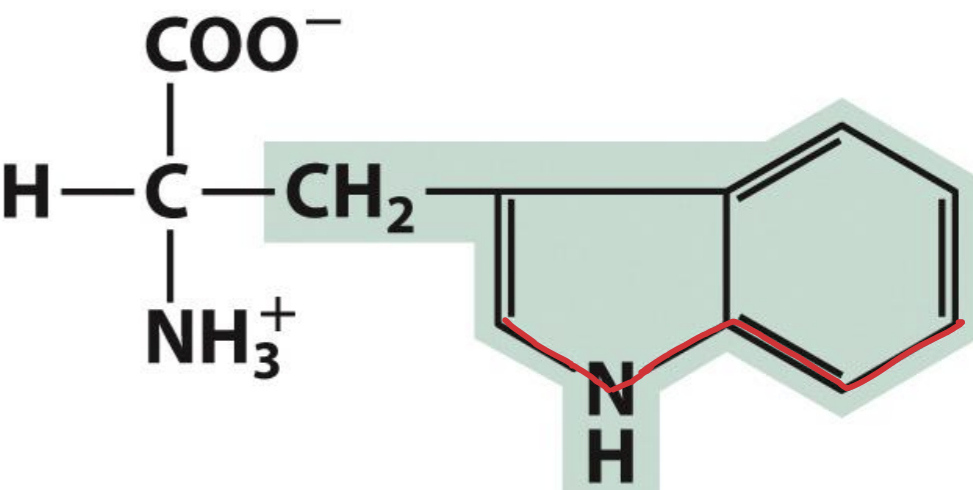
Tryptophan
3-letter: Trp
1-letter: W
Side chain/structure: –CH₂–indole ring
Characteristics: Nonpolar, hydrophobic, aromatic; contains nitrogen in its ring.
Charge/pH behavior: Side chain is generally uncharged at physiological pH.
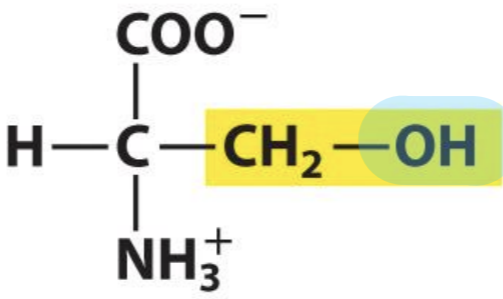
Serine
3-letter: Ser
1-letter: S
Side chain/structure: –CH₂–OH
Characteristics: Polar; contains a hydroxyl (–OH) group; interacts strongly with water.
Charge/pH behavior: Usually uncharged at physiological pH; the OH can lose H⁺ at very high pH.

Threonine
3-letter: Thr
1-letter: T
Side chain/structure: –CH(OH)–CH₃
Characteristics: Polar; contains a hydroxyl group.
Charge/pH behavior: Usually uncharged at physiological pH; can lose H⁺ at high pH.

Tyrosine
3-letter: Tyr
1-letter: Y
Side chain/structure: –CH₂–phenyl–OH
Characteristics: Polar; aromatic ring + hydroxyl group.
Charge/pH behavior: Usually uncharged at physiological pH; OH can lose H⁺ at sufficiently high pH.

Asparagine
3-letter: Asn
1-letter: N
Side chain/structure: –CH₂–CONH₂
Characteristics: Polar; contains an amide group; can hydrogen bond with water.
Charge/pH behavior: Side chain is generally uncharged.

Glutamine
3-letter: Gln
1-letter: Q
Side chain/structure: –CH₂–CH₂–CONH₂
Characteristics: Polar; contains an amide group.
Charge/pH behavior: Side chain is generally uncharged.
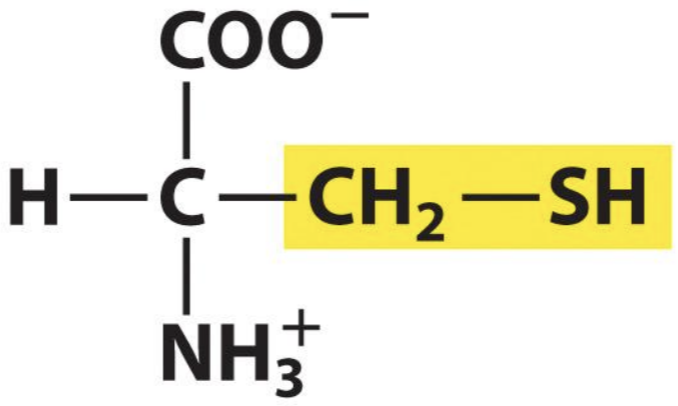
Cysteine
3-letter: Cys
1-letter: C
Side chain/structure: –CH₂–SH
Characteristics: Polar; can participate in chemical reactions. Can ionize at high pH. Two cysteine groups can undergo oxidation to form a disulfide bond, which is a covalent bond.
Charge/pH: At high pH, the –SH can lose H⁺ and become –S⁻. Protonation state depends on pH.
Important: Two cysteines can oxidize to form a disulfide bond (S–S), which helps stabilize protein structure.

Histidine
3-letter: His
1-letter: H
Side chain/structure: –CH₂–imidazole ring
Characteristics: Polar; ionizable; can participate in chemical reactions.
Charge/pH behavior: Can gain or lose H⁺ near physiological pH.
Protonated → +1
Deprotonated → 0
Important: Histidine can act as a buffer because it can switch between these states.
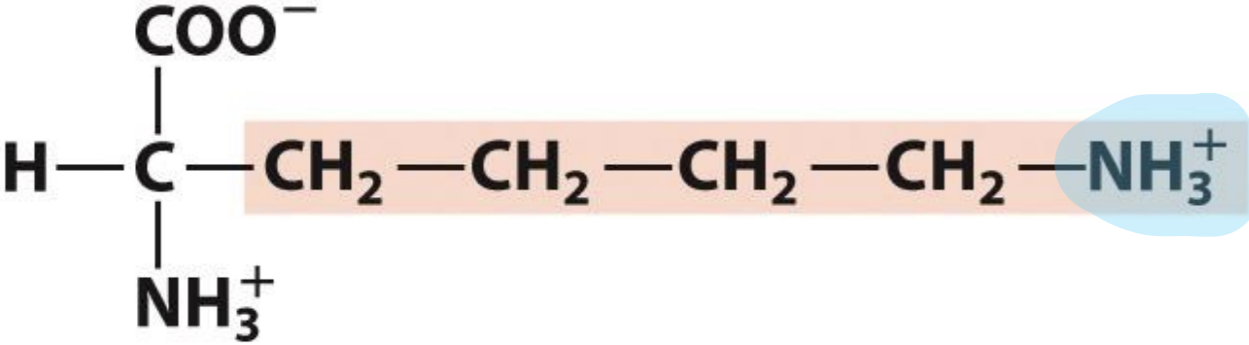
Lysine
3-letter: Lys
1-letter: K
Side chain/structure: –(CH₂)₄–NH₃⁺
Characteristics: Polar, basic, positively charged.
Charge/pH behavior:
Lower pH → +1
Physiological pH → +1
High pH → eventually loses H⁺ → 0
Important: One of the amino acids with a positively charged side chain at physiological pH.

Arginine
3-letter: Arg
1-letter: R
Side chain/structure: –(CH₂)₃–NH–C(=NH₂⁺)–NH₂ (guanidinium group)
Characteristics: Polar, basic, positively charged.
Charge/pH behavior:
Lower/physiological pH → +1
Very high pH → eventually loses H⁺ → 0
Important: Positively charged at physiological pH.

Aspartate
3-letter: Asp
1-letter: D
Side chain/structure: –CH₂–COO⁻
Characteristics: Polar, acidic, negatively charged.
Charge/pH behavior:
Low pH → –COOH = 0
Physiological pH → –COO⁻ = −1
High pH → remains −1
Easy distinction: Aspartate has ONE CH₂ before its carboxyl group.

Glutamate
3-letter: Glu
1-letter: E
Side chain/structure: –CH₂–CH₂–COO⁻
Characteristics: Polar, acidic, negatively charged.
Charge/pH behavior:
Low pH → –COOH = 0
Physiological pH → –COO⁻ = −1
High pH → remains −1
Easy distinction: Glutamate has TWO CH₂s before its carboxyl group.
What determines which amino acid it is?
The R group (side chain) determines the amino acid's identity and properties.
What happens when pH < pKa?
The group is protonated (has gained H⁺).
What happens when pH > pKa?
The group is deprotonated (has lost H⁺).
How do nonpolar vs. polar side chains interact with water?
Nonpolar: weak interaction with water.
Polar: strong interaction with water.
What are the 4 amino acids with charged side chains at physiological pH?
Lysine (+), Arginine (+), Aspartate (−), Glutamate (−)