Muscle Types, Movements, and Key Anatomy for Biology Students
 Call Kai
 Learn
Learn Practice Test
 Spaced Repetition
 Match
Match Flashcards
 Knowt Play
1/33

There's no tags or description
Looks like no tags are added yet.
Name | Mastery | Learn | Test | Matching | Spaced | Call with Kai | Chat |
|---|
No analytics yet
Send a link to your students to track their progress
34 Terms
Inflammation of the joints.
Arthritis
A form of arthritis that occurs when the body's immune system attacks the tissues of a joint.
Rheumatoid arthritis
Muscles (such as skeletal muscles) that are generally under conscious control.
Voluntary muscles
Muscles (such as smooth and cardiac muscles) that are not under completely conscious, voluntary control.
Involuntary muscles
Another name for skeletal muscle, so called because rows of filaments inside the cells give the tissue a striped (striated) appearance when viewed under a microscope.
Striated muscle
Muscle that consists of shorter, wider cells in a looser arrangement and is specialized for relatively slow, powerful, and prolonged contractions.
Smooth muscle
Muscle tissue found only in the heart.
Cardiac muscle
Muscles connecting the temporal bones of the skull to the sternum and clavicles that help turn the head from side to side.
Sternocleidomastoid
Muscles located on each side of the head that function to close the jaw.
Temporalis and Masseter
Shoulder movement muscles that permit pulling the shoulders back, shrugging, or tilting the head back.
Trapezius
The largest muscles of the chest, used to shove arms forward.
Pectoralis major
Muscles forming the curves of the shoulders that lift the upper arms away from the body.
Deltoid
Muscles connecting each humerus to the lumbar region of the spine, responsible for drawing arms to the rear.
Latissimus dorsi
Muscles extending from the bottom of the sternum to the front of the pelvic girdle, used when sitting up from a reclining position.
Rectus abdominis
Abdominal muscles that connect the ribs to the pelvis.
External oblique
The largest and strongest muscles in the whole body, which pull upper legs downward, away from the body, and toward the rear.
Gluteus maximus
A group of four muscles located in the front of each thigh that function to straighten the leg at the knee.
Quadriceps femoris
A group of three muscles in the back of each thigh that work together to bend the leg at the knee.
Hamstrings
A muscle extending diagonally from the pelvic bone to the tibia that lifts the lower leg and turns it inward.
Sartorius
The largest muscle of the calf, which functions to extend the foot downward.
Gastrocnemius

What is number 1.
Sternocleidomastoid

What is number 2
Temporalis

What is number 3
Masseter

What is number 4
Trapezius

5
Pectoralis major
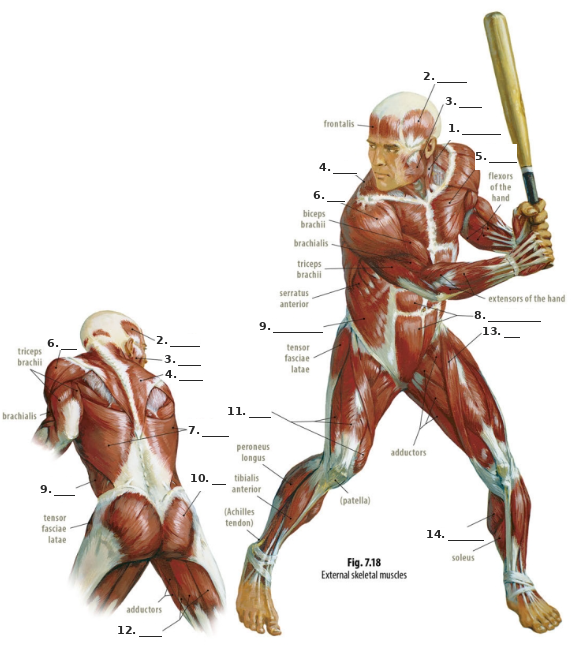
6
Deltoid

7
Latissimus dorsi

8
Rectus abdominis

9
External oblique
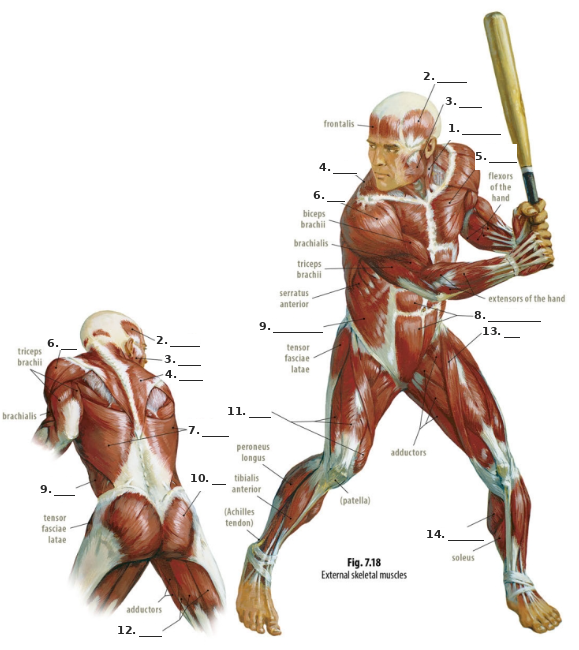
10
Gluteus maximus

11
Quadriceps femoris

12
Hamstrings
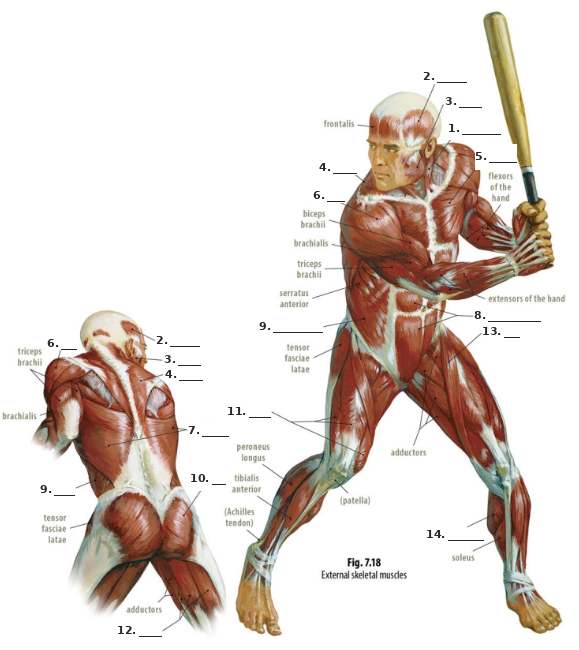
13
Sartorius

14
Gastrocnemius