Connective tissue
 Call Kai
 Learn
 Practice Test
 Spaced Repetition
 Match
 Flashcards
 Knowt Play
1/44

There's no tags or description
Looks like no tags are added yet.
45 Terms
"myo" refers to what?
things that can contract
whats connective tissue?
it provides support/cohesion, maintains form and acts like glue to hold everything together
connective tissue is made of different amounts of what?
fibers and cells, so they vary by density and cellularity
components of connective tissue are?
extracellular fibres
ground substance
cells
(proportion of these change depending on body part)
what are extracellular fibers?
they are protein ropes that provide strength and stretch
Types are:
collagen fibers
elastic fibers
reticular fibers
what is ground substance?
A gel-like fluid that fills the space between cells and fibers.
composed of water and "Proteoglycans and glycosaminoglycans": These are long, complex sugar-protein molecules that hold onto water, giving the gel its thickness.
Function: It allows nutrients and oxygen to travel from blood vessels to the cells, and waste products to travel back out.
define collagen fibers
The strongest. They are thick and tough and high in tensile strength. high Tensile strength means they resist being pulled apart.
eg type 1 collagen fibers in tendons and ligaments
Define elastic fibers
Made of a protein called elastin. They are like rubber bands; they can stretch and snap back to their original shape (found in lungs and arteries).
Define reticular fibers
Very thin, branching collagen fibers that make a delicate web or mesh. They act like a soft net to support squishy organs like the spleen or lymph nodes.
what are the 2 main categories of cells?
-Fixed/resident cells (permanent): Fibroblasts, adipocytes, mesenchymal stem cells
-Wandering/immune cells: Macrophages, mast cells, and white blood cells that defend against infection
types of fibroblasts
fusiform: spindle shaped (like a stretched out oval)
fibrocytes: Old, inactive fibroblasts.
Myofibroblasts: Contractile (can shrink) fibroblasts, usually found healing wounds.

what are fibroblasts?
The "builders." They are the most common cells. They make the fibers and the ground substance.

what are adipocytes?
Signet-ring appearance: When you look at them under a microscope, the huge fat droplet pushes the nucleus to the very edge, looking like a wax seal on an envelope.
fat cells (store lipids), They appear as "empty space" on slides because the fat gets washed away during slide prep.
do not undergo cell division
may occur in groups (adipose tissue)
may occur single (loose areolar tissue)
what are mesenchymal cells?
The "stem cells" of connective tissue.
Undifferentiated/Pluripotent: They haven't chosen what to be yet and can turn into any type of connective tissue cell when needed.
Stellate: Star-shaped.
along blood vessels
what are macrophages?
"Defense/protection cells." They eat bacteria and dead cells (phagocytosis).
what are mast cells?
Release histamine to start inflammation and allergic reactions.
histamine causes blood vessels to widen and become more permeable
what are plasma cells?
Produce antibodies to fight infection.
connective tissue is divided into what families?
proper: loose and dense connective tissue
supportive: bone and cartilage
fluid: blood
what are the types of loose connective tissue?
Areolar, adipose, and reticular connective tissues.
whats areolar connective tissue?
The most widespread connective tissue. It is the "packing material" of the body.
"Areola": Latin for "little open space." It looks like a loose web with lots of room for fluid.
whats areolar tissue composed of?
it has all three fiber types (collagen, elastic, reticular) in a random, loose arrangement. It contains fibroblasts and lots of wandering immune cells (macrophages, mast cells, white blood cells).
whats the function and location of areolar tissue?
Functions:
Binding/Support: holds organs, muscles and nerves in place while it Glues skin (epithelial tissue) to muscle.
Diffusion: Allows salts, oxygen and nutrients to reach tissues that don't have blood (like epithelium).
Immune Defense: Because it has so many white blood cells, it's the first line of defense against infection.
Locations: Right under the skin (papillary dermis), under epithelial layers (lamina propria), and wrapping around blood vessels and nerves.
whats adipose tissue?
fat tissue
whats adipose tissue made of?
adipocytes, they are lipid storing cells (fat cells)
with a small amount of collagen/elastic fibers holding it together.
adipose tissue functions?
Energy Storage: Stores fat for fuel (9 calories per gram).
Insulation: Subcutaneous (under the skin) fat keeps you warm.
Cushioning: Visceral (around organs) fat protects organs from bumping into each other.
Endocrine: Fat is an active organ! It releases hormones called adipokines (like leptin) that control appetite and how your body uses insulin.
What's reticular tissue?
What is it? A delicate, 3D spiderweb.
Stroma: This is the name for the supportive framework it creates. It acts like a sponge holding up soft organs.
Main Functions • Immune & Blood Cell Hosting: Provides attachment points and pathways for white blood cells and immune cells to monitor fluid and carry out defense or filtration duties
whats reticular tissue made of?
Composition: Made of thin Type III collagen fibers made by reticular cells. It is packed with immune and blood forming cells (lymphocytes, macrophages).
Staining: You can't see it with standard H&E stain. You have to use a silver stain, which makes the fibers turn black.
where is reticular tissue found?
Immune organs (lymph nodes, spleen, tonsils) and bone marrow. It provides the "scaffolding" for immune cells to sit on and monitor the body.
what are the types of dense tissue?
regular, irregular, elastic
what does regular mean?
The collagen fibers are perfectly parallel to each other, running in one direction (like uncooked spaghetti).

whats the structure of dense tissue?
The fibers are packed tightly together. There is very little ground substance or space.
Very few cells. Just squeezed, flattened fibroblasts between the fibers.
where is dense connective tissue found?
Tendons (muscle to bone), Ligaments (bone to bone), and Aponeuroses (broad, flat sheets of tendon)
whats the function of dense connective tissue?
-Incredible tensile strength. It can resist massive pulling forces, but only in one direction (applied along a single linear axis)
-Force Transmission: Efficiently transfers muscle contraction forces to bones to allow smooth joint movement
why is it called irregular dense connective tissue?
The collagen fibers are thick and densely packed, but they are arranged randomly in a 3D web (like a tangled ball of yarn)
whats the function of dense irregular tissue?
Because the fibers go in all directions, this tissue can resist stretching and tearing from any angle.
where is dense irregular tissue found?
Wherever the body needs a tough shield against forces from multiple directions. Examples: the deep layer of the skin (reticular dermis), joint capsules, and the tough capsules around organs like the kidneys and liver.
Other Coverings: Periosteum and perichondrium (surrounding bone and cartilage), cerebral dura mater, and nerve/muscle sheaths (epineurium, perineurium, and epimysium)
what is dense elastic connective tissue?
Dense tissue packed with elastic fibers (and some collagen) and widely spaced fibroblasts
whats the function of dense elastic tissue?
Recoil, stretch, support with flexibility. It can stretch enormously and immediately snap back to its original shape. provides a balance of tensile strength and elasticity where movement, expansion, and contraction occur constantly
where is dense elastic tissue found?
Large arteries (like the aorta, so it can stretch when the heart pumps) and the respiratory system (lungs need to stretch when you breathe in and snap back when you breathe out).
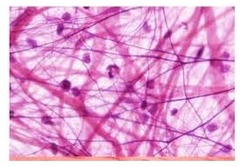
what tissue is this?
areolar connective tissue

what tissue is this?
reticular connective tissue

what tissue is this?
adipose connective tissue

what tissue is this?
dense regular tissue

what tissue is this?
dense irregular tissue

what tissue is this?
dense elastic tissue