Third Geology Study Guide
 Call Kai
 Learn
 Practice Test
 Spaced Repetition
 Match
 Flashcards
 Knowt Play
1/65

There's no tags or description
Looks like no tags are added yet.
66 Terms
What is needed to preserve fossils?
Gentle environment (low energy), oxygen-poor environment (anoxic), rapid burial, presence of hard parts
How many species have been found through fossils?
250,000 species
Why is the fossil record incomplete?
Low preservation potential, can’t sample entire Earth, not all periods are represented by sedimentary rock
What is evidence for natural selection and evolution?
Homologous structure, microbiology, direct observation

Homologous structure
Repeating patterns in nature (eg; similar skeletal structure) between species that do not serve the same purpose.
Evolution
The change in characteristics of a species over several generations via the process of natural selection.
It was assumed that evolution was slow and constant, called _. Now we know evolution proceeds slowly before suddenly accelerating, called _.
gradualism, punctuated equilibrium
Rapid acceleration in evolution is a result from:
change in climate, isolation of a breeding population, appearance of a predator/competition
Mass extinction
When major changes occur in the Earth that affect the entire planet, large fractions of the Earth’s species can go extinct at once.
Fossil records can show:
both species adapting and species going extinct
Causes of extinction:
climate change, asteroid impact, voluminous volcanic activity, introduction of a new predator
The largest mass extinctions were:
Cretaceous-Tertiary and Permian-Triassic
Cretaceous-Tertiary mass extinction qualities:
65 million years ago, 75% of plant and animal species went extinct due to meteor impact in modern Mexico, dinosaurs died, mammals thrived
How was the meteor impact discovered?
Layers of clay in the Earth mixed with soot and iridium; iridium is not common on Earth
Permian-Triassic extinction qualities:
252 million years ago, majority of marine and terrestrial vertebrate species went extinct, cause is less clear, fewer animals attached to seafloor post-extinction
Holocene-Anthropocene mass extinction
The speculated 6th mass extinction caused by human impact
How does the fossil record contain a record of evolutionary processes?
Series of fossils from different time periods demonstrate ways in which species adapted to their environment via natural selection
Why are we likely in the middle of a 6th mass extinction?
Humans have majorly disrupted ecosystems of animals globally, resulting in an unprecedented rate of extinction
Uniformitarianism
Things happening uniformly over time (eg; geologic processes) rather than happening catastrophically all at once
Steno’s Laws
Guideline for identifying the relative age of rock unitsO
Order of Steno’s laws:
superposition (younger layers of rock sit on top), original horizontality, cross-cutting pieces (layers must be older than any intrusion), lateral continuity (layers are continuous until they’re unable to)
Principle of baked contacts
If an igneous intrusion has metamorphosed the surrounding rock, then the surrounding rock must be older than the igneous intrusion.
The principle of inclusions
A rock containing inclusions of another rock must be younger than the inclusions
index fossil
can indicate the age of a rock unit relative to other fossil-containing rocks
Strata
Several layers of horizontal rock
Stratigraphy
The study of rock layers
Lithologic Correlation
Looking at stratigraphic columns of multiple locations allows geoscientists to expand their understanding of a region
Regarding the Moon’s formation, which is evidence for the Giant Impact Hypothesis?
Similar compositions, tidal lock, higher density of Earth
What contributed to the heat that made the Earth molten at the beginning of its creation?
Higher radioactive decay, heat from the high number of impacts, and gravitational compression all heated up the Earth at its formation. This heat of formation and continuing radioactivity are still the main sources of Earth’s internal heat.
In the solar system, the abundance of surface water characterizes the Earth. Which of the following is not considered as a possible source of Earth's surface water?
The moon
The oldest eon of the Earth is called the:
Hadean
Life on Earth likely started during:
the early Archean eon
Life in the early Phanerozoic eon (i.e., in the Paleozoic era) was dominated by:
Marine creatures such as trilobites
The era when dinosaurs roamed the Earth is called the:
Mesozoic
The era we are currently in is called the:
Cenozoic
Many scientists think we have entered a new epoch related to human activity, called the:
Anthropocene
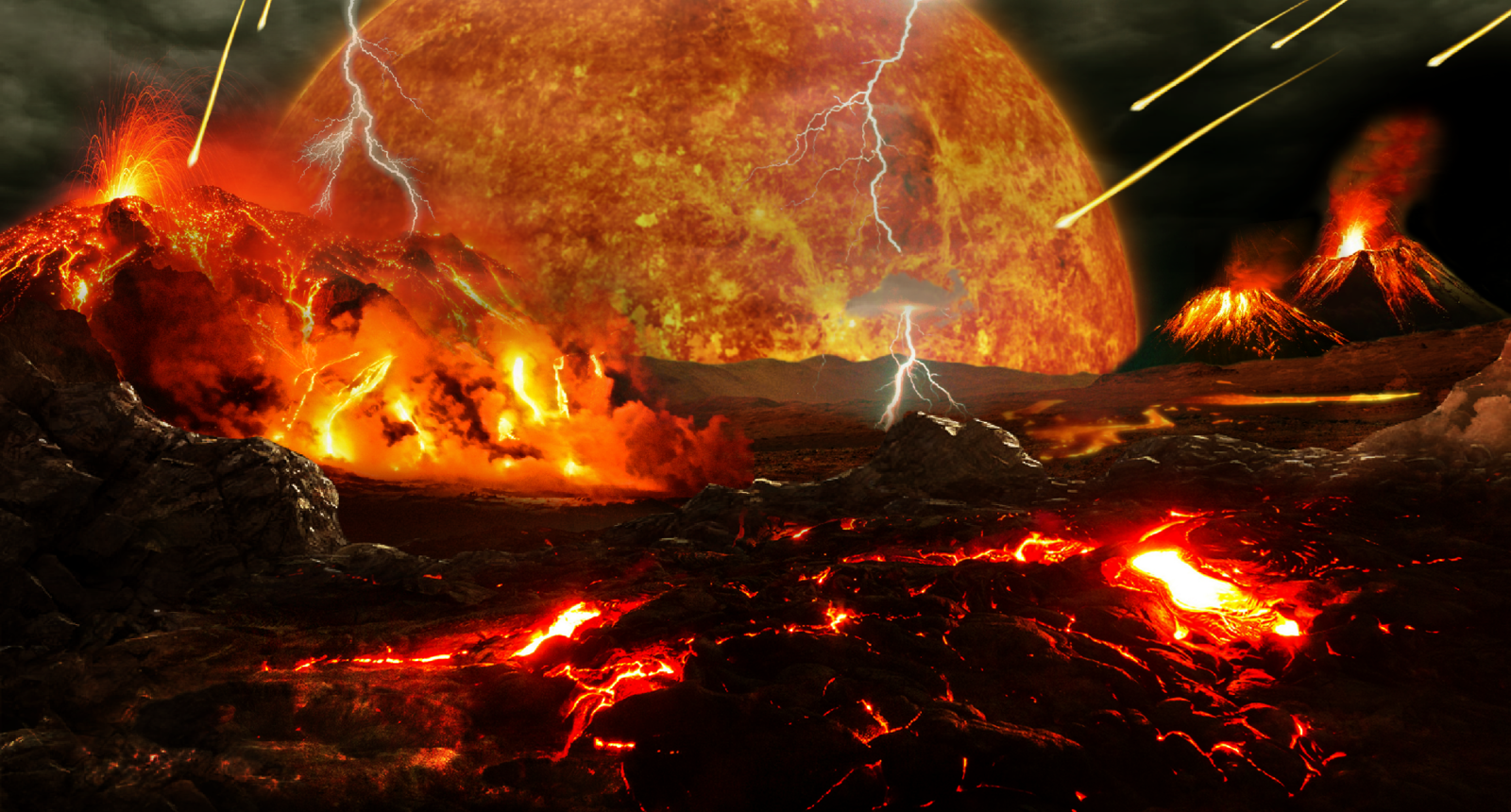
Hadean eon
4.55 billion years ago; the Earth forms by planetesimal accretion and is incredibly hot
How did the moon form?
The moon formed by a giant collision between Earth and a protoplanet, before the material accreted
Hadean eon characteristics
No rock record, meteorites bombard the surface, moon forms

Archean eon
Began 4 billion years ago; the first rocks in the rock record, the continents develop, oceans form, first life develops
Proterozoic eon
2.5 billion years ago; when the atmosphere became oxygen-rich, soft-bodied fauna develop, oceans freeze and glaciers cover continents
The final eon of Earth history is called the Phanerozoic. It is defined by three eras:
Paleozoic Era (Appalachian Geology), The Mesozoic Era (Dinosaurs), Cenozoic Era (Mammals and the Modern World)
Paleozoic era
540 million years ago; Cambrian explosion, Appalachian mountains form, Permian-Triassic mass extinction
Laurentia
Proto North America and Greenland; existed near equator around 510 MYA
Mesozoic era
250 million years ago; age of the dinosaurs, warm climate, KT mass extinction
Cenozoic era
66 million years ago; age of mammals, Pleistocene ice age, humans evolve

Earth Timeline Poster
Earth Timeline Poster
Most of the geology of the western side of the Appalachian mountains is dominated by ??? that occurred ~500-300 million years ago during the ???
sedimentary processes; Paleozoic Era
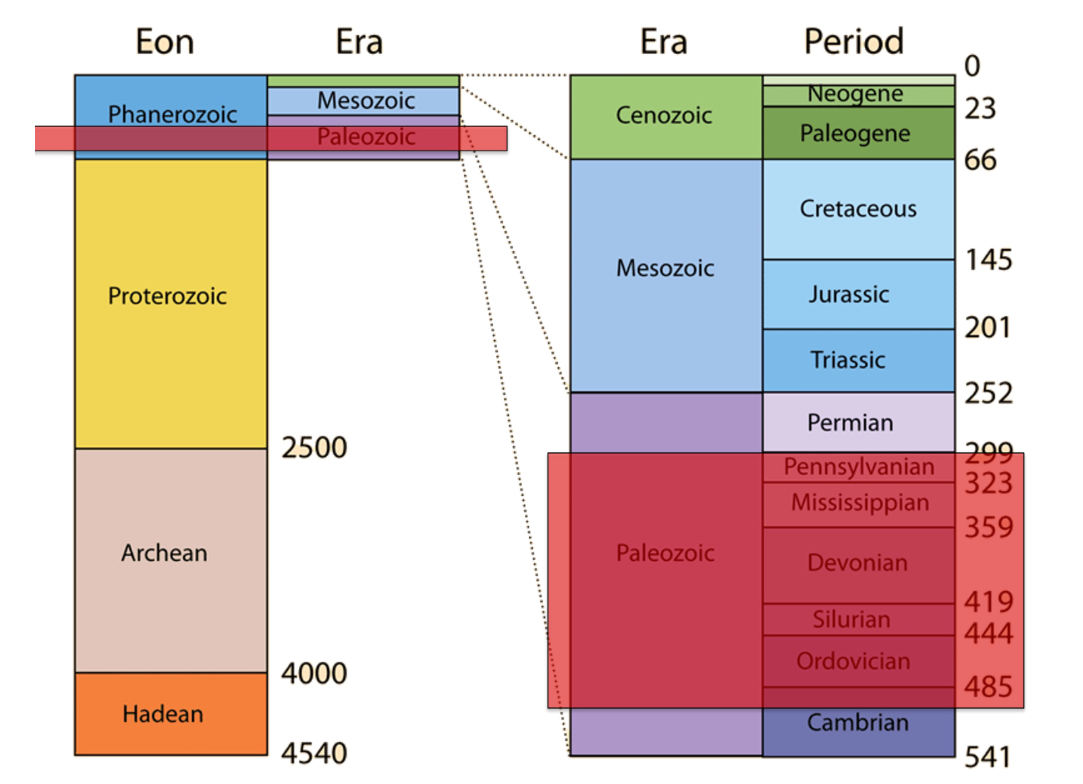
The oldest rocks exposed in Kentucky are ??? million years old, while the youngest are ??? million years old
500; 300
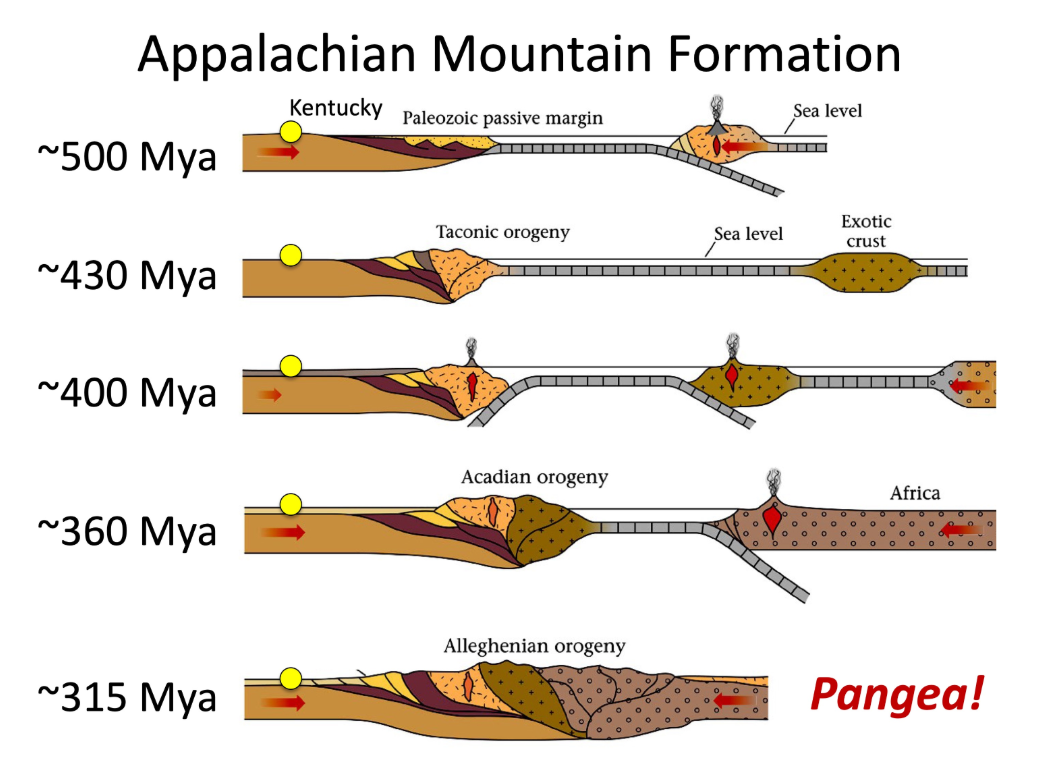
What kind of plate boundary formed the Appalachian mountains?
Like the modern Himalayas, the Appalachians formed in a continental collision zone (convergent plate boundary), in this case when North America collided with Africa.

Ordovician period
After cambrian period; major diversification of animal life, no life on land, modern Kentucky was underwater and collecting sediment (limestone from coral reefs)
When was the first mountain-building event for Appalachia?
Taconic orogeny; 430 MYA when a volcanic arc moved closer to the continent before eventually crashing (shale forms)
During the early Paleozoic, continental crust that would later correspond to Kentucky was submerged beneath a ???
warm, shallow sea. This sea was shallow because it was on a continental shelf and warm because the continent of North America was near the Equator at this time. This warm shallow sea provided the perfect environment for forming limestone from the shells of various sea creatures.
During the mid Paleozoic, the Taconic and Acadian orogenies form the proto Appalachian Mountains. Proto-Kentucky is a coastal delta during this time, resulting in the deposition of ??? sediments.
shale and siltstone; As rivers shift course, Kentucky becomes part of a carbonate shelf once more, forming another layer of limestone.
During the late Paleozoic, the Alleghenian orogeny occurs as North America and Africa collide, forming Pangea and the Appalachian mountains. As the seas recede, ??? and ??? are deposited in high-energy coastal environments.
sandstone and conglomerate; Kentucky is covered in vast swamps for much of this period, resulting in the deposition of organic matter that would later form coal.
What happened to Kentucky during the Mesozoic era?
Pangea begins to rift apart; a continental rift pulls North America and Africa that becomes a mid-ocean ridge; Dinosaurs roam the continent but are not preserved in Kentucky
What happened during the Cenozoic era?
The Mid-Atlantic Ridge continues to push North America and Africa to their current positions; the Pleistocene Ice Age results in continental glaciers eroding the Midwest flat, though these glaciers don't affect Kentucky
Order of Kentucky paleography:
Sedimentary rocks were deposited between 300 and 500 million years ago, when the region was submerged beneath a shallow sea.
The sea receded when North America and Africa collided, forming Pangea and the Appalachian mountains.
The organic matter that later formed coal was deposited during this time due to the prevalence of trees and swamps in the region.
Erosional process
Flat strata, warped strata via compressional force, erosion removes resilient top layer, weaker and younger layers are exposed and erode faster, result is an elevated plateau with knobs

Basin and Dome
Compressional structures formed from warping initially flat sedimentary layers during collisions
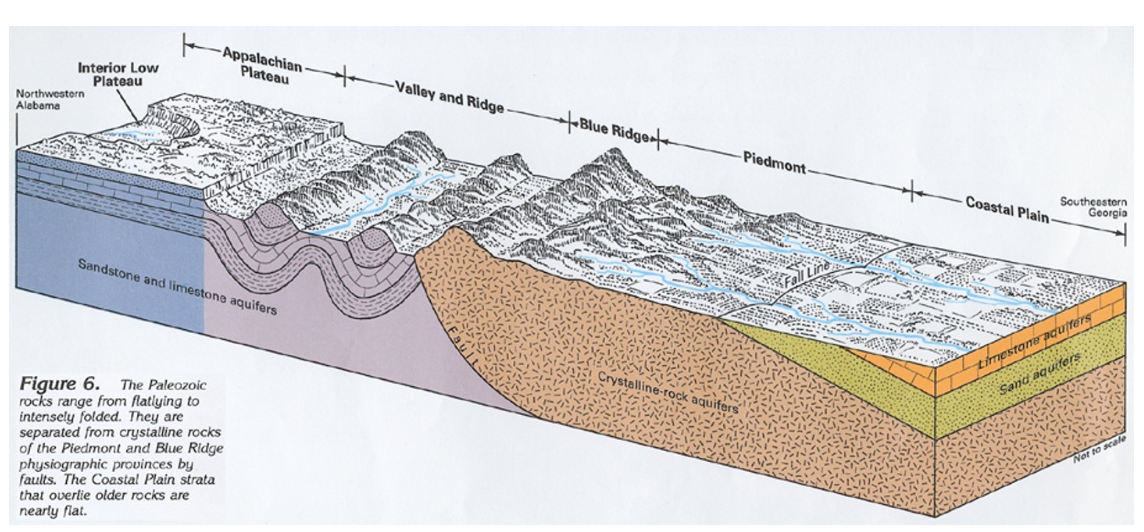
What are the provinces of Appalachia?
Appalachian Plateau, Valley and Ridge, Blue Ridge, Coastal Plain
Appalachian Plateau
Sediments that were moved upwards during mountain-forming events ~430-300 Mya: consists primarily of sandstone (and associated coal!) and remains elevated due to sandstone's resistance to physical weathering.
Valley and Ridge
Sediments that were intensely folded during mountain-forming events; same rocks as Appalachian Plateau
Blue Ridge Mountains / Piedmont Province
Both consist of 'exotic' crust; crust that formed somewhere else and was accreted to the North American continent during mountain-building events. These provinces contain ancient igneous and metamorphic rocks
Coastal Plain
Sediments sourced from rivers descending from the Appalachians (not really Appalachia)