PMCOL 343 - Animal Models
 Call Kai
 Learn
 Practice Test
 Spaced Repetition
 Match
 Flashcards
 Knowt Play
1/47

There's no tags or description
Looks like no tags are added yet.
48 Terms
Animal Behavioural Models - Purpose
Animal models are used to assess drug effects on behaviour and model aspects of human disease.
Applications include antidepressants, anti-anxiety drugs, antipsychotics, cognitive enhancers, and addiction treatments.
An animal model attempts to imitate selected aspects of a clinical condition.
Models help identify potential therapeutic drugs and investigate the biological substrates of clinical conditions.
Animal Behaviour - Descartes
Descartes viewed animals as automata whose behaviour could be reduced to simple reflex actions.
He argued that humans have a rational soul, abstract thought, and minds, whereas animals act through instinct.
Reluctance to compare humans with animals partly reflected beliefs that humans were God's creation and superior to animals.
Animal Behaviour - Darwin
Charles Darwin and Alfred Wallace developed the theory of evolution through natural selection.
Relevant works include On the Origin of Species and The Descent of Man.
Darwin argued that humans descended from animals and that animals can inherit instincts.
Darwin distinguished inherited instincts from learned habits, arguing that humans inherit instincts and learn habits.
Animal Behaviour - Historical Views
Sherrington (1900) argued that animals act without minds and that there was no evidence of thought, feelings, or perception.
Wundt (1911) suggested that basic sensations such as fear in animals may parallel human sensations.
Pavlov (1897) observed that a trained dog's perception of feeding could cause salivation, indicating perception, memory, and organized thought.
4 McKinney Criteria
Etiological Validity: The cause or trigger used to induce the condition in the animal model mirrors the actual etiology in humans.
Face Validity: The outward behavioral symptoms and physical manifestations in the animal accurately resemble the clinical profile of human patients.
Construct Validity: The biological pathways, affected neural circuits, and underlying neurochemical mechanisms are identical between the model and the disease state.
Predictive Validity: Interventions that successfully treat or prevent the condition in humans produce the same therapeutic effect in the animal model.
Opioid Dependence - Rat Model
Morphine is administered to rats through a slow-release subcutaneous capsule.
Rats develop tolerance to morphine, find it rewarding, and develop opioid dependence.
Withdrawal can be precipitated by removing morphine or administering naloxone, an opioid antagonist.
Researchers observe withdrawal behaviours in saline-treated controls and animals given potential treatments.
Opioid Withdrawal - Testing Treatments
Clonidine is used clinically to help treat opioid withdrawal and serves as a treatment control in the model.
Wet dog shakes are a measured withdrawal behaviour: saline-treated rats show substantial behaviour, while clonidine inhibits it.
BU224 is an experimental imidazoline receptor antagonist; it is ineffective against wet dog shakes but shows some effectiveness against mouth movements and diarrhoea at a higher dose.
Opioid use is associated with constipation, while withdrawal can cause diarrhoea.
Opioid Model - Validity
Inducing-condition similarity is limited because rats do not initially self-administer morphine in the same way that humans may use opioids.
Behavioural similarity is strong because rats develop dependence and withdrawal.
Neurobiological similarity is strong because the neurochemistry is similar and withdrawal can be severe.
Clonidine works in both rats and humans, supporting treatment similarity.
Laboratory Animals - Species Differences
Rat behaviour is strongly influenced by hunger, thirst, and the need to breed.
Rats are small, clean, inexpensive, easy to handle, have short gestation periods, and live approximately three years.
Mice are smaller, more affordable, and amenable to genetic manipulation, but their behavioural profile is less complex than that of rats.
Guinea pigs have been used in experiments for centuries; they contributed to the discovery of vitamin C in 1907.
Laboratory Rats - Origins
Donaldson established a breeding colony at the Wistar Institute in Philadelphia in 1906, supplying scientists until 1960.
Wistar rats were bred specifically for research.
Albino Wistar rats have poor vision.
Wistar rats may be unsuitable for experiments requiring good visual acuity.
Rat Strains - Long-Evans
Around 1915, researchers Long and Evans mated female Wistar rats with a wild male rat.
The resulting Long-Evans strain has good vision.
Long-Evans rats are useful for behavioural experiments requiring visual discrimination, including the Morris water maze.
Rat Strains - Sprague-Dawley
Sprague-Dawley rats were developed by mating a hooded rat with a white female Wistar rat and then remating the offspring.
The strain was selected for rapid growth, vigour, and good temperament.
A company was established to market Sprague-Dawley rats.
Sprague-Dawley rats have poor vision.
Rat Strains - Experimental Implications
Different strains, including different Wistar colonies, can show substantial behavioural differences.
Some Wistar strains drink little alcohol, while one inbred colony was found to drink ten times the normal amount.
Long-Evans and other hooded rats have better eyesight for visual-discrimination tasks.
Wistar and Sprague-Dawley rats have poorer vision, which can limit their suitability for such tasks.
Experimental Design - Variables
The independent variable is the factor manipulated by the researcher, usually the type or amount of drug in behavioural pharmacology.
The dependent variable is the observed outcome, such as a measurable behaviour.
Experiments may compare conditions such as injury alone versus injury plus PPF to investigate relationships between events.
Experimental Design - Experimenter Bias
Researchers can influence results if they know which condition a subject is in or which drug it receives.
Blinding helps reduce bias by preventing the experimenter from knowing the experimental condition.
Double-blind human studies conceal treatment assignments from both subjects and researchers.
Blinding reduces, but does not eliminate, subject and experimenter bias; keeping the behavioural experimenter blind is an important control in animal studies.
Experimental Design - Three-Group Design
Group 1 receives the experimental drug being tested.
Group 2 receives a placebo or vehicle control.
Group 3 receives an established drug with a known therapeutic effect.
Experimental drug versus placebo tests whether the new drug improves outcomes; established drug versus placebo checks whether the model can detect improvement; experimental drug versus established drug tests whether the new drug offers an advantage.
Behavioural Models
Antidepressant model: Porsolt forced swim test.
Anxiety models: elevated plus maze, Vogel conflict test, and defensive burying.
Learning and cognition models: Y-maze, Morris water maze, radial arm maze, and social interaction test.
Antidepressants - Porsolt Forced Swim Test
Roger Porsolt developed the forced swim test following research on learned helplessness, associated with Seligman's work in 1975.
Learned helplessness occurs when animals exposed to uncontrollable aversive events show decreased motivation to respond.
In the forced swim test, behaviours such as immobility, swimming, and climbing are measured over a set interval.
The test is used to assess the effects of potential antidepressant drugs on these behaviours.
Forced Swim Test - Drug Effects
Fluoxetine (Prozac), an SSRI, decreases immobility and increases swimming.
Reboxetine (Edronax), an NRI, decreases immobility and increases climbing.
Immobility is used as a behavioural measure associated with learned helplessness or behavioural despair.
Reminder: Review the example-data graph comparing immobility, swimming, and climbing.
Antidepressants - Tail Suspension Test
Mice are suspended by the tail using a transducer.
The amount of time spent immobile is measured as an indicator of behavioural despair.
Antidepressants, including SSRIs, prolong attempts to right themselves.
Why can antidepressants can act acutely in rodent tests when SSRIs generally take more than two weeks to work in humans.

Anxiety - Elevated Plus Maze
Rodents generally prefer enclosed arms over open arms, making the elevated plus maze a test of anxiety-like behaviour.
Researchers measure entries into open versus closed arms, time spent in open arms, and latency to enter an open arm.
Lorazepam, a benzodiazepine, increases time spent in open arms and reduces the latency to enter them.
Yohimbine, an alpha-2 adrenergic antagonist that can act as a stimulant and increase anxiety, decreases open-arm exploration and increases entry latency.
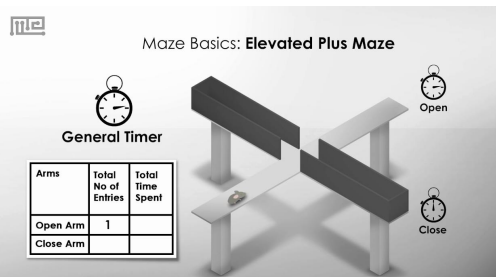
Elevated Plus Maze - Data Interpretation
Greater time spent in open arms is interpreted as reduced anxiety-like behaviour.
Longer latency to enter an open arm indicates greater avoidance of the exposed area.
Heat maps can illustrate the animal's movement around the maze.
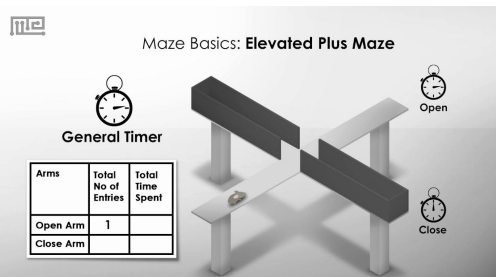
Anxiety - Vogel Conflict Test
The Vogel test is a conflict test used to screen drugs for potential anxiolytic effects.
Drinking is punished with mild electrical shocks, causing water consumption to decrease.
Anxiolytic drugs can restore drinking responses despite the punishment.
The animal must choose between satisfying thirst and avoiding the shock.

Anxiety - Defensive Burying
Defensive burying measures a behaviour considered more ethologically relevant.
Animals are habituated to the environment without a probe and then tested with the probe present.
Initial contact with the probe delivers a mild shock, triggering defensive burying.
Researchers measure latency to begin burying and the duration of burying.
Learning and Cognition - Y-Maze
The Y-maze is a rapid test of spatial memory.
A mouse starts in one arm and explores the other two arms, which should be visited in an alternating sequence such as A-B-C-A-B-C.
Researchers measure the percentage of successful alternations.
The test is sensitive to hippocampal lesions.
Learning and Cognition - Morris Water Maze
The Morris water maze is a more complex test of spatial memory using a pool of water at 22°C with a hidden platform.
The water is made milk-coloured so the platform is hidden, while the rat can use visual cues to learn its location.
Rats typically receive four trials per day and have 90 seconds to find the platform.
Performance depends on the hippocampus.

Morris Water Maze - Fragile X Model
The fragile X mouse model involves deletion of the FMR1 gene and has learning problems.
Fragile X mice show impaired Morris water maze performance, particularly when the task becomes more difficult during a reversal trial.
Non-fragile X mice learn the new platform location more rapidly during reversal, while fragile X mice show a slower learning curve.

Morris Water Maze - Evidence and Applications
Cortical lesions of similar magnitude do not impair performance in the same way as hippocampal lesions.
The Morris water maze is useful for studying learning and memory.
Scopolamine and benzodiazepines impair performance in this model, consistent with their effects on learning and memory in humans.
Performance declines with age; older rats do not perform as well.
Cognitive Treatments - Memory and Thinking
Cholinesterase inhibitors, including donepezil (Aricept) and rivastigmine (Exelon), prevent the breakdown of acetylcholine, which is important for memory and thinking.
Memantine (Namenda) regulates glutamate activity, which contributes to processing, storing, and retrieving information.
Learning and Cognition - Radial Arm Maze
The radial arm maze measures spatial reference memory and working memory.
The task depends on the hippocampus and also involves the prefrontal cortex (PFC).
The maze typically has eight arms, with four arms blocked and food placed in the other four.
Animals learn to enter arms to retrieve food; the task is sometimes called a delayed match-to-sample test.
Radial Arm Maze - Memory Errors
The test measures the incidence and type of memory errors during training and testing.
A working memory error occurs when an animal re-enters an arm it has already visited and emptied; this can occur during both training and testing.
A reference memory error occurs when an animal enters an arm that was baited during training but is no longer baited during testing.
Learning and Cognition - Social Interaction Test
The social interaction test uses a three-chamber apparatus.
After habituation to the environment alone, sociability is assessed by introducing an unfamiliar, non-cagemate mouse.
Researchers measure how much time the test mouse spends exploring or interacting with the stranger.
A social novelty test introduces a second stranger to assess the animal's response to a new individual.
Social Interaction Test - Drug Effects
Anxiolytic compounds can dose-dependently increase social interaction.
Examples include GABAergic agonists such as benzodiazepines, ethanol, and barbiturates.
Corticotropin-releasing factor (CRF) produces an anxiogenic-like effect and reduces social interaction.
The test is used in models of autism, fragile X syndrome, schizophrenia, and related conditions.
Behavioural Models - Interpreting Results
In the forced swim test, reduced immobility is a behavioural response associated with antidepressant treatment in rodents.
In the elevated plus maze, increased open-arm exploration is interpreted as reduced anxiety-like behaviour.
In the Vogel test, restored drinking despite mild shock is interpreted as an anxiolytic-like effect.
In defensive burying, researchers assess the timing and duration of the animal's defensive response to a threatening stimulus.
Antipsychotics - Startle Reflex
The startle reflex occurs in both humans and animals.
Repeated exposure to a startle stimulus produces a reduced response, called habituation.
Prepulse inhibition (PPI) occurs when a mild stimulus presented before the startle stimulus further reduces the startle response.
Patients with schizophrenia show deficient PPI, making it useful for modelling aspects of schizophrenia.
Antipsychotics - Apomorphine Model of Deficient PPI
Apomorphine is a non-selective dopamine agonist that disrupts PPI in rodents.
This disruption is used to develop a rat model of deficient PPI.
Most antipsychotics can reverse the apomorphine-induced PPI deficit.
Stroke - Middle Cerebral Artery Occlusion
Middle cerebral artery occlusion (MCAO) can be permanent or temporary.
MCAO restricts blood flow to brain tissue and can lead to cell death.
The model is used to screen drugs that may reduce damage following stroke.
NMDA antagonists and free-radical scavengers have been investigated using these models; edaravone (MCI-186) is shown as a free-radical scavenger with neuroprotective effects in mice with permanent focal brain ischemia.

Stroke - Tissue Analysis
MCAO tissue images distinguish redox-active, viable tissue from necrotic or dead tissue.
TUNEL staining marks apoptosis.
Individual cell types can also be stained to examine the tissue response.

Multiple Sclerosis - Disease Mechanism
Multiple sclerosis (MS) is a CNS-directed autoimmune disease.
It involves T-cell-mediated inflammation, demyelination, and axonal injury.
The animal model is experimental autoimmune encephalomyelitis (EAE).
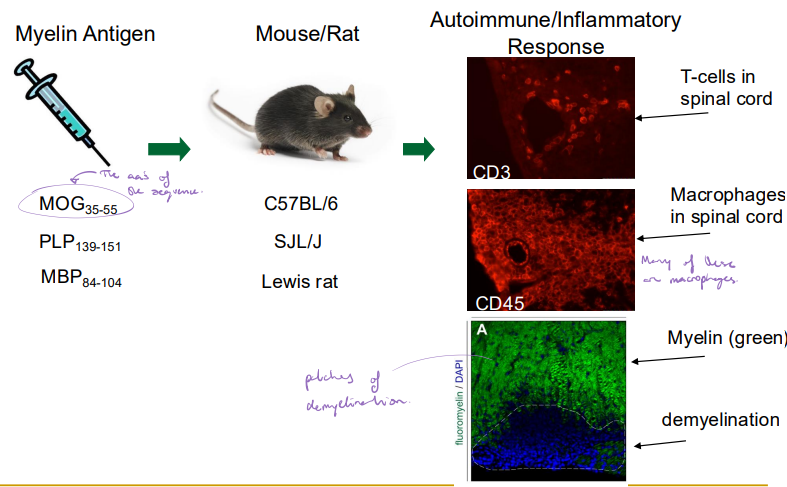
EAE is induced by immunizing a rat or mouse with a specific myelin peptide that triggers an immune response against myelin in the brain and spinal cord.
MS - EAE Model Components
Myelin antigens used include MOG35-55, PLP139-151, and MBP84-104.
The immune response involves inflammatory cells, including T cells and macrophages, in the spinal cord.
Tissue images show immune-cell markers such as CD3 and CD45, along with myelin staining and demyelination.
MS - EAE Disease Activity
Disease activity is assessed using a weakness or paralysis score.
Clinical signs typically appear 10–14 days after immunization.
The EAE model has been instrumental in the development of MS therapies.

Modern Approaches - Cre-Lox System
Cre-Lox is a gene-manipulation strategy that is more precise than a global knockout.
It can knock out or knock in a specific gene in a defined population of cells.
The gene of interest is flanked by loxP sites, and Cre recombinase acts at those sites to enable the genetic modification.

Cre-Lox - KCNMA1 Example
Cre recombinase is driven by the AdVil promoter, identified as being expressed only in sensory neurons of the dorsal root ganglion (DRG).
These mice are crossed with mice carrying loxP sites around the KCNMA1 gene, producing a floxed KCNMA1 arrangement.
KCNMA1 encodes the BK subtype of potassium channel; the resulting mice lose BK channels in sensory neurons while other cells retain normal expression.
This reduces off-target effects and the system can be inducible and reversible, allowing manipulation at selected times using drugs such as tetracycline-related compounds or tamoxifen.
Gene Editing - CRISPR-Cas9
CRISPR stands for Clustered Regularly Interspersed Short Palindromic Repeats.
These DNA sequences occur in prokaryotes and form part of a prokaryotic immune system that identifies genetic sequences for cleavage by Cas9.
Jennifer Doudna and Emmanuelle Charpentier pioneered the use of CRISPR as a gene-editing tool in eukaryotic cells.
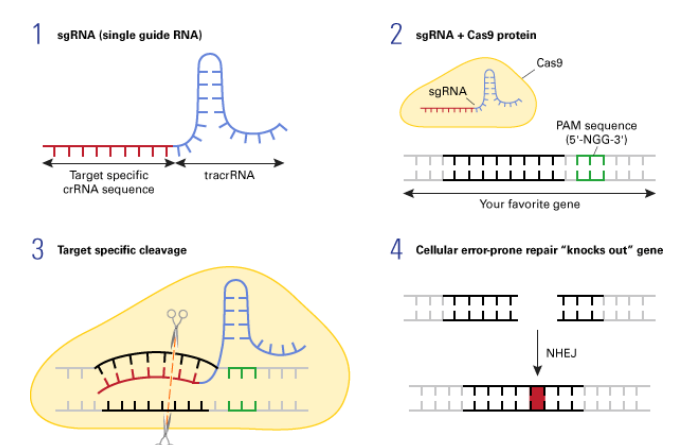
Optogenetics - Mechanism
Four main steps.

Optogenetics - Basic Principle
Optogenetics controls neuronal activity using light.
Channelrhodopsin (ChR2) is activated by blue light and is excitatory.
Halorhodopsin (NpHR) is activated by yellow light and is inhibitory.

Optogenetics - TRPV1 Pain Model
A TRPV1-Cre mouse is crossed with a mouse carrying a loxP-flanked STOP cassette that prevents expression of ChR2-EYFP.
In the offspring, Cre recombinase removes the STOP cassette, allowing ChR2-EYFP expression in TRPV1-lineage neurons.
EYFP-positive DRG neurons show functional ChR2 expression in nociceptors.
Blue light at 470 nm evokes currents in the same neurons that respond to capsaicin, a TRPV1 channel agonist.

Optogenetics - Evoked Pain Behaviour
Blue light activates ChR2 in TRPV1-positive pain-sensing neurons and evokes a strong nocifensive response.
Delivering local anaesthetic to TRPV1-positive pain-sensing neurons prevents blue light from activating the cells.
When the cells are no longer activated, the behavioural response is absent.
