session 4 - DNA
 Call Kai
 Learn
Learn Practice Test
 Spaced Repetition
 Match
Match Flashcards
 Knowt Play
1/8

There's no tags or description
Looks like no tags are added yet.
Name | Mastery | Learn | Test | Matching | Spaced | Call with Kai | Chat |
|---|
No analytics yet
Send a link to your students to track their progress
9 Terms
Describe how eukaryotic DNA is packaged in the cell:
DNA winds around histone proteins (H2A, H2B, H3, H4), the histone proteins are formed from positive charged amino acids, allowing the negative DNA to wind.
DNA-Histone complex forms chromatin, which is made from repeating units of nucleosome.
Euchromatin = Less condensed, so more access to the proteins, so increased rate of transcription
Heterochromatin = Highly condensed, so less access to the proteins, so decreased rate of transcription (darker colour of nucleus)
The chromatin then coils even more to form solenoid.
These solenoid condense even more to form the arms of the chromosomes.
DNA → Chromatin → Solenoid → Chromosome
Humans have 22 autosomal chromosomes and 2 sex chromosomes.

The structure of DNA
DNA structure:
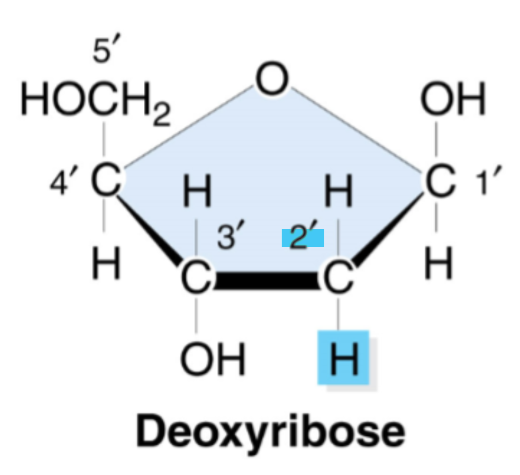
Deoxyribose sugar
Nucleotide are the monomers:
Nucleosides: Sugar + nitrogenous base => Deoxyadenosine // Deoxyadenosine monophosphate
Nitrogenous bases => joined by H-bonding (separated by heating)
Purines: Cyclical ring containing 9 atoms (Adenine and Guanine)
Pyrimidines: Single ring with 6 atoms (Thymine and Cytosine (Uracil, but found only in RNA))]
Twists of DNA are uneven
Major: Allows for proteins to bind to DNA and start transcription
Minor: Exists because of the uneven base pairing
Phosphodiester bonds: 5’ → sugar → Phosphate → Sugar → Phosphate → 3’
Describe and outline the primary, secondary, teritiary and quaternary structure of DNA
Primary: The sequence of nitrogenous bases
Secondary: Double helix formed by 2 identical copies of DNA bound via H-bonding
Tertiary: 3D geometrical structure of DNA
A: Found in low humidity conditions, short and wider than B
B: Found in high humidity conditions, longer and narrower than A
Z: Not fully understood, but research says it plays role in disease (Alzhemier’s)
Quaternary: DNA associated with histone proteins, packaged into chromatin
Compare and contrast DNA and RNA
DNA:
Deoxyribose sugar, where on the 2’C has H instead (more stable doesn’t have O so doesn’t undergo hydrolysis)
DNA bases: A, T, C, G
RNA:
Ribose sugar, where on the 2’C has OH instead of H (more likely to be hydrolysed, split)
Contains: U, A, C, G
Single stranded

Describe the general outline of the mechanism of DNA replication in prokaryotic and eukaryotes
Eukaryotes:
DNA unwinds at the point of origin, where there are many A and T (since only A=T 2 hydrogen bonds, easier to remove), Helicase separates them into a fork model.
Then Primase adds in an RNA primer, which allows DNA polymerase to bind, DNA polymerase catalyses DNA replication by adding nucleotides Triphosphates into the 3’ to 5’ end.
For the lagging strand, DNA ligase joins the short Okazaki fragments.
Checks are then made by replisome, which proof-reads the DNA replication, if there are mistakes then exonuclease removes it, leading the DNA polymerase to go back and add correct base pair.
DNA ligase is used to join together either side of replicated DNA.
Prokaryotes:
Similar overview:
Initiation → Elongation → Termination
Describe what is meant by semi-conservative replication
When DNA strand is separated, and each molecule is copied in parallel, forming two genetically identical DNA strands, each containing one newly synthesised and one old strand
Outline and explain the process occurring at a DNA replication fork

Once separation of strand occurs: Semi-discontinuous replication
Leading strand: Copied as a single continuous piece of DNA, since copied in the 5’ to 3’ end
Lagging strand: Copied in short sections called the Okazaki fragments, since lagging strand is reversely complementary starting at the 3’ end
Describe the main functions of the enzymes involved in the process of DNA replication
Helicase: Separates the 2 DNA strands from the origin
Primase: Synthesises RNA primer so that DNA polymerase can bind
DNA polymerase: Extends an existing molecule of DNA, with RNA molecule primer allows the DNA polymerase to work
DNA Ligase: Sticks together new pieces of DNA (joins the Okazaki fragments)
Topoisomerase: Changes the configuration (shape) of DNA by removing excess supercoiling
Replisome: Proof-reads the DNA strand
Exonuclease: Removes any incorrect nucleotide triphosphatase, where the DNA polymerase takes a step back and adds the correct base pair to continue the chain
What is the function of Telomeres?
The RNA primer added by the primase, it cannot be replaced with DNA, by DNA polymerase, which will shorten the DNA overtime, leading to loss of DNA
To overcome the issue, the ends of DNA contain repeat sequences called telomeres, recognised by telomerase.
Telomerase contains RNA and protein component
The telomerase binds to the overhaning strand of DNA and replaces it with RNA primer => the protein components replaces the RNA primer with a piece of DNA