R11,R12,R14- Steroids in the treatment of asthma and copd 1
 Call Kai
 Learn
 Practice Test
 Spaced Repetition
 Match
 Flashcards
 Knowt Play
1/29

Earn XP
Description and Tags
mechanisms,steroid families ,glucacorticoids
30 Terms
Why are steroids important?
Respiratory Theme
• Biosynthesis
• Adrenocorticoids
• Pharmaceutical derivatives used in respiratory diseases
Endocrinology Theme
• Adrenal diseases
• Sex Hormones
Cardiovascular Theme
• Statins
Note - some molecules aren’t steroids by structure but work the same way
What is the key structure of a steroid?
6,6,6,5 Ring
A modified tail which differs across different types of steroids
What are the ways to discuss the steroid structures?
1. Lettered: A, B, C, D
A is a six membered the ring bearing the oxygen
Numbered
Starts from the A ring, at the top of the skeleton, works its way round, then goes to the side chains last
Side chains are at position 17; they can have alpha or beta positions= chiral
up solid - beta; away dashed- alpha

How does the arrangement of steroid rings affect their structure and function?
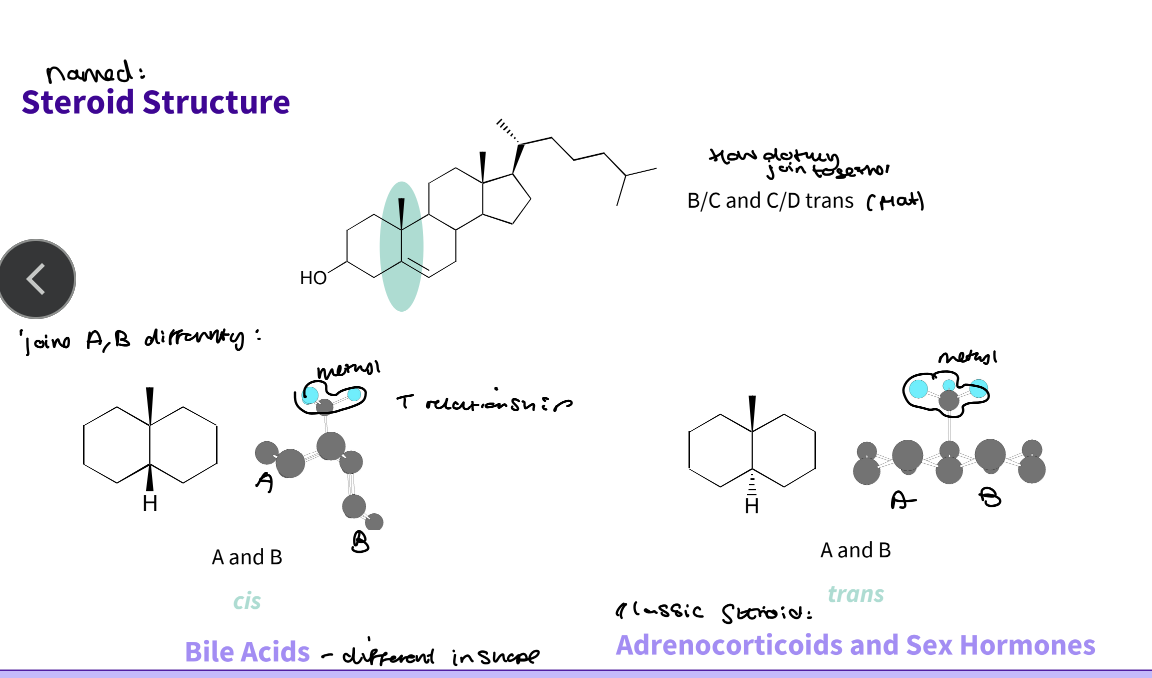
Steroids contain four fused rings (A, B, C and D): three 6-membered rings and one 5-membered ring.
The B/C and C/D ring junctions are trans in the typical steroid structure.
The A/B ring junction can be either cis or trans, affecting the overall 3D shape of the steroid.
Ring arrangement | Structure | Examples |
|---|---|---|
Cis A/B | Rings are bent, giving a less flat structure | Bile acids |
Trans A/B | Rings form a more extended, relatively flat structure | Many adrenocorticoids and sex hormones |
Key point: The cis or trans arrangement changes the steroid's 3D shape, which influences how it interacts with receptors and its biological function.
How are steroids made ?
Multi-step biosynthesis ( the mevalonate pathway) - makes multiple products along the way, more than one way of making the molecules
• Starting material is acetyl coenzyme A
• Step one – synthesis of mevalonate
• Step two – synthesis of isopentenyl pyrophosphate
• Step three – synthesis of squalene
• Step four – cyclisation to lanosterol
• Step five – synthesis of cholesterol
This always goes up in multiples of 5 carbons

Describe the first step - synthesis of mevalonate from acetyl-CoA?
uses 3 molecules of acetyl-CoA
2 part: claisen and aldol reaction which occur at the acetyl-CoA synthase
HMG-CoA reductase removes mevalonate from the enzyme

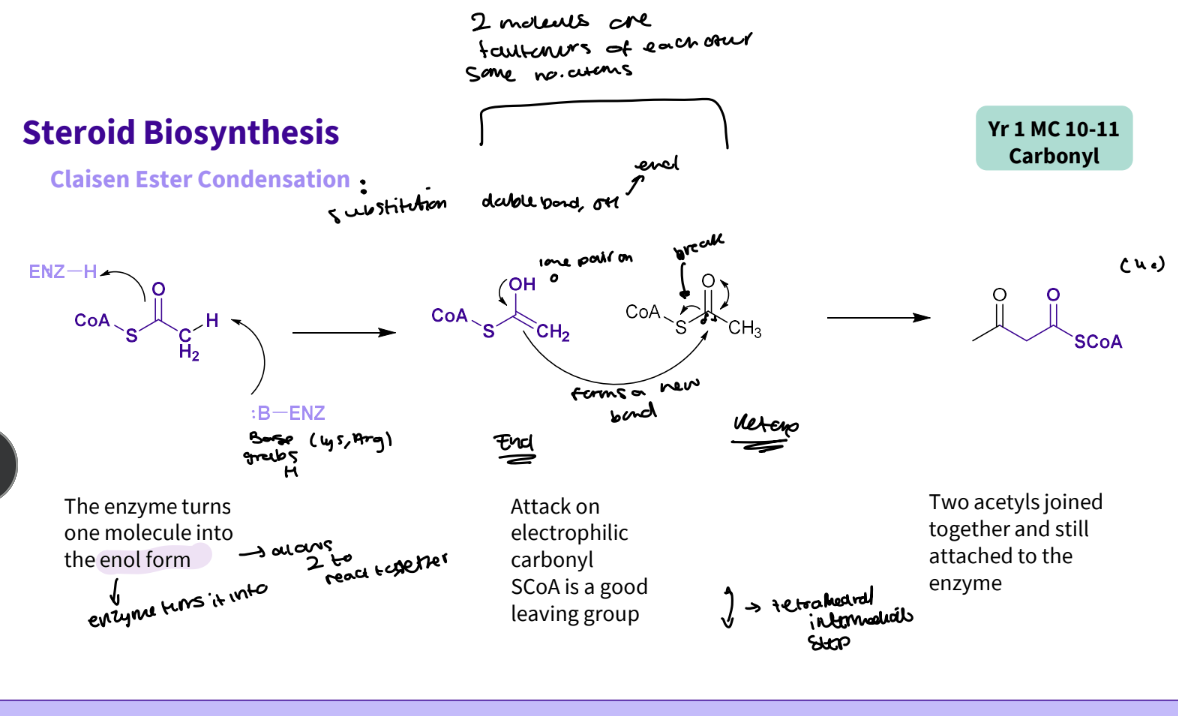
Describe the Claisen ester condensation in steroid biosynthesis?
Enol is formed - enzyme acts as a base and removes a hydrogen from the carbon (CH3) on one of the acetyl-CoA molecules; this makes an enol, which is electron-rich and can attack an electrophile
Nucleophilic attack - the enol attacks teh electrophilic carbon (C=O) of a second acetyl-CoA molecule, making a bond between teh carbons ( tetrahedral intermediate )
Elimination of CoA - the tetrahedral intermediate collapses, reforming the (C=O) bond. The CoA-containing group leaves as CoA-SH because it is a good leaving group. This produces acetoacetyl-CoA, a four-carbon β-keto thioester.
Two acetyls are joined together
Describe the mechanism of the aldol reaction in steroid biosynthesis.
Step 1: Formation of the enol - The third acetyl-CoA molecule is converted into its enol/enolate form by an enzyme. This makes the α-carbon nucleophilic (electron-rich), allowing it to attack an electrophile.
Step 2: Nucleophilic attack (aldol addition)
The enol/enolate attacks the electrophilic carbonyl carbon (C=O) of acetoacetyl-CoA, formed in the previous Claisen condensation reaction.
A new carbon–carbon bond forms, joining the third acetyl-CoA to acetoacetyl-CoA.
The carbonyl oxygen is protonated (gains H⁺), forming an OH group.
This produces a six-carbon intermediate containing three acetyl units.
Step 3: Hydrolysis
One thioester bond is broken by hydrolysis (addition of water).
This releases CoA-SH and forms a carboxylic acid group (COOH).
The final product is HMG-CoA, which contains six carbon atoms

Describe the synthesis of isopentenyl pyrophosphate from mevalonate (step2)
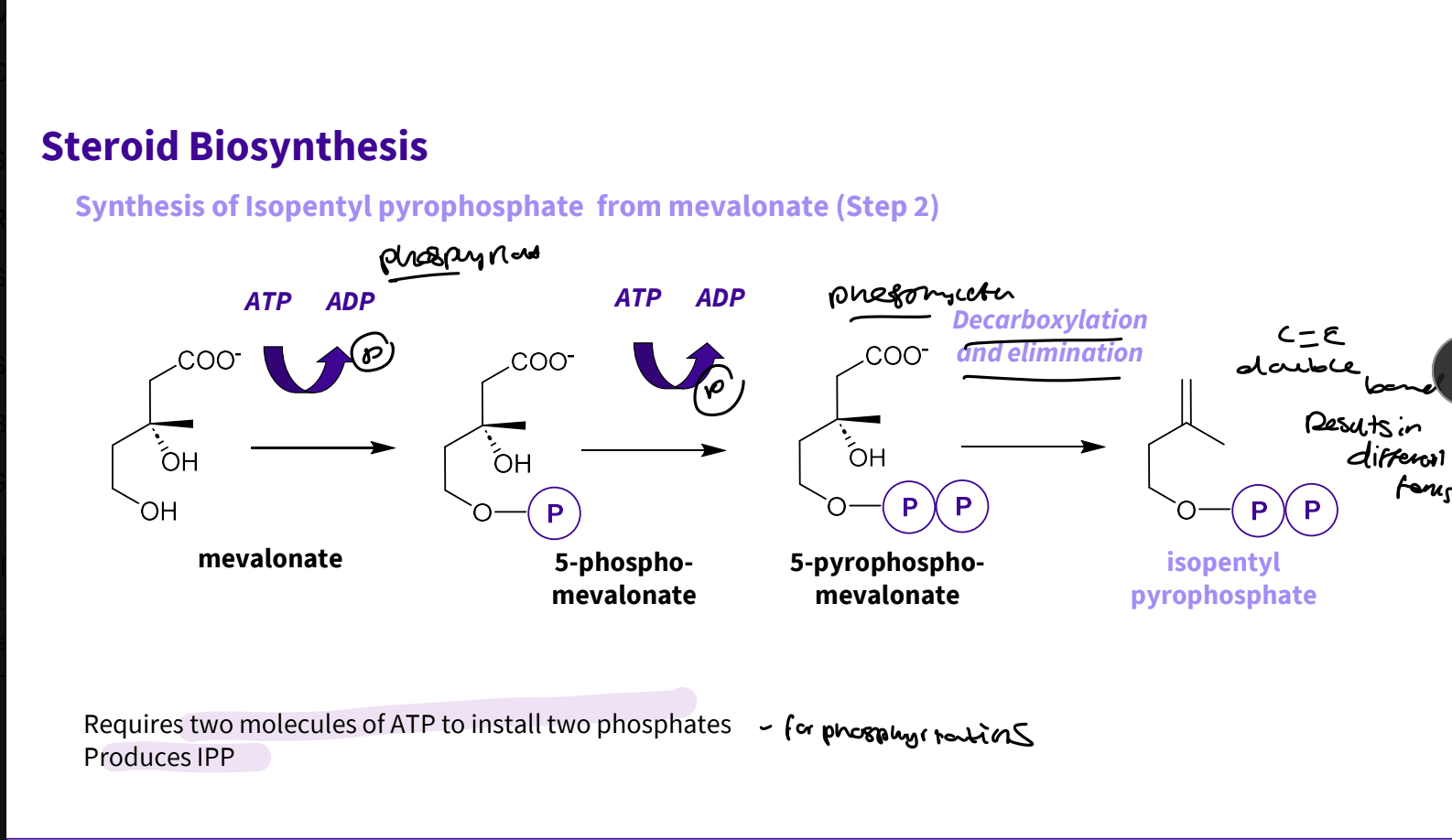
1. First phosphorylation: Mevalonate reacts with ATP, which donates a phosphate group to the hydroxyl group at carbon 5, forming 5-phosphomevalonate. ATP is converted to ADP.
2. Second phosphorylation: Another ATP molecule donates a second phosphate group, forming 5-pyrophosphomevalonate (mevalonate-5-diphosphate). ATP is again converted to ADP.
3. Decarboxylation and elimination: The molecule undergoes ATP-dependent decarboxylation, releasing CO₂, followed by elimination of the hydroxyl group and formation of a C=C double bond. This produces isopentenyl pyrophosphate (IPP), a five-carbon molecule.
Note: this reaction requires two molecules of ATP to install two phophates produces ipp

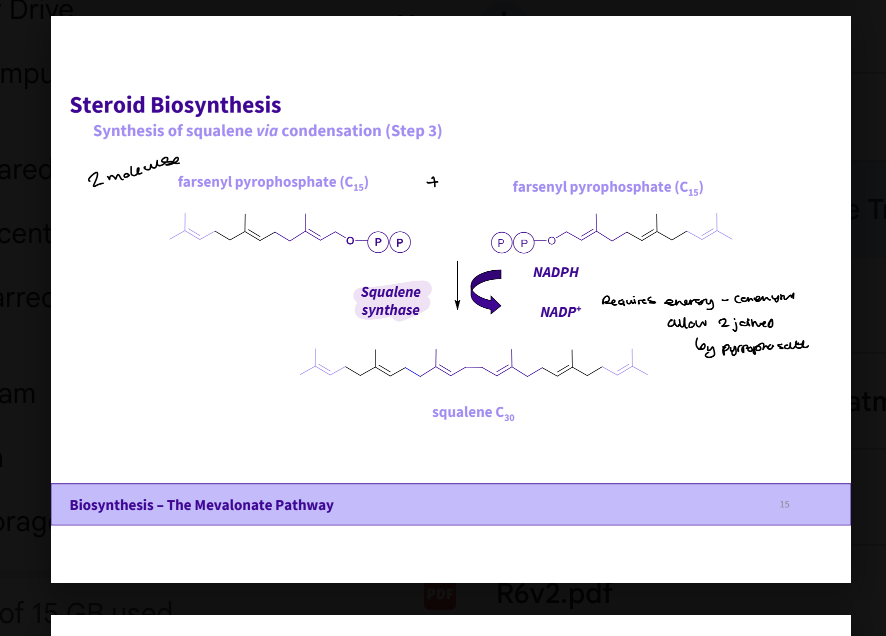
Describe the synthesis of squalene via condensation (step 3) - to make monoterpenes geranyl phosphate
The formation of geranyl pyrophosphate (GPP) involves enzymatic isomerisation, formation of an allylic carbocation, electrophilic addition and elimination.
1. Enzymatic isomerisation: Isopentenyl pyrophosphate (IPP) is converted into dimethylallyl pyrophosphate (DMAPP) by rearranging the position of the C=C double bond. This reaction is reversible equilibrium favoured forwardly
2. Formation of an allylic carbocation: DMAPP loses its pyrophosphate group (PPi), which acts as a leaving group, producing a positively charged allylic carbocation.
3. Resonance stabilisation: The positive charge is delocalised across the allylic system through resonance, making the carbocation more stable.
4. Electrophilic addition: The allylic carbocation acts as an electrophile, while the C=C double bond of another IPP molecule acts as a nucleophile. The double bond attacks the carbocation, forming a new C–C bond and joining the two five-carbon units.
5. Elimination: A proton (H⁺) is removed from the intermediate, allowing a new C=C double bond to form, producing geranyl pyrophosphate (GPP).
Describe the synthesis of farnesyl phosphate - step 3
Part 1: Formation of farnesyl pyrophosphate (FPP)
1. Formation of an allylic carbocation: Geranyl pyrophosphate (GPP, C₁₀) loses its pyrophosphate group (PPi), which acts as a leaving group, forming an allylic carbocation.
2. Resonance stabilisation: The positive charge is delocalised through resonance, stabilising the allylic carbocation.
3. Electrophilic addition: The allylic carbocation acts as an electrophile, while the C=C double bond of isopentenyl pyrophosphate (IPP, C₅) acts as a nucleophile. The double bond attacks the carbocation, forming a new carbon–carbon bond and extending the carbon chain.
4. Elimination: A proton (H⁺) is removed, allowing a new C=C double bond to form, producing farnesyl pyrophosphate (FPP, C₁₅).

Daescribe the final synthesis step of squalene using farsenyl phosphate
Part 2: Formation of squalene
1. Condensation: Two molecules of farnesyl pyrophosphate (C₁₅) combine in a head-to-head condensation reaction catalysed by squalene synthase.
2. Reduction: NADPH provides reducing power, allowing the intermediate to be converted into squalene (C₃₀), with the release of pyrophosphate groups.
3. Final product: Squalene is a 30-carbon molecule that acts as a precursor for cholesterol and other steroids
Describe the cyclisation of squalene to lanosterol and cholesterol (step 4 and 5 )
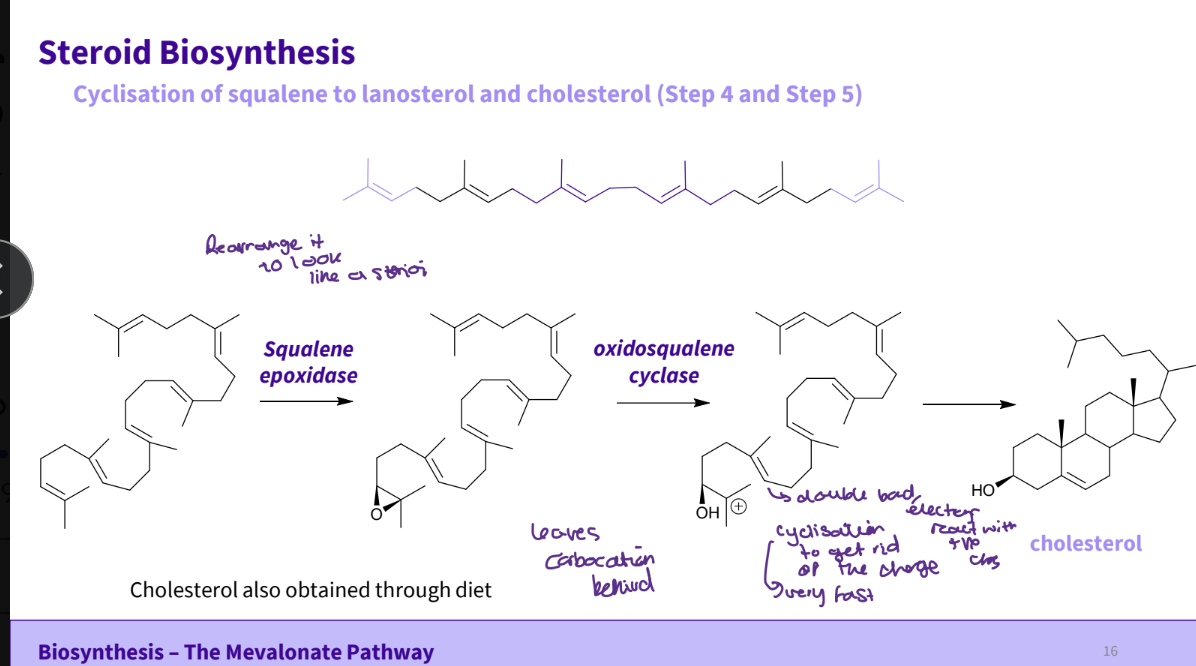
The conversion of squalene into cholesterol involves epoxidation, cyclisation and further structural modifications.
1. Epoxidation: Squalene (C₃₀) is converted into 2,3-oxidosqualene by the enzyme squalene epoxidase, which introduces an epoxide (a three-membered ring containing oxygen).
2. Cyclisation: The enzyme oxidosqualene cyclase converts oxidosqualene into lanosterol by folding the molecule and forming four fused carbon rings, producing the characteristic steroid ring structure.
3. Formation of cholesterol: Lanosterol undergoes further modifications, including removal of three carbon atoms, rearrangement of double bonds and reduction reactions, to produce cholesterol (C₂₇).

what is the steroid families that you can make using cholesterol?

describe the synthesis of pregnenolone from choletsrol ( loss of a side chain)
• Stimulated by adrenocorticotropic hormone (ACTH)
•1st step – multi-hydroxylation by cytochrome P450 monooxygenase - introduces OH groups on the side chain (requires NADPH and O2)
•2nd step – cleavage of the bond between hydroxyl groups by desmolase

Describe the synthesis of progesterone from pregnenolone
•1st step – oxidation of the ring alcohol to a ketone
•2nd step – isomerisation of the double bond it moves form the B ring to the A ring ,common double bond in the 4,5-ring allows extended conjugation and different types of reactions

How are corticoids synthesised ( adrenocorticoids)
In the adrenal cortex
The levels are determined by feedback
2 types:
Glucocorticoids
• Responsible for the synthesis of carbohydrates from proteins
• Involved in the deposition of glycogen in the liver
• Very important in inflammatory processes
useful drug targets
Mineralocorticoids
• Control the electrolyte balance (diuresis)
• Promote retention of sodium and chloride
• Promote loss of potassium
used less

Describe the synthesis of cortisol from progesterone
Step 1 – Hydroxylation at carbon 17 (C17):
Progesterone undergoes hydroxylation at the 17α-position.
An –OH group is added at the α-position (pointing away from us).
This forms 17α-hydroxyprogesterone.
Step 2 – Hydroxylation at carbon 21 (C21):
17α-hydroxyprogesterone undergoes hydroxylation at carbon 21, on the side chain.
An –OH group is added to the side chain.
This forms 11-deoxycortisol.
Step 3 – Hydroxylation at carbon 11 (C11):
11-deoxycortisol undergoes hydroxylation at the 11β-position.
An –OH group is added in the β-position (pointing towards us).
This produces cortisol.
- Enzymes involved: All three hydroxylation reactions are catalysed by cytochrome P450 enzymes, which require NADPH and oxygen (O₂).

What are glucocorticoids uses in ?
Glucocorticoids have a role in
rheumatoid arthritis
skin diseases
respiratory diseases
Cortisol (hydrocortisone) has significant mineralocorticoid activity
Need to minimise mineralocorticoid activity to design effective drugs
what structural components are needed for a glucocorticoid?
C21 pregnane skeleton (2-carbon side chain)
17 beta COCH2OH side chain
11beta hydroxyl
keto at the 3 position (generally)
4-5 double bond
17-alpha hydroxyl (generally)
Generally - still important but some don’t have these characteristics

what is structural components are needed for a mineralocorticoid?
Mineralocorticoids
C21 pregnane skeleton
17 BETA COCH2OH side chain
keto at position 3 (generally)
4-5 double bond

Where do glucocorticoids work /bind at?
Nuclear receptor
N-terminus
Central DNA-binding domain
C-terminal ligand-binding domain
Ligand-binding domain
All steroid receptors have 11α-helices and 4β-strands
Glucocorticoids bind in an area formed from :
-α-helices 3, 4, 5, 6, 7
-β-strands 1 and 2
All key binding interactions are via H-bonding
note - changing any part of steroid ,changes binding cause nearly everything has a n interaction

what is cortisol, and what is it used for?
Highly effective, particularly for skin diseases
But oral use shows mineralocorticoid systemic side effects
note - need to find a way to reduce mineralocorticoid activity

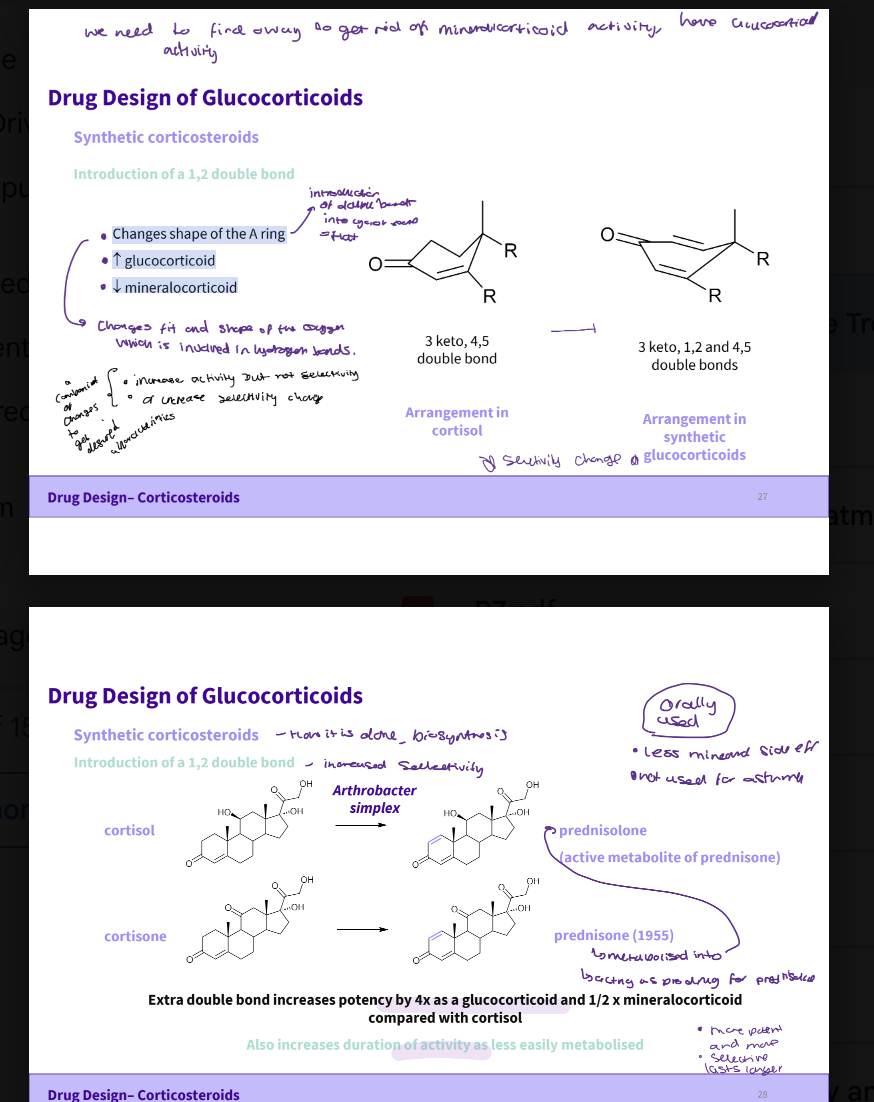
`What changes are made to make synthetic corticosteroids - 1 ?
Introduction of a 1,2 double bond
Changes the shape of the A ring, making it flatter
Increases glucocorticoid
Decreases mineralocorticoid
What changes are made to make synthetic corticosteroids - 2?
Introduction of a 9α-fluoro substituent
increases lipophilicity,stays longer in lung tissue
increases glucocorticoid (10x)
also increases mineralocorticoid (300 - 600x)
Chloro also works
Also reduces metabolism, so increases duration of action

What changes are made to make synthetic corticosteroids - 3 ?
Introduction of a 9α-fluoro substituent and a position 16 substituent:
Substituent can be a or b
Substituent can be Methyl or hydroxyl - chnages ability to bond
increased glucocorticoid (overall)
decreased mineralocorticoid
Believed to reduce ability to bind at mineralocorticoid receptor
Introduced in 1958

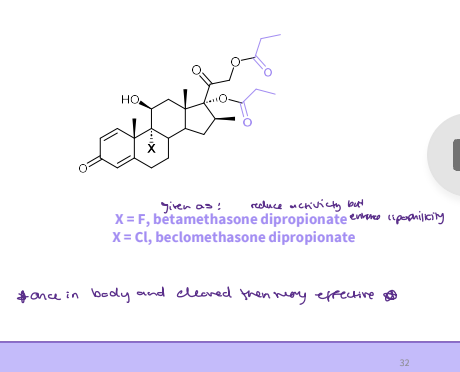
What can you do to improve pharmacokinetics?
Formulation as esters
For inhalation and topical use
Generally the dipropionate
Increases lipophilicity , reduces activity ( once in the body and cleaved it is highly effective )
Easily cleaved in situ
What does introducing a substituent at position 16 affect?
Introduction of a substituent at position 16
Possible to combine the changes to the A ring and a substituent at the 16 position
No halogen
Formulated as an acetal to enhance lipophilicity
Active drug, not a prodrug – 21-OH free

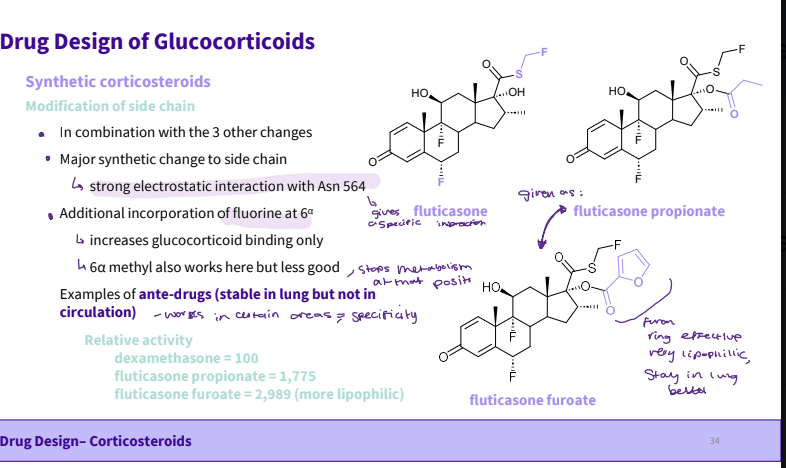
What does modifying the side chain affect?
Modification of side chain
In combination with the 3 other changes
Major synthetic change to side chain - Strong electrostatic interaction with Asn 564
Additional incorporation of fluorine at 6α - increases glucocorticoid binding only ,6α methyl also works here but less good
Examples of ante-drugs (stable in lung but not in. circulation)
drug design sar of glucocorticoids
