phylogeny and a brief history of life
 Call Kai
 Learn
Learn Practice Test
 Spaced Repetition
 Match
Match Flashcards
 Knowt Play
1/14

There's no tags or description
Looks like no tags are added yet.
Name | Mastery | Learn | Test | Matching | Spaced | Call with Kai | Chat |
|---|
No analytics yet
Send a link to your students to track their progress
15 Terms
what do phylogenies represent
evolutionary relationships and (sometimes) the timescale of change
what can phylogenies help distinguish
homologous traits (traits shared due to common ancestry)
from
analogous traits (produced through convergent evolution, which is when unrelated species display independent evolutionary responses to similar selective pressure)
what does interbreeding within a species allow
gene flow
what is a clade
a monophyletic group of organisms that include a single ANCESTOR and all of its DESCENDANTS. that is a single branch on the ‘tree of life’
what is a common ancestor
an ancestral organism, from which 2 or more different lineages descended
on a tree, it is represented by a node where a single lineage splits into a sister group
what is a sister group/taxa
two descendant groups that split from the same exact node representing a common ancestor
they are each other’s closest relatives on the evolutionary tree
what is an outgroup
a distantly related organism that is located outside of the ingroup (group of interest)
branches off near the base of the tree
it provides a baseline for comparing traits to see how the main group evolved
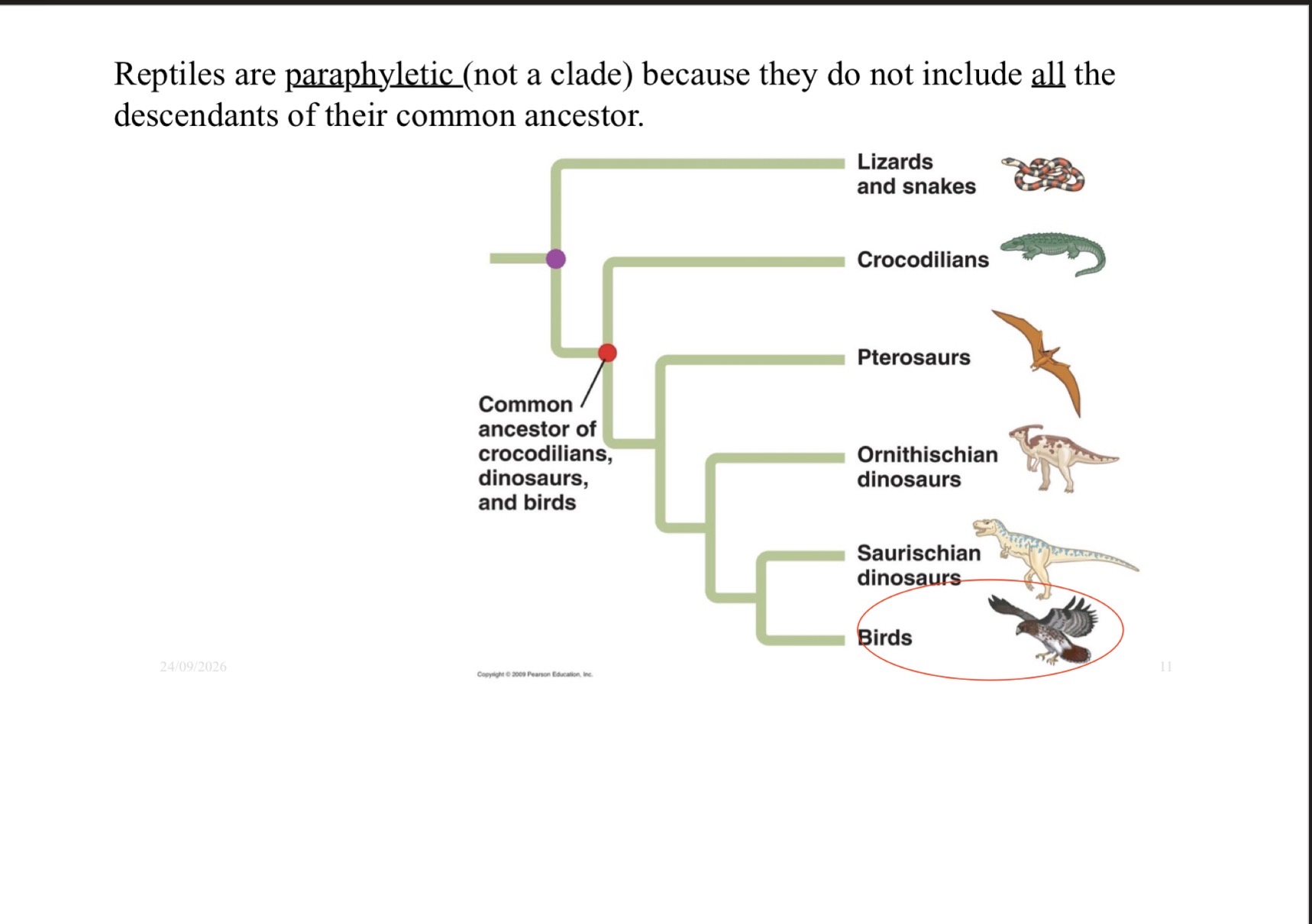
paraphyletic group
a collection of organisms that include a common ancestor, and some but not all of the descendants of that ancestor, often because they evolved very different physical traits/new ways of life
when + how was the earth and moon formed
earth = 5 billion years ago
moon = 4.5 billion years ago when earth collided with another planet
life could not have survived this event, but it was present by 4.3.Ga
what are the 4 aeons and what events occurred during them
Hadean = Earth has formed but too hot for any life to live — heavy bombardment from space, volcanic, co2 atmosphere
Archean = First fossil evidence of life , reduced bombardment from space
Proterozoic = GREAT OXYGENATION EVENT 2300 MYA photosynthesis + cyanobacteria increased oxygen
Phanerozoic = plentiful fossils representing many phyla
Marine sponges, jellyfish, comb jellies existence confirmed
events associates with cambrian period
(540-480 MYa)
rapid emergence of modern animals
events associates with carboniferous period
(360-300 Mya)
large scale emergences of life in land
events associated with cretaceous period
(140-66 Mya)
emergence of flowering plants, ended with a mass-extinction due to asteroid collision
events associated with eocene period
(66-22 Mya)
emergence of mammals as dominant form of large animals on land
events associated with holocene period
(10,000 years ago-present)
from the end of the most recent ice age to present. emergence of human farming and major human impacts