TAE010 - Introduction to Agricultural & Environmental Technologies
 Call Kai
 Learn
 Practice Test
 Spaced Repetition
 Match
 Flashcards
 Knowt Play
1/51

There's no tags or description
Looks like no tags are added yet.
52 Terms
Internet of Things - IoT
Interrelated computing devices, mechanical and digital machines, objects, animals, or people that are provided with unique identifiers (UIDs) and the ability to transfer data over a network without intervention.
Components of IoT Devices
Thing
Sensing
Computational Intelligence (Microcontroller)
Internet Connectivity
Thing
In the context of the Internet of ____s (IoT), is an entity or physical object that has a unique identifier (usually not a computer )
Vehicle to vehicle (V2V)
Share information among adjacent cars (location, speed, and dynamics)
Vehicle to infrastructure (V2I)
network of vehicles and road infrastructures (traffic light, lane markings, toll booths)
Vehicle to pedestrians (V2P)
Through the use of a mobile application (locate nearby taxi)
Vehicle to network (V2N)
Intelligent Transport System (ITM) and weather forecast department can also connect with the network to alert the drivers about change in weather conditions or an accident on the road.
IoT’s Current State
Progress in sensing technology
Availability of high-speed internet access
Advances in microcontrollers
Advances in artificial intelligence
Transistors
Act as switch
Amplify signals
7-10 nanometers in size
Moore’s Law
Number of transistors in a dense integrated circuit (IC) doubles about every two years.
Internet and Wireless Connectivity
Broadband speeds have increased exponentially
Sensor cost 2x down
Bandwidth cost 40x down
Processing cost 60x down
All within a 10-year timeframe
Social Benefits of IoT
Makes life easier
Repetitive tasks done
Economic growth
Job opportunities
Wide range of applications in various domain
Saving more energy with residences/offices
Maximize safety, efficiency, reliability
Increase security
Global interaction and accessing wide range of information
Security Breaches
Ex. Through IoT, hackers use compromised cameras to access people’s homes, harass children and even demand ransoms.
Obsolete by Digital Tech
Physical payment methods
Remote control (controlled by a smart phones)
CD/DVD (online streaming services)
Physical keys
External storage devices (cloud storage)
Paper documents/book
Business cards
Parking meters
Pay phones
Calculators
Remote Sensing
Acquiring information about a certain surface, object, phenomenon, without contact.
Emittance or reflectance involved
Processing, analyzing, applying that information
Passive Sensor
uses & calculates energy from the Sun (e.g., Landsat, Multispectral/Hyperspectral imaging)
Active Sensor
Inputs own energy source to scan/retrieve info. (e.g. Lidar)
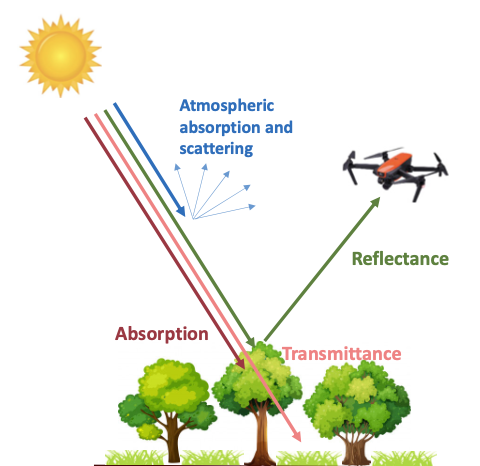
Electromagnetic radiation interaction
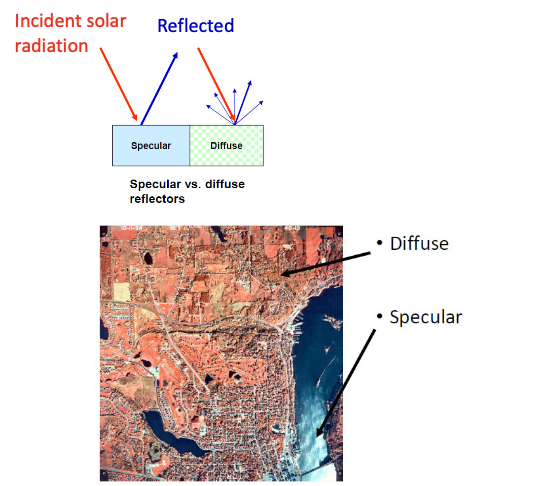
Solar radiation surface interaction
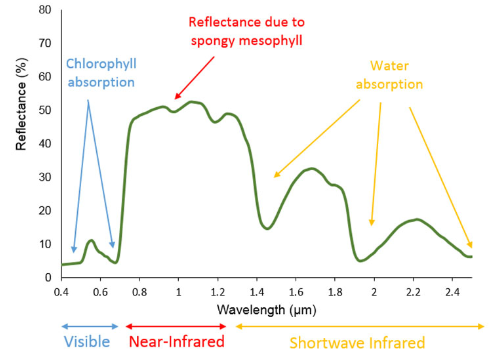
Spectral Signature
Unique spectral response pattern found in every object
Y: Reflectance (%)
X: Wavelength
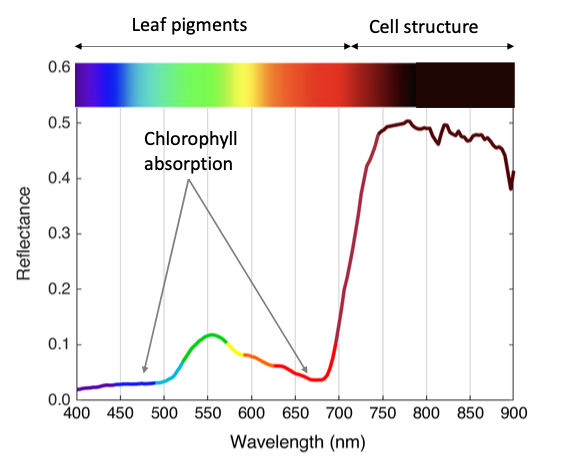
Spectral signature of vegetation
Platforms for Remote Sensing
Ground coverage increases as you go higher in elevation but decreases in spatial resolution
Inverse relationship
Drone
Flying autonomous robot, software-controlled flight plans in their embedded systems, working in conjunction with onboard sensors and GPS.
Examples of Unmanned Aerial Vehicle
Fixed wing
Vertical takeoff & landing
Hybrid
Miscellaneous
Drones: Applications in Environment
Fire trend patrol
Forest administrator rescue
Fire disaster rescue
Drone Applications: Other
Rescue operations
Tree planting
Real estate marketing
Police/law enforcement
Traffic control
Monitoring pipelines
Drones: Agricultural Applications
Crop health assessment
Disease detection
Stress detection
Yield prediction
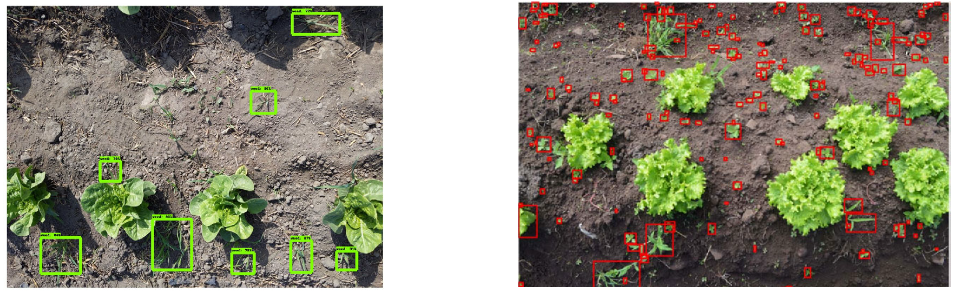
Weed detection
Irrigation management
Soil mapping
Crop scouting
Spraying
Livestock management
Image-based Sensors
RGB Imaging
Multispectral imaging - Micasense (1) and Landsat 8 (2)
Hyperspectral imaging
Thermal imaging
Multispectral Image
Scans several bands (4-10 bands)
Discrete
Consists of broader bands
20nm
Reflectance of:
Blue
Green
Red
Red Edge
Near Infrared
Lower spectral resolution
True Color
Also known as natural color, approximate to what we would see with our naked eyes.
False Color
Highlights different features of land surface like vegetation (enhancing the contrast between object of interest and background)
Hyperspectral Imaging
Integration of imaging and high-resolution (very defined) spectroscopy.
Collects images from (hundreds of bands) across the electromagnetic spectrum, mostly visible and near-infrared regions.
Continuous spectrum for each pixel
Very narrow bands (2nm)
High spectral resolution
Hyperspectral imaging on plant sample
Hyperspectral Image V. Multispectral Image
Former is a gradient of wavelength values, latter is set to RGB, NIR, and Red Edge
Hyperspectral imagery is involved in these fields:
Ag:
Planning, detection, management, phenotyping, yield, identification
Food processing/engineering
Chemical engineering
Pharma
Enviro
Artificial Intelligence
Using computers/machines to solve problems
Making automated decisions for tasks that require human intelligence
Recognizing patterns in observations and data
Making computers learn from previously observed data on their own and predict a future observation
Machine Learning
Subset of AI that explores ways to get computers to improve their performance based on experience.
Deep Learning
Subset of machine learning that involves training neural networks with many layers of units.
Turing Test
Human evaluator engages in natural language/convo with a machine and a human.
“a test of a machine's ability to exhibit intelligent behavior equivalent to, or indistinguishable from, that of a human.”
Factors Behind AI Boom
Big data, performance over data is disproprortionate
Advanced algorithms
Computing, power & storage
AI: Email Spam Detection
Binary classification problem, filtering spam emails
Algorithm trained for pattern recognition
Automated decision ← email content
Variables like several links + earn case = spam
Machine Learning Problem - Example
Real estate → multiple features of a house input into system → find target variable of a house’s price
Training process → model output
Machine Learning Algorithms: 3
Supervised Learning
Unsupervised Learning
Reinforcement Learning
Supervised Learning
Assigning labels to samples (pixels, image objects) → think email & spam binary classification, healthy/stressed leaves & spectral response
Classification
Regression
Unsupervised Learning
Clustering
Dimensionality Reduction
Association
Classification
Classifying samples (data) into groups → plants classified into weed and non-weed classes
Regression
Predicting a continuous quantity (y), based on value of features (x) → Housing price prediction, yield estimations
Clustering
Grouping (1 group = cluster) similar samples of data together → land cover/land use
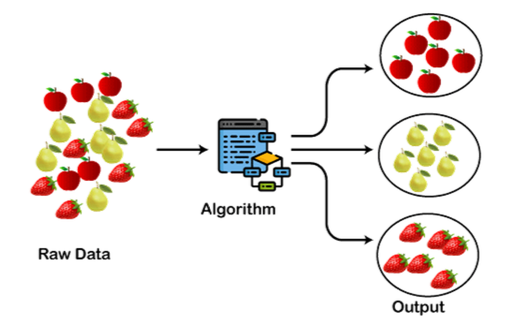
K-means Clustering
K: refers to number of clusters. User defines K before clustering begins.
Selecting K samples randomly as the initial centroids
Assigning other samples to the cluster with closest centroid
Recomputing the centroid of each cluster after assigning
Continue step 2-3 until centroids do not change
Uses Cosine/Euclidean distance 4 calculating similarity features
Assign future samples to cluster with closest centroid
Dimensionality Reduction
Projecting data into a lower dimension → feature extractions in hyperspectral imaging
Association
Discovering patterns and relations between variables → Market basket analysis (data mining technique that analyzes combinations of products bought together)