RTR.4 Diagnostic and Therapeutic Procedures
 Call Kai
 Learn
 Practice Test
 Spaced Repetition
 Match
 Flashcards
 Knowt Play
1/40

There's no tags or description
Looks like no tags are added yet.
41 Terms
Aspirations (Fine Needle Aspiration)
Withdrawing fluid or tissue for diagnostic purposes, but can also provide temporary relief
Fine Needle Aspiration = 25g needle collects tissue sample by breaking up the tissue, for pathologies more solid in nature and with limited fluid, eg. tumors
Biopsies
Core Needle Biopsies: a cylindrical column of tissue is collected
UGI Prep and Procedure
ES&D
NPO night before
Barium and gas pills
Pt positioned LPO → roll 360
SBFT Prep and Procedure
NPO after evening meal
AXR → thin barium, record time → pt is supine
Barium Enema
barium prep, laxatives, NPO
barium and possibly air
Voiding Cystourethrograms Pt Position and Procedure
Male: 30 RPO
Female: AP or slight OBL
Foley catheter to inject contrast, then pts voids after removal of the foley
Retrograde Cystography Procedure
Foley to inject contrast, and pt voids via foley
Percutaneous Nephrolithotomy
Removal of medium-to-large kidney stones in the urinary tract by inserting a scope through the patient's back
Higher success
Effective for larger stones
Extracorporeal Shockwave Lithotripsy
small kidney stone removal
currently used more often than PCNL
lower sucess, and only for small stones <3cm
Cryoblation
Cycle of freezing (Ar) and thawing (He) to destroy cancerous cells
Mircrowave Ablation
High-frequency microwave heat to destroy cancerous cells
Radiofrequency Ablation
Radio wave heat to destroy cancerous cells
CT Enterography Prep and CM
NPO 3hrs prior
IV and oral (1-2L Breeza or PEGlyte)
Colongraphy
Prep
CM
Post-processing
Purpose
colon prep
PEGlyte and CO2
3D remodelling of the colon on a 3D station
for pts who had an unsucessful optical colonscopy
Required contrast enhancement level
250-300 HU
RA Bolus Arrival Time @3-3.5ml/s
6-12s
Pulmonary Artery Bolus Arrival Time @3-3.5ml/s
9-15s
Aortic Arch Bolus Arrival Time @3-3.5ml/s
15-22s
Carotids Bolus Arrival Time @3-3.5ml/s
16-24s
Bolus Triggering/ Monitoring/ Tracking
Scan auto-triggered or manually started once bolus is seen in the ROI
Test Bolus Method
Test bolus used to pre-determine TTP
Produces higher contrast enhancement but additional time and contrast are used, thus used for PE studies
18g Flowrate
4-6mls
20g Flowrate
3-4ml/s
22g Flowrate
1.5-3mls
24g Flowrate
1-2ml/s
Transient Interruption of Contrast (TIC)
Temporary halt of CM flow in the arms, due to large breath holds
Head Perfusion Scan vs. Venogram
Perfusion = assess blood flow and brain tissue damage
Venogram = assess venous structures eg. cerebral veins and venous sinuses
Cardiac CT Pharmaceuticals
nitroglycerin to dilate vessels
betablocker if pt has >60BPM
T score higher than -1
normal
T-score between -1 to -2.5
osteopenia
Less than -2.5
osteoporosis
Double J Stent
Curled ends (which prevent stent migration) reside in the renal pelvis and bladder to allow urinary flow
Generally require changing every 3-6 months

Dynamic Hip Screws

Hip Screw

IM Nail

Cannulated Hip Screws
Vertebroplasty vs. Kyphoplasty
vertebroplasty: to stabilize fracture fragments and further prevent VB collapse
kyphoplasty: the use of a balloon catheter to expand a compressed vertebra
Vertebroplasty/Kyphoplasty Cement Mixture
PMMA (polymethyl-methacrylate) and barium powder
sets after 5mins
Percutaneous Transluminal Angioplasty (PTA)
therapeutic procedure utilizing specialized catheters to dilate a stenotic vessel

IVC Filiters
specialized devices that are placed in a patient’s IVC to trap and prevent blood clots from traveling into the pulmonary arteries
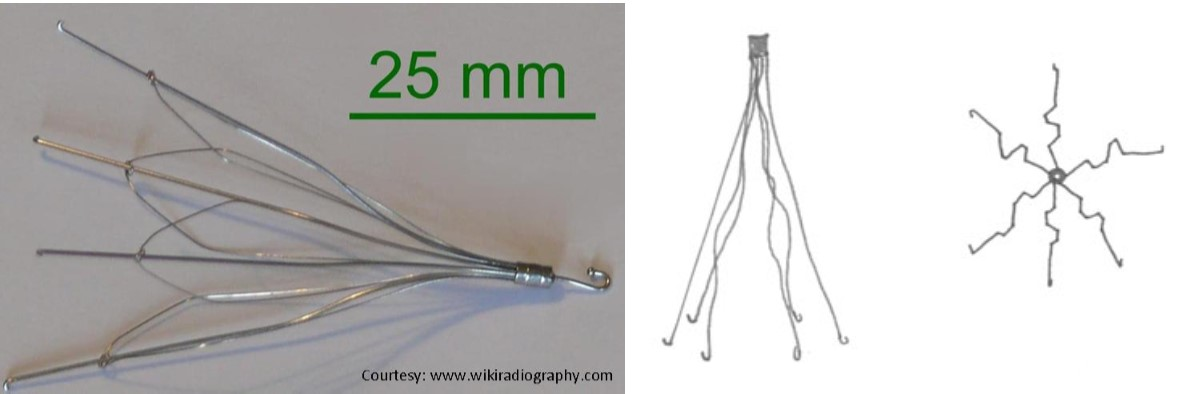
IVC Filter Indications
diagnosed with deep vein thrombosis (DVT) that:
(1) have a contraindication to anticoagulant therapy due to their increased risk of hemorrhaging, or
(2) still have progressive DVT or embolisms despite the use of anticoagulants
that are suffering from multiple trauma injuries