CHEM115 4th exam
 Call Kai
 Learn
 Practice Test
 Spaced Repetition
 Match
 Flashcards
 Knowt Play
1/59

There's no tags or description
Looks like no tags are added yet.
60 Terms
Aufbau Principle
put electrons in lower energy levels first (completely fill)
Electron diagram/Orbital diagram
Diagram with the arrows

Electron Configuration
ex: 1s22s22p6
Electron Configuration Filling Order
1s, 2s, 3s, 3p, 4s, 3d, 4p, 5s, 5p, 6s, 4f, 5d, 6p, 7s, 6d, 7p

Ground state
the lowest energy configuration of an atom
Excited State
any other allowed configuration. Adds energy to promote an electron to a higher energy
Hund’s Rule
lowest energy configuration for an atom’s is the one having the maximum number of unpaired electrons (electrons have to spin the same direction until you start doubling up)
Paramagnetic
having 1 or more unpaired electrons. Will be strongly drawn into the magnetic field (looks like an increase in mass)
Diamagnetic
having no unpaired electrons. Slightly repelled by the magnetic field (will appear to decrease in mass)
Electron Configuration Table
s starts at 1
p starts at 2 (s2)
d starts at 3 (s4)
f starts at 4 (s6)

Periodic Law
when elements are arranged by atomic number, their physical and chemical property vary periodically
3 properties: atomic radius, (size) electron affinity (energy released to gain an electron), ionization energy (energy to remove an electron)
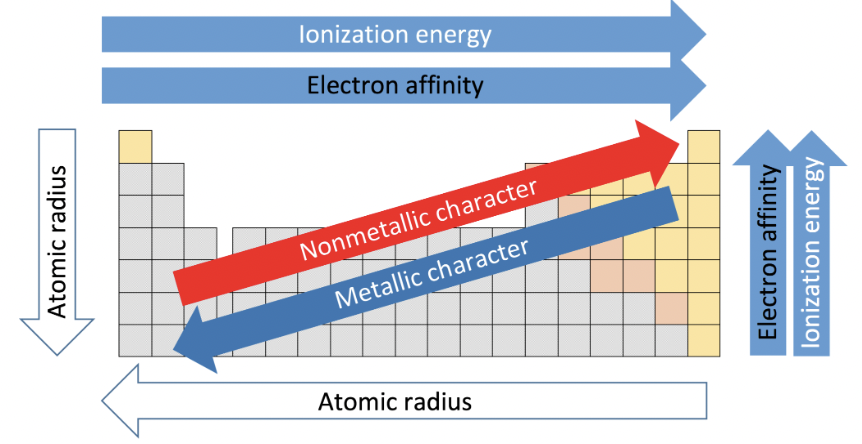
Atomic Radii
-Size, bond length
-Increases as you go left + down
-Effective Nuclear Charge (Zeff)
-Smaller radius — electrons held more tightly
Ionization Energy (IE)
-Energy to remove the outermost electron from the gaseous atom or ion
-Increases as you go up + right
-More energy to remove the second electron
-You can know how many valence electrons are left due to a large jump in ionization energy (ex: if you see a jump from third to forth, you know there is 3 valence electrons
Ions + their properties
Size: going down a column, ions get bigger. Cations smaller anions bigger. in a group of isoelectrion ions, the one with the most protons is the smallest
Electron Affinity: easier to remove electrons as you go up + right
Isoelectric
different species with the same number of electrons
Metallic Character
Low ionization energy tends to be metals while high ionization energy tends to be nonmetals
Most metallic elements are the lower left of the periodic table
Metals- lustrous, malleable, ductile, good conductors of heat
Nonmetals- if not gases, they are generally dull, brittle, poor conductors of heat and electricity.
Metalloids- characteristics of metals and nonmetals (ex: Silicon is shiny but brittle and a poor conductor of heat and electricity)
Electron Affinity
Energy released to gain an electron
Increases as you go up + right
Metallic Character
Low ionization energy tends to be metals while high ionization energy tends to be nonmetals
Most metallic elements are the lower left of the periodic table
Metals- lustrous, malleable, ductile, good conductors of heat
Nonmetals- if not gases, they are generally dull, brittle, poor conductors of heat and electricity.
Metalloids- characteristics of metals and nonmetals (ex: Silicon is shiny but brittle and a poor conductor of heat and electricity)
Ionic
Metal and nonmetal typically
Solids want to form structures with positive and negative ions surrounding each other
Form very ordered crystals that are hard, brittle, and cleave along the plane of atoms
Soluble in water
Coulomb’s Law: E = kQ1Q2/r (k=8.99x10⁹)(e-=1.602x10⁻¹⁹C)
Ex: NaCl → (8.99x10⁹)(-1.602x10⁻¹⁹)(-1.602x10⁻¹⁹)/(2.83x10-10) = 8.15x10⁻¹⁹ J → 491 kJ (idk how right this is tbh)
Electrostatic forces are very strong. Must simultaneously break all the bonds to melt.
Lattice Energy– energy necessary to separate an ionic compound into isolated ions. You can estimate it with coulomb’s law.
Higher ionic charge = strong lattice energy = smaller radius
Ex: Greatest lattice energy?: MgF2, CaF2, ZrO2
CaF2 < MgF2 since Ca has the larger radius, thus lower lattice energy
MgF2 < ZrO2 since ZrO2 has the higher charge
Molecular Bond
atoms with unpaired electrons can lower their energy by sharing electrons
Covalent Bond
chemical bond formed by sharing a pair of electrons
Minimize energy by finding the optimal bond distance
Polar Covalent Bonds– electrons not equally shared, electrons spend more time with one atom than the other (ex: HCl)
Electronegativity (X) – measure of the ability of an atom to draw bonding electrons to itself. Increases as you go up and right
The more electronegative ion with be ઠ- while the less electronegative ion will be ઠ+
Difference in electronegativity is the rough measure of bond polarity
Ex: C–O > C–Br > C–S
Delocalized bonding
a bonding pair of electrons spread over a number of atoms rather than being localized between two atoms
What can exceed the octet rule?
3rd row elements and below ex: SF4
Formal charge
FC = (#e- in free atom) - (# of assigned e- to atoms)
FC = (# of valence e- ) - (# of bonds) - (# of non-bonding e-)
Bond Order
Single – 1 bond order
Double – 2 bond order
Triple – 3 bond order
Bond order increases → bond length decreases, and bond energy increases
VSEPR Theory
Valence Shell Electron Pair Repulsion Model
1) Draw the Lewis structure 2) Put pairs as far apart as possible 3) Determine positions 4) Determine the name of the molecular structure
Steric #
number of atoms something is bonded to + the number of lone pairs
Electric Domain
Number of bonds or lone pairs an atom can have
Electron Geometry
Geometry that tells you where the electrons are regardless of if its a bond or a lone pair
Molecular Geometry
Geometry that describes the positions of the atoms, not the lone pairs
Linear (Electron Geometry)
2 electron domains
sp
180 degrees
Trigonal Planar (Electron Geometry)
3 electron domains
sp2
120 degrees
Tetrahedral (Electron Geometry)
4 electron domains
sp3
109.5 degrees
Trigonal Bipyramid (Electron Geometry)
5 electron domains
sp3d
90,120,180 degrees
Octahedral (Electron Geometry)
6 electron domains
sp3d2
90 degrees
Linear (Molecular Geometry)
2 electron domains
0 bonding pairs
sp
180 degrees
Trigonal Planar (Molecular Geometry)
3 electron domains
0 bonding pairs
sp2
120 degrees
Bent (Molecular Geometry)
3 electron domains
1 bonding pairs
sp2
120 degrees
Tetrahedral (Molecular Geometry)
4 electron domains
0 bonding pairs
sp3
109.5 degrees
Trigonal Pyramid (Molecular Geometry)
4 electron domains
1 bonding pairs
sp3
109.5 degrees
Bent (Molecular Geometry)
4 electron domains
2 bonding pairs
sp3
109.5 degrees
Trigonal Bipyramid (Molecular Geometry)
5 electron domains
0 bonding pairs
sp3d
90, 120, 180 degrees
See-saw (Molecular Geometry)
5 electron domains
1 bonding pairs
sp3d
90, 120, 180 degrees
T-shaped (Molecular Geometry)
5 electron domains
2 bonding pairs
sp3d
90, 120, 180 degrees
Linear (Molecular Geometry)
5 electron domains
3 bonding pairs
sp3d
90, 120, 180 degrees
Octahedral (Molecular Geometry)
6 electron domains
0 bonding pairs
sp3d2
90 degrees
Square Pyramid (Molecular Geometry)
6 electron domains
1 bonding pairs
sp3d2
90 degrees
Square Planar (Molecular Geometry)
6 electron domains
2 bonding pairs
sp3d2
90 degrees
Non polar bonds
Electrons are shared equally
Symmetric
Dipoles cancel out
Doesn’t mix well with water (hydrophobic)
Lower boiling points
ex: N2, Cl2, CO2
Polar bonds
Electrons shared unequally
Asymmetric
Dipoles do not cancel out
Partial charges
Attracted to water (hydrophillic)
ex: H2O, HF, HCl
Valence Bond Theory
theory to explain the electron pair or covalent bond by quantum mechanics
Overlap
Overlap – when a portion of an orbital on one atom and a portion of an orbital on another atom occupy the same region of space
You want to maximize overlap! The overlap of two p orbitals is greatest, and the orbitals are directed end to end; other arrangements result in less overlap.
The greater the orbital overlap, the stronger the bond
Sigma (σ) bonds
made out of s orbitals, have overlap between two atoms
Pi bonds (𝝅)
made by p orbitals, are parallel, giving overlap above and below
Hybrid Orbitals
Obtained by taking combinations of the atomic orbitals of the isolated atoms
The number of hybrid orbitals formed always equals the number of atomic orbitals used
sp3d2
steric # 6
sp3d
steric # 5
sp3
steric number 4
sp2
steric number 3
sp
steric # 2