Kaplan MCAT Organic Chem Chapter 2: Isomers
 Call Kai
 Learn
 Practice Test
 Spaced Repetition
 Match
 Flashcards
 Knowt Play
1/19

There's no tags or description
Looks like no tags are added yet.
20 Terms
What are isomers?
same molecular formula, but different structures, chem and physical properties

What are structural(constitutional) isomers?
least similar of all isomers
only share similar molecular formula, so molecular weights are the same
What are physical properties? chemical properties?
Physical: don’t change the composition of matter like melting point, boiling point, solubility, odor, color and density
Chemical: have to do with the reactivity of the molecule and result in changes in chemical composition
What are stereoisomers?
same chemical formula and also share the same atomic connectivity(structural backbone)
What are conformational isomers?
the same molecule, but interconvert by simple bond rotation
arise from the fact that varying degrees around single bonds can create diff levels of strain
Describe the Newman projection conformations.
Staggered: lowest energy state; groups 60 deg apart
Anti staggered: two largest groups opp sides of each other/180 deg apart; most energetically favorable
Gauche: the two largest groups 60deg apart
eclipsed: 2 methyl groups 120 deg apart and overlap with the H atoms on the adjacent C
totally eclipsed: 2 methyl groups directly overlap with 0deg separation; highest energy state; least energetically favorable
at very low temperatures, conformational interconversions are very slow

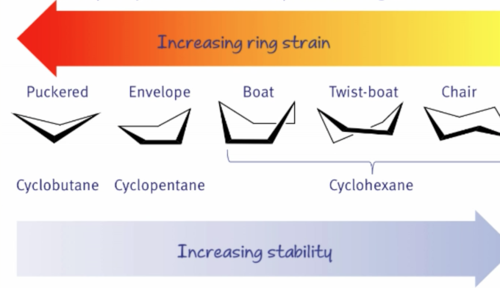
Stability of cycloalkanes depends on ring strain based on 3 factors:
angle strain: bond angles deviate from their ideal values by being stretched or compressed
torsional strain: cyclic molecules must assume conformations that have eclipsed or gauche interactions
nonbonded strain:nonadjacent atoms or groups compete for the same space(dominant source of steric strain)
To alleviate strain, cycloalkanes attempt to adopt various nonplanar conformations. Cyclobutane puckers into a
V shape
cyclopentane adopts an envelope conformation
cyclohexane has chair, boat, and twist-boat forms
most stable for cyclohexane is chair conformation: H atoms perpendicular to the plane of ring are axial(sticking up or down) and those parallel to the plane of the ring are equatorial(sticking out)
if pointing down→dash, if pointing up→wedge
with a chair flip, all axial groups become equatorial and vice versa; all dashes remain dashes and all wedges remain wedges
for substituted rings, the bulkiest group will favor the equatorial position to reduce nonbonded strain
for nomenclature, if both groups are located on the same side of the ring, molecule is cis; if opposite sides→trans
What are configurational isomers?
can only change from one form to another by breaking and reforming covalent bonds
the 2 types are enantiomers and diastereomers; both are considered optical isomers bc the diff spatial arrangement of groups in these molecules affects the rotation of plane-polarized light
enantiomers: nonsuperimposable mirror images of each other that have the same connectivity but opposite configurations at every chiral center in the molecule
diastereomers: chiral and share the same connectivity but are not mirror images of each other; this is bc they differ at some of their multiple chiral centers
What is chirality?
an object is chiral if its mirror image can’t be the same when placed on the original object
chiral center: carbon with 4 diff substituents
Enantiomers have identical physical and chemical properties with 2 notable exceptions:
they rotate plane-polarized light in opposite directions and react differently in chiral environments
at the molecular level, one enantiomer will rotate plane-polarized light to the same magnitude but in the opposite direction of its mirror image→ a compound that rotates the plane of polarized light to the right, or clockwise is dextrorotatory(d-) and labeled (+)
a compound that rotates light toward the left, or counterclockwise is levorotatory and is labeled (-)
direction of rotation determined experimentally
What does it mean if a compound is optically active?
it has the ability to rotate plane-polarized light
ordinary light is unpolarized, which means that it consists of waves vibrating in all possible planes perpendicular to its direction of propagation; a polarizer allows light waves oscillating only in a particular direction to pass through, producing plane-polarized light
the amount of rotation depends on the number of molecules that a light wave encounters; this depends on 2 factors: the conc of the optically active compound and the length of the tube through which the light passes
set standard conditions are 1 g/mL for conc and 1 dm(10cm) for length to compare the optical activities of diff compounds
specific rotation equation is a=aobs/c(l) where a is specific rotation in degrees, aobs is observed rotation in degrees, c is the conc in g/mL and l is the path length in dm
What is a racemic mixture?
when both (+) and (-) enantiomers are present in equal concs, they form this→rotations cancel each other out→no optical activity; ex: a solution containing 2M (R)-2-butanol and 2 M (S)-2-butanol
these solutions will not rotate plane-polarized light
What are diastereomers?
non-mirror image configurational isomers with diff chemical/physical properties; also rotate plane-polarized light
occur when a molecule has 2 or more stereogenic centers and differs at some, but not all of these centers
for any molecule with n chiral centers, there are 2^n possible stereoisomers
an example of diastereomers include E and Z of the same molecule since those are cis-trans isomers

What are cis-trans isomers(geometric isomers)?
specific subtype of diastereomers in which substituents differ in their position around an immovable bond, such as a double bond, or around a ring structure, such as a cycloalkane in which the rotation of bonds is restricted
in simple compounds with only 1 substituent on either side of the immovable bond, we use cis and trans; if 2 on same side→cis; if opp→trans
What are meso compounds?
for a molecule to have optical activity, it must not only have chiral centers within it, but also lack a plane of symmetry
meso compound: compound with chiral centers and internal plane of symmetry
a meso compound, with an internal plane of symmetry, will also be optically inactive bc the two sides of the molecule cancel each other out
meso compounds are made up of 2 halves that are mirror images; as a whole, they are not optically active
D- and L- tartaric acid are both optically active, but meso version has a plane of symmetry and is not optically active→this means that even though meso-tartaric acid has 2 chiral C atoms, the molecule does not display optical activity

What is relative and absolute configurations of a chiral molecule?
configuration of a stereoisomer refers to the spatial arrangement of the atoms or groups in the molecule
relative: its configuration in relation to another chiral molecule(often through chemical interconversion); this is used to determine whether molecules are enantiomers, diastereomers, or the same molecule
absolute: describes the exact spatial arrangement of these atoms or groups, independent of other molecules
relative configuration is retained if the bonds of the stereocenter are not broken→position of groups around the chiral carbon are maintained
absolute configuration is retained if both reactant and products are same E/Z nomenclature
Describe E and Z forms.
used for compounds with polysubstituted double bonds
to do this, look for the highest priority substituent attached to each double bonded carbon
priority is assigned based on the atom bonded to the double bonded carbons: the higher the atomic number, the higher the priority
if the atomic numbers are equal, priority is determined by the next atoms outward
the alkene is named Z if the two highest priority subs on each carbon are on the same side of the double bond and E if they are on opp sides

How do you determine R or S for a molecule?
used for chiral centers in molecules
1. assign priority to the 4 substituents, looking only at the atoms directly attached to the chiral center; if atomic numbers are equal, priority determined by the combo of the atoms attached to these atoms; if there is a double bond, it is counted as 2 individual bonds to that atom; if there is a tie→ work outward until broken
2. any time two groups are switched on a chiral carbon, the stereochemistry is inverted; if we do this step, we must switch our final answer
3. draw a circle from 1 to 2 to 3; if circle is drawn counterclockwise, asymmetric atom →S; if clockwise→R
4. name written out: (R) and (S) put in parentheses and sep from the rest of the name by a hyphen; if a compound has more than 1 chiral center, location specified by a number preceding the R or S within the parentheses and without a hyphen

Describe Fischer projections
horizontal lines indicate bonds that project out from the plane of the page(wedges) and vertical lines are bonds going into the plane of the page(dashes)
point of intersection of the lines represents a carbon atom
make sure lowest priority group projects into the page; lowest priority group can be on the top or bottom of the molecule and still project into the page
switching one pair of subs in a fischer inverts the stereochem of the chiral center; switching two pairs retains the stereochem
rotating a fischer 90 deg inverts the stereochem of the chiral center; rotating 180 deg retains the stereochem