Is Sociology a Science?
0.0(0)
Studied by 1 person Note
 Call Kai
 Learn
 Practice Test
 Spaced Repetition
 Match
 Flashcards
 Knowt Play
Card Sorting
1/4

There's no tags or description
Looks like no tags are added yet.
5 Terms
1
New cards
Sociology __is__ a Science - Objectivity and Evidence
**Comte**:
* It is possible to establish ==**objective facts**== through scientific research methods and the thorough ==**collection and analysis of empirical evidence**==
* A good sociologist identifies a social problem or question. Following research, they formulate a ==**hypothesis.**==
* They use rigorous, reliable research methods that produce sound ==**quantitative data**== which can be analysed
2
New cards
Sociology __is__ a Science - Study of Suicide
**Durkheim:**
* Conducted his famous study of suicide in part to establish how the ==**science of sociology**== could explain all human behaviour, even that which most would consider fundamentally individual and “antisocial”.
* He tested his ==**hypothesis**== against a range of “variables” (e.g. religious belief)
* While **Durkheim’s** study has been extensively criticised, he did reach ==**conclusions**== that supported his hypothesis and published them in a highly influential and much read essay.
**Evaluation:**
* Ideas of social cohesion and social control were hard to ==**operationalise**== as a result of the quantitative/positivist data
* **Popper:** Positvist data uses ==**inductive reasoning**== instead of deductive reasoning.
* Instead of trying to ==**falsify (falsification)**== research, they try to find data that supports their hypothesis.
* Researchers should aim to prove their hypothesis wrong, as you can use research to manipulate conclusions.
3
New cards
Sociology __is__ __**NOT**__ a Science - Falsification
**Popper:**
* Positvist data generally fails to be scientific as it uses ==**inductive reasoning**== rather than deductive reasoning.
* In other words, instead of subjecting their hypothesis to ==**falsification,**== trying to find evidence to disprove it, they do the opposite: they try to find evidence that supports their hypothesis.
* If you had a hypothesis that ==**"all swans are white"**==, you would find more and more supporting evidence with every white swan you found. But the critical evidence is the black swan that proves your hypothesis incorrect.
* **Popper** calls this ==**falsification**.==
* Instead of searching for supportive evidence, the researcher should try and prove that their hypothesis is untrue. If they are unable to do so, it remains the best explanation.
4
New cards
Sociology __is__ __**NOT**__ a Science - Interpretavism
\
**Interpretivists** argue that the study of human society must go beyond ==**empirical**== and supposedly ==**objective evidence**== to include **subjective** views, opinions, emotions, values: the things that can't be directly observed and counted. These are phenomena that ==**require interpretation**.==
* Humans are not like chemicals or elements, about which laws can be established and proved. Each human is unique and has the agency to make his or her own decisions.
* Individuals are ==**'architects of society'**== - human behaviour is truly unpredictable and forever-changing.
5
New cards
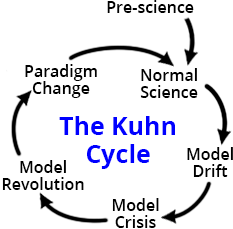
Sociology __COULD__ be a Science - Cycle
**Kuhn:**
A ==**paradigm**== is a particular and accepted set of thoughts and assumptions about the way things are and the way research should be done.
**Kuhn** argues that the way most people see science is not quite accurate. It is not purely objective: at a particular point in time scientific research is done within a ==**particular paradigm.**==
* There will be ==**‘radical science’**== that challenges those assumptions, and so possibility arises for a paradigm shift; with that the radical science may become the new mainstream – ==**the radical becomes the norm.**==
* **Kuhn** argues that sociology is not a ==**mature, mainstream science**== because it hasn’t found a ==**unifying paradigm**== (yet).
* i.e. Debate between functionalism, Marxism, feminism.
* He concludes that sociology is a ==**‘young science’**== but that it could, in the future, coalesce around one paradigm and become a science.