Chapter 18: Demand side polices
 Call Kai
 Learn
 Practice Test
 Spaced Repetition
 Match
 Flashcards
 Knowt Play
1/14

There's no tags or description
Looks like no tags are added yet.
15 Terms
What is fiscal policy?
Fiscal policy is the use of government spending, taxation, and borrowing to influence a country's economy, manage aggregate demand.
What are the aims of fiscal policy?
maintenance of a low and stable rate of inflation
low unemployment rate
stable economic environment for long term growth
reduce fluctuations in the business cycle
balance between export revenue and import expenditure
What is expansionary fiscal policy?
Form of Keynesian demand management.
govs can lower income taxes to increase disposable income and encourage consumption
if gov want to increase investment, it can lower corporate taxes so that firms have higher after tax profit
givs can have major investment projects themselves, public works
Expansionary fiscal policy involves a trade off between higher inflation and lower unemployment

Examples of fiscal policy (RWE)
It is effective in the long run, especially during recessions.
Great depression 1930s, countries that adopted expansionary fiscal policy cam through faster.
Same with world recession in 2008
Constraints of fiscal policy
Time lags - taxes cant be changed quick, and when changed will take time for AD to shift. Economy may have already began to recover.
Political pressure - gov spending and taxation are more political then economical. eg deflationary fiscal policy may be needed but political parties might not in fear in losing votes due to higher taxes
Sustainable debt - govs may have to run budget deficits in order to fund expansionary fiscal policies and over time may accumulate to an unmanageable amount
Effect on net exports - expansionary fiscal policy may see a rise in interest rates, making exports less attractive and imports more attractive, may lead to a fall in (X-M) which will work against desired outcome of expansion.
Crowding out effect - if govs increase borrowing, they monopolise funds available for firms to invest so will fall. AD wont shift as much, since the increase in gov spending (G) will partially or completely offset by a fall in investment (I).
What is the mlutiplier effect?
Government spending to close a deflationary gap increases aggregate demand by more than the initial spending, as any increase in AD leads to a proportionately larger increase in national income due to the multiplier effect.
The multiplier effect
- Injections: Government spending and business investment add income to the circular flow. This creates a multiplied effect as people receive income and spend a proportion of it, creating income for others.
- Withdrawals: Income leaves the circular flow through taxation, savings and spending on imports. The remaining income is spent on domestically produced goods and services, becoming income for others and generating further rounds of spending.
- Marginal propensity to consume (MPC): The proportion of additional income spent on domestic goods and services. For example, if 60% is spent domestically, MPC = 0.6.
- Example of the multiplier: If the government spends $100 million on a school, workers and suppliers receive this income. If 40% is withdrawn through taxes, savings and imports, the remaining $60 million is spent domestically. This process repeats, eventually increasing national income by $250 million, which is 2.5 times the original injection.
Multiplier formulas
k= 1/1-mpc
k= 1/mpw
k= 1/ mps+mpm+mrt
Where:
MPW = marginal propensity to withdraw
MPS = marginal propensity to save
MRT = marginal rate of taxation
MPM = marginal propensity to import
Factors affecting the multiplier
Higher taxation or a higher propensity to save/import increases withdrawals and reduces the multiplier.
Lower taxation or a lower propensity to save/import reduces withdrawals and increases the multiplier.
Government fiscal policy
To close a deflationary gap, the government must estimate the gap between equilibrium output and full-employment output, as well as the multiplier, to calculate the required injection. Inaccurate estimates of either value can limit the effectiveness of fiscal policy.
What is monetary policy?
set of official policies governing the supply of money and interest rates.
What are the aims of monetary policy?
maintenance of a low and stable rate of inflation
low unemployment rate
stable economic environment for long term economic growth
reduce fluctuations in the business cycle
achieve a balance between import expenditure and export revenue
What is expansionary monetary policy?
Changes in base interest rate can influence AD
A reduction is the base rate will decrease the cost of borrowing and make consumption more attractive.
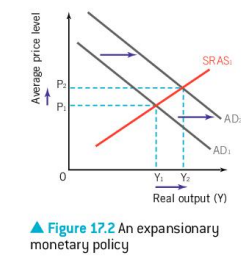
The effects of an expansionary monetary policy can be seen in Figure 17.2. If the government follows a successful expansionary monetary policy, then there will be a shift of aggregate demand from AD, to AD. This will have a number of economic outcomes. There will be inflationary pressure as the average price level rises from P₁ to P₂. However, there will be an increase in real output, from Y, to Y, which will mean an increase in national income, an increase in economic growth, and very probably, a decrease in unemployment.
What are the strengths of monetary policy?
relatively quick to put into place (set by the central bank so can be changed quick)
there is no political intervention (bank controls it so does not need to go through a political system to be changed)
absence of crowding out
ability to make small changes (interest rates may be adjusted by as little as a quarter of a percent)
Limitation of monetary policy
time lags (although they are quick to change monetary policy still takes time to come into affect)
ineffectiveness when interest rates are low (eventually interest rates will hit 0)
low consumer and business confidence (even if interest rates are low, the effect on expenditure may not be as much if confidence is low)
Credit creation
Credit creation is the process by which commercial banks create money by lending to individuals and businesses, increasing the money supply.
Banks lend a multiple of their deposits rather than simply lending out the original deposits. This is known as the money (credit) multiplier.
The minimum reserve requirement is the percentage of deposits banks must legally hold in reserve to meet customers’ cash withdrawals.
Example: If a customer deposits $100,000 and the reserve requirement is 20%, the bank must hold $20,000 in reserve. It can use the remaining $80,000 to support lending.
When a bank issues a loan, it credits the borrower's account, creating new deposit money. As loans and deposits circulate through the banking system, further lending creates more money.
With a 20% reserve requirement, the original $100,000 deposit can support total deposits of $500,000, giving a money multiplier of 5.
Formula:
money multiplier = 1 / minimum reserve requirement
What are tools available to the government to control money supply (pg 261)
minimum reserve requirements (Minimum reserve requirement: The percentage of deposits commercial banks must legally hold in reserve. A higher reserve requirement leads to a lower money multiplier.
- Contractionary monetary policy: Increasing the minimum reserve requirement reduces banks’ ability to create credit, decreasing the money supply. This raises interest rates, reducing consumption and investment and therefore lowering AD.
- Expansionary monetary policy: Reducing the minimum reserve requirement increases banks’ ability to create credit, increasing the money supply. This lowers interest rates, encouraging consumption and investment and therefore increasing AD.)
open market operation (buying and selling of securities, expansionary MP bank will buy back their securities increasing supply of money they have to lend]
changes in the central bank minimum lending rate (raise the minimum lending rate. When this happens, commercial banks and other financial institutions, such as building societies, will increase their lending rates and also their interest rates paid to people who save. This will be likely to discourage consumers and businesses from borrowing money and will also encourage consumers to save more. This will reduce consumption and investment and so reduce AD.)
quantitative easing
What determines the equilibrium nominal rate of interest?
Money market and interest rates
Interest rates are the opportunity cost of holding or spending money, as money could instead be saved or invested.
Nominal interest rate: Interest rate before adjusting for inflation.
Real interest rate: Interest rate adjusted for inflation.
Demand for money
High nominal interest rates increase the opportunity cost of holding money, so demand for money falls.
Low nominal interest rates reduce the opportunity cost, so demand for money rises.
Therefore, the demand curve for money slopes downwards.
Supply of money
The central bank controls the money supply through monetary policy.
It is usually shown as perfectly inelastic because it does not change in response to the nominal interest rate.
Equilibrium interest rate
- Determined where the demand for money equals the supply of money.
Monetary policy
Contractionary: Money supply falls → nominal interest rate rises.
Expansionary: Money supply rises → nominal interest rate falls.

Real vs Nominal interest rate
Real interest rate = Nominal rate — Inflation rate
- Example: Nominal rate = 5%, inflation = 3% → real rate = 2%.
Savers gain only 2% in real terms.
Borrowers repay at a real interest rate of 2%.
- Negative real interest rates: Occur when inflation exceeds the nominal interest rate.
Example: 2% nominal rate − 4% inflation = −2% real rate.
Savers lose 2% of their savings' purchasing power per year.
Borrowers repay less in real terms than they borrowed.
This discourages saving and encourages borrowing.