Ciliates and Flagellates
 Call Kai
 Learn
Learn Practice Test
 Spaced Repetition
 Match
Match Flashcards
 Knowt Play
1/43

There's no tags or description
Looks like no tags are added yet.
Name | Mastery | Learn | Test | Matching | Spaced | Call with Kai | Chat |
|---|
No analytics yet
Send a link to your students to track their progress
44 Terms
Only ciliate that needs to be memorized for this test is ___ ___.
Balantidium coli
Balantidium coli is transmitted by ingestion of an infective ___ through the ___ route.
Found mainly in ___ and ___ regions, especially in ___-farming areas.
cyst; fecal-oral; tropical; subtropical; pig
The natural host of Balantidium coli is mainly ___. The accidental hosts are ___.
pigs; humans
Both the cyst and trophozoite of Balantidium coli contain ___ nuclei.
macronucleus - ___ bean shaped
micronucleus - small, round and lives within the curvature of the ___
2; kidney; macronucleus
The micronucleus of Balantidium coli is ___ visible on stained slides.
rarely
The trophozoite of Balantidium coli has a slightly ___ anterior end containing a cilia-lined ___. It’s cytoplasm contains ___ vacuoles.
Motility is achieved via ___, gliding movement.
pointed; cytosome; food; cilia
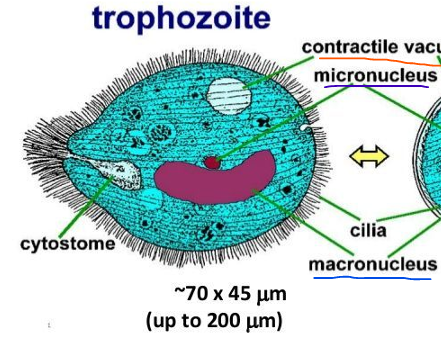
The cyst of Balantidium coli is not very ___ visually, would have to match context clues such as ___ exposure, ciliated troph to presumptively ID it.
unique; pig

Balantidium coli primarily lives in the ___ intestine and may cause ___ lesions.
large; ulcerative
Balantidium coli infection may be ___ or cause self-limiting diarrhea with nausea, vomiting, and abdominal tenderness.
More severe B. coli infection is more likely in ___ patients and may cause abdominal pain, dysentery, persistent diarrhea, weight loss, and nausea/vomiting.
asymptomatic; immunocompromised
Untreated B. coli infection can lead to bowel ___ (hole in the wall of the gastrointestinal (GI) tract - allows stool to leak out into abdominal cavity, risk of ___ bacterial infection).
perforation; secondary

What is the name of this organism?
Balantidium coli

The main ___ flagellates to know are Giardia duodenalis, Dientamoeba fragilis, and Trichomonas vaginalis.
pathogenic
Giardia duodenalis was formerly called Giardia ___ and lives in the ___ (first part of small intestine).
lamblia; duodenum
Trichomonas vaginalis is a ___ flagellate rather than an intestinal flagellate.
urogenital
The main ___ flagellates are Chilomastix mesnili and Trichomonas hominis.
nonpathogenic
___ flagellates have 2 life-cycle stages: cyst and troph.
Name the exceptions that LACK a cyst stage:
___ ___
Trichomonas ___
Trichomonas ___
most; Dientamoeba fragilis; vaginalis; hominis
In flagellates that lack a cyst stage, the infective form is the ___.
trophozoite

Giardia duodenalis is a ___ that is ___ (non or patho).
Infective form: ___ via ___ route.
Body site where infection occurs: ___ (duodenum)
Cysts:
up to ___ nuclei
appearance on trichrome often ___ due to ___ flagella and other internal structures
flagellate; pathogenic; cyst; fecal-oral
intestines; 4; cluttered; retracted

Giardia duodenalis Trophs:
pear, teardrop shaped, bilaterally symmetric
“___ ___” appearance due to bi___ (2 oval nuclei)
“falling ___” motility
___ pairs of flagella
ventral ___ disk
old man; nucleate; leaf; 4; sucking

Dientamoeba fragilis is a ___ that is ___ (non or patho).
Infective form: ___ (transmission unclear)
Body site where infection occurs: ___
Cysts: LACKS cyst form!
Trophs:
tiny
most are __nucleate (“Di”-entamoeba)
karyosome consists of 4 to 8 discrete ___ (nucleus is fragmented)
outline indistinct and ___ into background (cuz its tiny)
flagellate; pathogenic; trophozoite
intestines; bi; granules; blends

Trichomonas vaginalis is a ___ that is ___ (non or patho).
Infective form: ___ passed person-to-person as a ___
Body site where infection occurs: ___ tract
Cysts: LACKS cyst form!
Trophs:
___ anterior (front) flagella
Undulating membrane - extends ___ the length of body
___ motility
flagellate; pathogenic; trophozoite; STI
urogenital; 4; half; jerky

Chilomastix mesnili is a ___ that is ___ (non or patho).
Infective form: ___ via ___ route
Cysts:
___ shaped w/ anterior ___
Small central ___ in nucleus that is ___ by fibrils that curl around the cytosome (shepherd’s ___ appearance)
On Trichrome: nucleus, cytosome, and curved fibrils are visible
Trophs:
cytosome and nucleus are prominent in ___ of organism
flagellate; nonpathogenic; cyst; fecal-oral
lemon; knob; karyosome; surrounded; crook; anterior
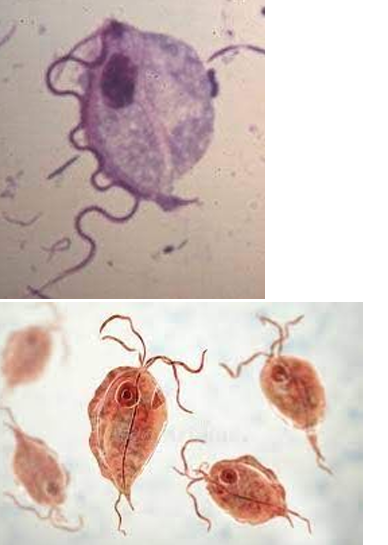
(Penta)trichomonas hominis is a ___ that is ___ (non or patho).
Infective form: ___ associated with ___ contamination
Body site where infection occurs: nonpathogenic, but may colonize the ___ intestine
Cysts: LACKS cyst form!
Trophs:
___ anterior flagella
Undulating membrane - extends the ___ of organism
flagellate; nonpathogenic; trophozoite; fecal
large; 4; length
Giardia (lamblia) duodenalis process of infection
begins with ingestion of infective ___ by the ___ route.
host’s stomach acid initiates ___, and cyst then moves to the ___ (first part of small intestine).
senses the pH ___ from stomach to intestine
in response, attaches to ___ of small intestine in duodenum via ventral ___ disk
carbs and bile in area stimulate ___ growth
cysts; fecal-oral
excystation; duodenum
shift
lining; sucking
trophozoite
Giardia (lamblia) duodenalis
Risk factors:
fecal-oral, drinking ___ water where ___ live (one of the major animal reservoirs)
travel to ___ areas (especially those w/ poor ___)
children in ___ centers (person-to-person spread)
untreated; beavers; endemic; sanitation; daycare
Giardia (lamblia) duodenalis cyst viability:
very ___! can survive several months in cold water.
somewhat resistant to ___ and ___
susceptible to desiccation (drying) and ___ (~50C)
resistant; bleach; iodine; heat
Giardia (lamblia) duodenalis is the ___ commonly reported intestinal protozoan infection in US.
It requires a LOW infectious dose of ___ cysts (takes very little contamination to lead to an outbreak)
The causative agent of ____ and “___’s” diarrhea (aka “backpacker’s diarrhea” or “beaver fever”).
most; 10; gastroenteritis; traveler
Acute infection with Giardia (lamblia) duodenalis is mostly self-___.
Incubation period: 12-___ days
Symptoms:
can cause ___ (general feeling of discomfort), cramps, nausea, and abdominal tenderness
___, foul-smelling, non-blood diarrhea (1-4 weeks)
limiting; 14; malaise; explosive
Chronic infection with Giardia (lamblia) duodenalis causes persistent ___-like syndrome (fats and vitamin B12).
Can cause upwards ___% of weight loss, fatigue, anorexia, steatorrhea (oily-lipid rich stool), and large amounts of gas (since carbs and lipids are not properly absorbed – bacteria feast and break them down, producing gas).
malabsorption; 20

Giardia (lamblia) duodenalis organisms vary in ___ throughout the stool.
Concentration methods and trichrome may be ___ for detection!
Stool ___ may be more reliable, including:
___ immunoassays using monoclonal Ab
___ tests (rapid ~15 min)
DFA to detect cysts in stool
concentration; unreliable
immunoassays; enzyme; immunochromatographic
Duodenal ___ may be used for detection of Giardia (lamblia) duodenalis when persistent symptoms or refractory/resistant treatment are encountered, but organism is not ID’d in the ___.
aspirates; stool
Trichomonas vaginalis process of infection
___ form is passed person-to-person via intercourse
establishes infection in the ___ tract. (No ___ stage)
trophozoite; urogenital; cyst
Trichomonas vaginalis
Risk factors: STI; sexual exposure to an infected person
mostly ___ carriers (especially in men) is one of the reasons why transmission keeps happening
Incubation period: 5-___ day incubation period
asymptomatic; 28
Trichomonas vaginalis common symptoms:
In women:
more ___ compared to men (___ symptomatic, 2/3 asymptomatic)
vaginal itching
frothy, creamy, mucopurulent discharge
___ (painful urination)
Chronic infection:
Mild symptoms; major source of transmission (may lead to Pelvic Inflammatory disease)
symptomatic; 1/3; dysuria
Trichomonas vaginalis common symptoms:
In men:
more commonly ___ carriers
nongonococcal ___ (inflammation of urethra -> painful urination)
milky discharge (4 weeks)
asymptomatic; urethritis
The most practical and rapid method for Trichomonas vaginalis identification is ___ ___ prep.
ID during urinalysis
Not as sensitive as DFA (Direct Fluorescent Assay)
Other methods of identification of Trichomonas vaginalis includes:
Fluorescent staining of exudates (sensitivity 30-70%)
Commercial system using plastic pouch
PCR
EIA using monoclonal abs
Immunochromatographic tests
wet mount
Trichomonas vaginalis infection…
may occur along with other ___, such as gonorrhea.
may possibly be transmitted from a pregnant mother to her ___.
is associated with cervical neoplasia and pelvic ___ disease.
PID can occur if the organism ascends into the uterus, fallopian tubes, and ovaries
is associated with an increased risk of ___ due to inflammatory damage of mucosal membranes
STIs; newborn; inflammatory; HIV

What cyst?
Hint: Up to 4 nuclei; appearance on trichrome cluttered due to retracted flagella and other internal structures
Giardia duodenalis
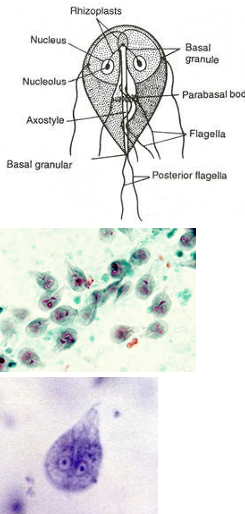
What troph?
Hint: “Old man” appearance (binucleated); Teardrop shaped; 4 pairs of flagella; ventral sucking disk; “falling leaf” motility
Giardia duodenalis

What troph?
Hint: No cyst form; Tiny; most binucleated; Karyosome consists of 4 to 8 discrete granules (nucleus is fragmented – unique!)
Dientamoeba fragilis

What troph?
Hint: no cyst form; 4 anterior flagella; undulating membrane extends HALF the length of body; jerky motility
Trichomonas vaginalis

What cyst?
Hint: Lemon shaped w/ anterior knob; karyosome surrounded by fibrils that curl around the cytosome (Shepherd’s crook appearance)
Chilomastix mesnili

What troph?
Hint: Cytosome and nucleus are prominent in anterior of organism
Chilomastix mesnili

What troph?
Hint: no cyst form; 4 anterior flagella; undulating membrane extends the LENGTH of organism
Trichomonas hominis