(12) H1 Antagonists
 Call Kai
 Learn
Learn Practice Test
 Spaced Repetition
 Match
Match Flashcards
 Knowt Play
1/14

There's no tags or description
Looks like no tags are added yet.
Name | Mastery | Learn | Test | Matching | Spaced | Call with Kai | Chat |
|---|
No analytics yet
Send a link to your students to track their progress
15 Terms
Tell me process of how Histamine and H₁ receptors are released/activated and what happens after.
Allergen binds a surface antibody called IgE on mast cell /basophil
histamine is released
H₁ receptors activate
leads to symptoms such as runny nose, sneezing, itchy eyes, and itching.
Tell me about H₁ receptor
Gq coupled GPCR
Anaphylaxis treatment
H₁ antihistamines act too slowly to be the main emergency treatment.
Tell me about histamine structure
Histamine has a side-chain primary amine and an imidazole ring with two nitrogens.
The π nitrogen is closer to the side chain; the τ nitrogen is farther away.
NτH has hydrogen on the nitrogen τ. NπH has hydrogen on the nitrogen π.
Pyrrole like - has N-H
Pyridine like - N has NO H
Draw me two types of histamine structures

Tell me about Histamine’s side chain pka
Histamine’s side chain amine has pKa 9.4 and is positively charged at pH 7.4.
The basic ring nitrogen has pKa 5.8.
REFRESHER INFO:
Higher pKa → holds onto H⁺ more strongly.
higher pKa means more basic. It is more likely to pick up and keep H⁺.
Basic nitrogen:
pH < pKa → protonated → positive (+)
pH > pKa → unprotonated → neutral
How histamine binds, then activates H₁
NτH histamine binds H₁: (RECOGNITION)
its positive amine attaches to negative Asp107 and forms ion-ion bond
while Lys191 and Asn198 help hold it
Lys forms ion-dipole bond
Asn forms a H-bond
H₁ is still off.
NτH changes to NπH inside H₁ (ACTIVATION)
H₁ turns on.
How histamine binds, then activates H₁ - draw it
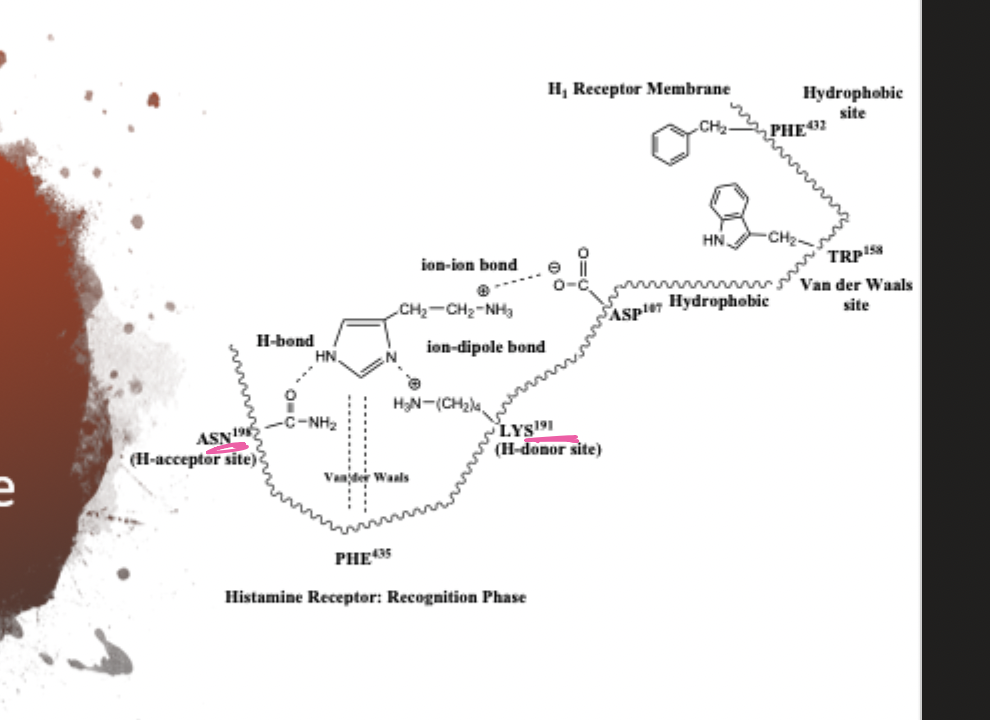
How H₁ antagonists work
The antihistamine’s positive amine attaches to Asp107
Its two aromatic rings fit into two pockets.
The histamine binding site closes, so histamine cannot turn on H₁.
antagonist structure
Look for | What it helps predict |
|---|---|
Anchoring nitrogen | Binding to Asp107 and sedation |
X group | Sedation, potency, and motion sickness use |
Two aromatic rings | Potency and duration of action |

The general antagonist pharmacophore does not look like histamine
When shown an antagonist structure, how to read?
find the two rings → follow them to X → follow the chain to the amine.
Anchoring nitrogen
Most H₁ antagonists have a tertiary amine.
Exceptions
loratadine = carbamate
desloratadine = secondary amine.
Small amine (straight-chain N,N-dimethyl or pyrrolidine)
more likely to enter the brain → more sedation.
Larger amine ring (piperidine or piperazine)
may help keep the drug outside the brain → less sedation.
A large ring alone is not enough to decide.
First generation: some sedation. Second generation: marketed as nonsedating.

Spacer Group
x group
X group | Class | Remember |
|---|---|---|
CH–O | Aminoalkyl ether | Among the most sedating; diphenhydramine is an example |
CH or C=C | Alkylamine | Among the most potent first generation agents |
N | Ethylenediamine | Two nitrogens; often used for motion sickness/antiemetic effects |

REMEMBER, THEY ALL ARE FIRST GENERATION ANTIHISTAMINE, SO ALL SEDATING!! THIS ABOUT WHO IS MORE OF WHAT!!!
Spacer Group
2 Aromatic rings - structure

Spacer Group
Tell me about the 2 Aromatic rings and how it binds to the H1?
Trp158 = larger van der Waals pocket. The cis ring binds here.
Phe432 = smaller hydrophobic pocket. The trans ring binds here.
A bulky para substituent such as Cl fits the larger Trp pocket, so only one ring can carry it in this arrangement.
