Astrophysics
 Call Kai
 Learn
 Practice Test
 Spaced Repetition
 Match
 Flashcards
 Knowt Play
1/76

There's no tags or description
Looks like no tags are added yet.
77 Terms
How do lenses work?
Lenses change the direction of light rays by refraction
Lens diagram terminology
Principal axis - horizontal axis through the centre of a lens
Lens axis - the vertical axis
Axial rays - rays parallel to the principal axis
Principal focus - where axial rays passing through the lens converge
Non-axial rays - rays that aren’t parallel to the principal axis
Focal plane - the plane perpendicular to the principal axis that contains the principal focus
Focal length - the perpendicular distance between the lens axis and the focal plane
Converging lenses
Convex shape (thicker across middle than edges)
Causes light rays to bend towards each other
Causes parallel axial rays to converge at the principal focus
Causes parallel non-axial rays to converge elsewhere on the focal plane
Diagram of parallel axial rays passing through a converging lens
(The rays converge at the principal focus)

Diagram of parallel non-axial rays passing through a converging lens
(The rays converge on the focal plane)

Where is the principal axis on a mirror?
It’s perpendicular to the surface and passes through its centre
When is an image formed?
When light rays from an object pass through a lens, an image is formed where the rays meet.
You can draw a ray diagram to work out where the image will appear
Ray diagram rules:
Ray diagrams show how light rays travel (e.g. from an object through a lens)
Draw rays coming from the top of the object (where they meet each other is where the top of the image will be formed)
Only draw 2 rays from the top of the object - one parallel to the principal axis that passes through the principal focus, and one passing through the centre of the lens that doesn’t get refracted at all
If an object sits on the principal axis, the bottom of the image will be on the principal axis
If an object doesn’t sit on the principal axis, you’ll need to draw 2 rays from the bottom of the object to find where the bottom of the image will be formed
Ray diagram for light passing through a converging lens
In reality, the ray through the lens centre will refract one way as it enters the lens, and then back again when it leaves. The overall direction won’t be changed, so in ray diagrams you can just draw it as a straight line

What can a ray diagram reveal about an image?
Whether an image is diminished (smaller than the object), the same size or magnified
If the image is further from the lens axis than the object, it’s magnified
If the image is closer to the lens axis than the object, it’s diminished
If the image is the same distance to the lens axis as the object, it’s the same size
What is a real image?
A real image is formed when light rays from a point on an object are made to pass through another point in space
The light rays are actually thee, and the image can be captured on a screen
What is a virtual image?
A virtual image is formed when light rays from a point on an object appear to have come from another point in space
The light rays aren’t really where the image appears to be, so the image can’t be captured on a screen
What images can converging lenses form?
Both real and virtual
If the object is further than the focal length away from the lens, the image is real and inverted
If the object is closer than the focal length away from the lens, the image is virtual
Tip: if the image is formed on the same side of the lens as the object, it’s a virtual image. Otherwise, it’s real.
Ray diagram of a real image formed by a converging lens
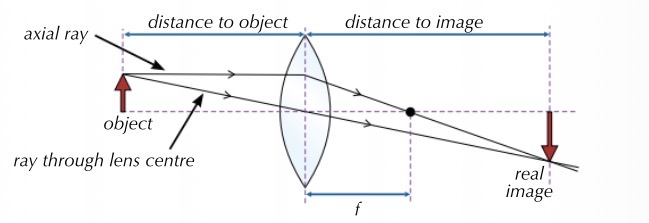
Ray diagram of a virtual image formed by a converging lens

Real vs virtual image examples
Mirror - virtual image. You’re not really behind the mirror, it just looks like the light rays are coming from behind the mirror.
Glass ball (picture below) - real and inverted. The garden is further from the converging lens than the focal point of the lens, so the image formed is real and inverted.

The lens equation variables
u - the distance between the object and the lens axis
v - the distance between the image and the lens axis (positive if the image is real, negative if the image is virtual)
f - focal length

What is the lens equation?
1/f = 1/u + 1/v
Why is measuring distance in space difficult?
Not all methods work for all distances
What are some distance measurements astronomers use?
Parsecs and light years
What is parallax? EODM
Imagine you’re in a moving car. You see that (stationary) objects in the foreground seem to be moving faster than objects in the distance. This apparent change in position is called parallax
How does temperature relate to radiation?
All objects that are hotter than absolute zero emit electromagnetic radiation due to their temperature. At room temperature, this radiation lies mostly in the infrared part of the spectrum (which we can’t see), but if an object is heated up enough, it will start to glow and emit visible light. This is because the wavelengths of radiation emitted depend on the temperature of the object.
What is a black body? EODM
A black body is an object with a pure black surface which emits radiation strongly and in a well-defined way. It absorbs all light incident on it - we call them black bodies because they don’t reflect any light.
What is a black body?
A black body is a body that absorbs all electromagnetic radiation of all wavelengths and can emit all wavelengths of electromagnetic radiation
What is black body radiation?
Because black bodies emit all wavelengths of electromagnetic radiation, they emit a continuous spectrum of electromagnetic radiation, called black body radiation.
A graph of radiation power output (energy emitted per second) against wavelength for a black body varies with temperature, but they all have the same general shape - called black body curves.

What is a perfect black body?
There is no such thing as a perfect black body. However, to a reasonably good approximation, stars and some other astronomical sources behave as black bodies.(The Sun can be assumed to be a black body).
We can use black body radiation curves to make estimations about an object’s temperature and other properties.
Wien’s displacement law
All black body spectra have a peak intensity. The wavelength that this peak occurs at is called the peak wavelength (λ max). The higher the surface temperature of a star, the shorter the peak wavelength.
Wien’s law in context 1/3
A hotter black body will emit more radiation that a cooler one, and it’s peak wavelength will be a shorter wavelength
It also has a higher total power output (assuming it has the same surface ares)

Wien’s law in context 2/3
A hotter star may not appear as bright as a cooler one, as it may mostly emit radiation that isn’t in the visible part of the electromagnetic spectrum.
If a cooler star emits more radiation in the visible region than a hotter one, it will appear brighter
Wien’s law in context 3/3
If you assume that a source acts as a black body, you can use Wien’s displacement law to estimate the surface temperature of the source using measurements of peak wavelength. The temperature you calculate is the source’s black-body temperature
Star life cycle (for stars similar size to the Sun)
Nebula
Protostar
Main sequence star
Red giant
White dwarf
Black dwarf
Protostar
Clouds of dust and gas (nebula) contract under the force of gravity, most of which was left when previous stars blew themselves apart in supernovae
Hydrogen fusions start under high pressure and temperature, forming helium and realising a large amount of energy which creates enough pressure to stop the gravitational collapse
Main sequence star
The star ignites (this is the current stage our sun is at)
The gravitational force inwards is equal to the outwards force produced by hydrogen fusion pressure (fusion creates mostly helium). This particular process is called core hydrogen burning
The star is stable while it fuses hydrogen into helium
Power output of the sun = 3.8×10²6 Js
Red giant
The star runs out of hydrogen so nuclear fusion stops, so the outwards pressure stops and the core of the star collapses, increasing the temperature under the weight of the star, causing expansion
The outer layers expand and cool, causing the red appearance
The Sun as a red giant has diameter of 2AU
White dwarf
The star shrinks as it begins to run out of fuel for helium fusion
The outer layers are shed and only the core remains
Black dwarf
The last fusion reactions stop and the star cools down
Doppler effect definition
The apparent change in frequency of a wave due to the relative motion between the source of the wave and the observer
Why does the frequency and wavelength change during the Doppler effect?
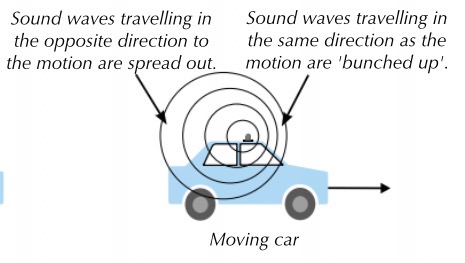
Because the waves bunch together in front of the source and stretch out behind it
The amount of stretching or bunching together depends on the velocity of the source
The distance between wavefronts is always equal to the wavelength
What happens is the object is stationary, moving towards or moving away from you?
Stationary - sound waves emitted at same wavelength and frequency in all directions
Moving towards (you hear the ‘bunched up’ bit as sound waves travel in same direction as motion) - shorter wavelength, high frequency
Moving away (you hear the ‘stretched out’ bit as sound waves travel in opposite direction to motion) - longer wavelength, lower frequency
How is the Doppler effect used in everyday life?
In weather radars to detect the movement of precipitation
A microwave signal is directed at the precipitation, which reflects it
The reflected signal is measured to see how the motion of the precipitation has affected the signal
What is red shift?
The Doppler effect happens with all waves, including electromagnetic radiation
When a light source moves away from us, the wavelength of the light reaching us becomes longer and has a lower frequency
This shifts the light that we receive towards the red end of the spectrum and is called red shift (as red light is the lowest frequency of light in the visible spectrum)
The light we receive from a star moving away from us is redder than the actual light emitted by the star

What happens is a light source is moving towards us?
The light undergoes blue shift - the light from the star looks bluer than it actually is
Blue light has the highest frequency of the visible light spectrum. In blue shift, light gets shifted towards (or beyond) the blue end of the visible spectrum
NOTE: In both blue and red shift, the frequency of the source doesn’t change, just the frequency of the radiation reaching us

What is cosmological red shift?
Light from distance galaxies reaches Earth with a longer wavelength than it should have
This change in wavelength is known as red shift
This suggests that most galaxies are moving away from us
The universe is expanding (and the light waves are being stretched along with it)
(This is called cosmological red shift to distinguish it from red shift produced by sources that are moving through space)
The same formula works for both types of red shift as long as v is much less than c (If v is close to the speed if light, you need a nasty relativistic formula instead)
What do more distant galaxies show?
More distant galaxies show more red shift, so must be moving faster (away from us)
Therefore, what does a faster moving object show?
A bigger change in wavelength
(The higher the velocity, the more the waves are shifted)
What does the evidence from red shift suggest?
The evidence from red shift suggests that all of the galaxies in the universe (and everything in them) started from the same, infinitely dense and infinitely hot, tiny point
What formula links the amount of red shift with velocity?
z = -v/c if v«c (v is much less than c)
z = red shift (no units)
v = velocity of the source in line with the observer in ms^-1
c = speed of em radiation in a vacuum in ms^-1
(You can use any units for v and c as long as they are the same)
Why is velocity negative in the equation?
Velocity has a direction
Here it’s defined as negative if the source is moving away from the observer (red shift) and positive if it is moving towards the observer (blue shift)
What is the rule when referring to red shift?
An increase in wavelength is always referred to as red shift, even if it’s a shift of wavelength taking place at a wavelength higher than that of red visible light e.g. shift from infrared to radio wavelengths
A decrease in wavelength is always referred to as blue shift


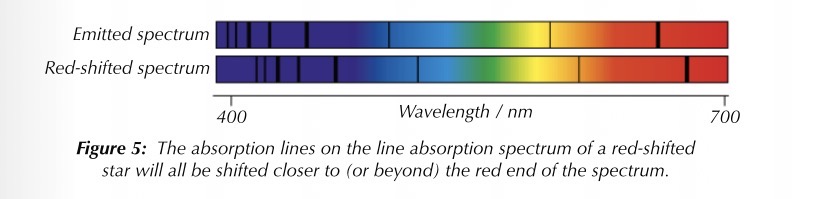
What does red shift look like?
The entire radiation spectrum of a moving source will be shifted, depending on its motion - including any absorption lines in the spectrum
How can you identify the actual wavelengths of the absorption lines in red shift?
Different atoms and molecules only absorb particular wavelengths of light that correspond to the differences between their energy levels
You can identify the actual wavelengths of the absorption lines for a particular atom or molecule in the lab
How can you calculate the red shift of a star?
Looking at the wavelength or frequency of known absorption lines (like the Balmer series) in the observed spectrum and comparing them to the wavelengths or frequencies they should be
How can you calculate red shift from the change in frequency and the frequency emitted by the source?
z = -Δf/f
Δf = difference between emitted and observed frequencies (obs - emitted)
f = frequency of light emitted by the star
If star is red shifted, f>fobs, so Δf is negative and z is positive
If star is blue shifted, f<fobs, so Δf is positive and z is negative
EXACTLY SAME IF YOU USE WAVELENGTHS RATHER THAN FREQUENCY
Units don’t matter as long as they’re the same
What do you get if you combine the two equations?
For v«c
Δf / f = -v/c
Or
Δλ / λ = -v/c

Remember the wavelength of the absorption line found from a lab source isn’t red-shifted and is the actual wavelengths of the absorption line

What is the cosmological principle?
On a large scale the universe is
homogeneous (every part is the same as every other part)
isotropic (everything looks the same in every direction, so it doesn’t have a centre)
Why is the cosmological principle important?
It represents the idea that no part of the universe is any more special than any other
The history of beliefs about the universe
Until 1930s - astronomers believes that the universe was infinite in both space and time (therefore it had always existed) and static. This seemed the only way that is could be stable using Newton’s law of gravitation
Even Einstein modified his theory of general relativity to make it consistent with this Steady-State Universe
Edwin Hubble was the first scientist to realise that the universe is expanding
How did Hubble realise the universe is expanding?
He used type 1a supernovae as standard candles to calculate the distances to galaxies, as well as measuring their red shift
The spectra from galaxies all show red shift (apart from a very few close ones)
The amount of red shift gives the recessional velocity (how fast the galaxy is moving away)
Hubble realised that the speed that galaxies moved away from us depended on how far they were away
A plot of recessional velocity against distance showed that they were proportional, which suggests the universe is expanding
The further away a galaxy is, the faster it’s travelling away from us, and this gives rise to Hubble’s law
What is Hubble’s law?
v = Hd
v = recessional velocity in kms^-1
H = the Hubble constant in kms^-1Mpc^-1
d = distance in Mpc
What is the SI unit for the Hubble constant?
S^-1
To get H in SI units you need v is ms^-1 and d in m
Why was the value of H disputed for a long time?
Because distance is very difficult to measure
How can you estimate H on a graph?
H = v/d so a graph of recessional velocity against distance from Earth can be used to estimate H
The gradient of the line of best fit is an estimate of H
Why is the universe cooling down?
The universe is expanding and cooling down (because it’s a closed system - which means energy and momentum are conserved. If there’s only so much energy in the universe, as it expands, it must also be cooling)
Therefore, further back in time it must have been denser and hotter
What is The Big Bang theory?
The Big Bang theory - the universe started off very hot and very dense (perhaps as an infinitely hot, infinitely dense point) and has been expanding ever since
What evidence do we have of the Big Bang?
The spectra from all galaxies (apart from a few very close ones that are moving towards us) show red shift
This shows they’re all moving apart
The red shift of distance galaxies is one piece of evidence
Why are we not at the centre of the universe?
Since the universe is expanding uniformly away from us it seems as though we’re at the centre of the universe, but this is an illusion
You would observe the same thing at any point in the universe
How can you estimate the age of the universe?
If the universe has been expanding at the same rate for its whole life, the age of the universe can be estimated
t = distance / velocity = 1/H
(Hubble’s law says v=Hd so 1/H = d/v)

The universe is actually thought to be 13.75 billion years old to within 1%

What is the size of the universe?
The absolute size of the universe is unknown, but there is a limit on the size of the observable universe, which is a sphere with Earth at the centre
The universe is bigger than this sphere, but it isn’t observable to us because we can only see light that has had time to travel to us
The radius of this sphere is equal to the maximum distance that light can travel during its age, taking into account the expansion of space itself
Has the rate of expansion of the universe been constant?
No - this is why we can only estimate the age and observable size of the universe
Is the expansion of the universe accelerating or declerating?
All the mass in the universe is attracted together by gravity
This attraction slows down the rate of expansion of the universe
It’s thought that the expansion was decelerating until about 5 billion years ago
In the late 90s, astronomers found evidence that the expansion is now accelerating, and are trying to explain this acceleration using dark energy - a type of energy that fills the whole of space
There are various theories of what dark energy as it’s hard to test them, but it is generally accepted that it does exist
What is cosmic microwave background radiation?
The Big Bang model predicts that loads of electromagnetic radiation was produced in the very early universe. This radiation should still be observed today (as it hasn’t had anywhere else to go
Because the universe has expanded, the wavelengths of this CMBR have been stretched and are now in the microwave region (which is why it is known as CMBR)
Facts about CMBR
Satellites have been sent into space to have a detailed look at the radiation. They found the CMBR has a perfect black body spectrum corresponding to a temperature of 2.73K
CMBR is largely isotropic and homogeneous, which agrees with the cosmological principle
There are very tiny fluctuations in temperature due to tiny energy-density variations in the early universe, where were needed for the initial formation of galaxies
It shows the Doppler effect, indicating the Earth’s motion through space
It turns out the Milky Way is rushing towards an unknown mass (the great Attractor) at over a million miles an hour

What has the Big Bang also explained?
The large abundance of helium in the universe
The early universe had been very hot, so at some point it must have been hot enough for hydrogen fusion to happen
This means that, together with the theory of the synthesis of the heavier elements in stars, the relative abundances of all of the elements can be accounted for