Relationships and attraction (6)
 Call Kai
 Learn
 Practice Test
 Spaced Repetition
 Match
 Flashcards
 Knowt Play
1/47

There's no tags or description
Looks like no tags are added yet.
48 Terms
Interpersonal relationships
a relationship w someone else cuz of association to your friends/ family
difficult to study because we choose our relationships
Harlows monkeys
monkeys had access either to a cloth monkey mo w no food (simulates a real mom) or a wire monkey (clearly fake) with a milk bottle
monkeys tended to stick to the cloth monkey
challenges the thought that babies love their moms just cuz they feed them, shows that we also need social connection and contact
Elephant experiement
natural observation
Elephants raised without proper socialization
tended to be more aggressive cuz no mom elephant to teach them
shows the significant of socialization
feral children
feral children are those that grew with limited social contact
cant speak well, walk late, struggle w relationships
again shows the importance of socialization
importance of relationships
stress reduction
particularly affiliate w those facing a similar threat
cognitive clarity
gain info
others are a good source of what were gonna face
can claify our own thinking
chronic shyness
risk for lonliness, a feeling of isolation, and social deprivation
criteria for basic needs
evolutionary basis
universal
guides social cognition
satiable
severe consequences if unfulfilled
consequences of social rejection
some animals who are socially rejected have a shorter lifespan
in humans higher social isolation reported higher pain
feelings of shame and distress
social rejection can reduce ability to regulate behaivior
social exchange theory
we evaluate relationships based on costs and benefits
comparison level: our standard for wht we expect in a relationship
comparison level for alternatives: Whether we think we could find better elsewhere
equity theory
relationships feel best when the rwards and costs are balanced
exchange relationships: Short term; keeping track
Communal relationships: More long term/ close relationships; give without immediate expectation of return, simply caring for the partners needs atm.
john bowlby
attachment theory
early bonds w our caregivers shape how we approach relationships later in life
evolution wired us to attach to caregivers for survival
stages of attachements
preattachement (0-6w): no particular attachment
indiscriminate (6w-7mo): prefrance shown to primary caregives (parents)
discriminate(7+mo): strong attachment to one caregiver
mutiple (10+mo): bonds w other caregivers
strange situation experiment
infants reaction is observed after the mother leaves the child in a room w stranger then returns
secure attachment
feels secure in relationships
comftrable with intimacy
wants to be close w others in times of stress
anxious insecure attachment
insecure in relationships
compulsively seeking closeness but always worrying about the relationship
during stress, excessivly try to get close to others
more likely to have substance use problems and eds
avoidant insecure attachment
insecure in relationships
needs to be fully self reliant
prefers distance from others
becomes detached and dismissive during stress
disorganized attachement
incosistent and unpredictable behaviour in regards to relationships
fearful/confused responses to closeness\
difficulty trusting others
follow approach avoidance behavior
seeking closeness then withdrawing
difficulty trusting others
often linked to trauma or neglect in early life
attachment effects
most to least likely to have a breakup
avoidant-anxious-secure
secure least likely to have marital problems
anxious has more fear and sadness during temporary seperations
avoidant attachment seeks less physical contact from partners
avoidant and anxious BAD pair
proximity effects
more likely to like people were geographically closer to (duh??)
mere exposure
repeated exposure without negative consequence makes the stimulus more pleasant
signlas that the stimulus is safe and non-threatening
rats raised on music1 prefered it over rats raised on music2
easier to process info abt familiar stimuli, easier processing=pleasant
similarity
tend to be more similar/ have similar beliefs to ur partner
finding somone similar to u who agrees w ur takes gives u validation
interacting w people more alike is less conflict, easier, again easy=pleasant
dissimilarity can increase dislike
false consensus bias
assuming most people see things the way we do, dissimilarity (or disagreement, simply) violates this assumtion and can make us unconftrable
complimentarity
traits that complememht each other can be opposites
ex sub/dom
ex status exchange hypothesis (rich man being w attractive woman), each has smth to give (but in different areas)
pratfall effect
highly perfect person making (small) mistakes makes them more likeable
a mistake as an average person hurts u tho
we like competent people until their competence surpasses mine in MY field, then ill feel inadequate by comparison and thus their attractiveness will be diminished
reciprocal liking
we like ppl who like us,
self esteem plays a role tho
ex low self esteem will underestimate how much people like them
physical attractiveness
pretty privilage
immediacy
ie looks is the first thing we notice when meeting people
affects our “gut reaction”
prestige
pretty is socially valued ie higher social status
halo effect
halo effect
people who are more physically attractive are often assumed to have other poritive traits
matching phenomenon
tendency to choose a good match in attractiveness and other traits
potential partener desiarability = pretty X partner prob of accepting u
evolutionary look on beauty
less abnormal looking is more attractive (more average)
choice
too much choive can make ppl less happy w what they do choose
also decision paralysis
praise
if we think the praise is genuine well like them more
if we think its not, we like them less
gain loss theory
Changing opinions affect us more:
Someone growing to like us is more rewarding than someone who liked us from the start.
Losing someone's affection hurts more than being disliked all along.
reward theory of attraction
The idea that we are attracted to others who reward us, who we find rewarding, and who we associate with reward
misattribution of arousal
The process whereby people make mistaken inferences about what is causing them to feel the way they do
love
A combination of emotions, cognitions, and behaviours that often plays a critical role in intimate relationships
companionate:friends and family
compassionate: parents and spouses
romantic: duh
like vs love
intertwined w time
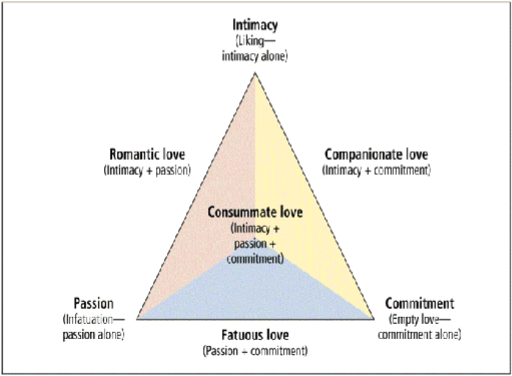
sternbergs triamgular model of love
three components:
intimacy
passion
commitment
like a three way venn diagra, types of love by the overlap.
leads to 7 types of love
Liking
Intimacy without passion or commitment
Infatuation
Passion as the only element
Empty Love
Commitment without intimacy or passion
Romantic Love
Intimacy and passion
Companionate Love
Intimacy and commitment
Fatuous Love
Passion and commitment without intimacy
Consummate Love
Intimacy, passion, and commitment
theory of social penetration
Relationships deepen through self-disclosure.
Gradual sharing of personal information increases intimacy
porcupines dilemma
We crave intimacy but fear vulnerability and rejection.
we want to be intimate without revealing our secrets so i cant get hurt
authenticity
The freedom to share your true feelings and beliefs (even negative ones) with your partner
men and love
fall in love more quickly
more likely to endorse romantic beliefs
less minimal parental investment therefore less selective
select mates in part based on fertility
women and love
companionate love more important than romantic passionate kinds of love
exponentially greater minimal parental investment
select mates in part based in their ability to provide resources to potential offspring
developing intimacy
Knowledge: Deep understanding of each other. (self disclosure)
Caring: Support and affection.
Mutuality: "Us" mentality.
Trust: Faith in partner's care.
Interdependence: Needing and influencing each other.
Commitment: Intention to stay.
Four horsemen of divorce
criticism: overly critical of partner
defensiveness: Refusing to accept responsibility
stonewalling: withdrawal, refusing to emotionally interact
contempt: especially predictiv ewhe the contempt is from women at men
baxter 1982
four ways to break up essentially
Withdrawal/avoidance
Pulling away from the partner gradually.Hoping the partner will get the hint and initiate the breakup themselves.
Positive tone
Ending the relationship while trying to spare the partner's feelings.
Manipulative strategies
Ending the relationship indirectly, often involving a third party or trickery.
Open confrontation
Being direct, honest, and upfront about wanting to end the relationship.
Rusbult 1986/7
two sub dimesions: constructive/destructive and passive/active
4 ways of coping
loyalty (P,C): Waiting and hoping the situation will improve without taking direct action.
neglect (P,D): Ignoring the partner or relationship; letting it deteriorate.
voice (A,C): Actively trying to improve the relationship by discussing problems and seeking solutions.
exit (A,D): Ending the relationship; leaving the partner.
Adaptive communication
straight talk and benefit of the doubt (situational/dispositional attributions)
immediate feedback
feeling vs judgement
express feelings rather than judgments.