Lecture 8: Histone Acetylation
 Call Kai
 Learn
Learn Practice Test
 Spaced Repetition
 Match
Match Flashcards
 Knowt Play
1/9

There's no tags or description
Looks like no tags are added yet.
Name | Mastery | Learn | Test | Matching | Spaced | Call with Kai | Chat |
|---|
No analytics yet
Send a link to your students to track their progress
10 Terms
Explain what histone acetyltransferases do chemically, acetylation of the ε-amino group of lysine with acetyl-CoA as the donor, say what this does to the net positive charge of the residue, and note that acetylation also occurs non-enzymatically
Histone acetylation is done by enzymes called histone acetyltransferases (HATs)
Acetylate the ε-amino group (epsilon group) of lysine residues
ε-amino group provides positive charge to lysine
Acetylation decreases net positive charge of lysine
Acetyl-CoA acts as the acetyl donor, linking acetylation to the metabolic state of the cell
Acetylation also occurs non-enzymatically
Molecular basis of substrate specificity is not well understood
Name the three major HAT families, GNAT, MYST and p300/CBP, give one founding member of each, state that HATs also carry a KAT designation, give the histone specificity of at least one enzyme from each family, and say which genomic features H3K9ac and H3K27ac mark
Three major families
Each HAT has a KAT number and target residues (table below)
H3K9ac marks active promoters; H3K27ac marks active enhancers
MYST family: Founded by MOZ (human monocytic leukemia zinc-finger HAT), yeast YBF2, SAS2, and TIP60. All members contain a conserved region called the MYST domain
GNAT family: Gcn5-related N-acetyltransferase
p300 family

Explain the two modes of regulating acetyltransferase activity, assembly into multiprotein complexes, which sets substrate specificity and supplies the partner subunits a HAT needs to act on nucleosomes, and autoacetylation, and name the complexes formed by the Gcn5/pCAF and MYST families with the histones each acetylates.
Two major modes of regulation:
1. Assembly into multiprotein complexes:
Assembly regulates activity and sets substrate specificity, which residue of which protein is targeted (see the HAT table)
Assembly also supplies the partner subunits a HAT needs: Gcn5 alone acetylates free histones but requires Ada2 and Ada3 to acetylate nucleosomes
Gcn5/pCAF form SAGA and SLIK in yeast, TFTC and STAGA in humans, and acetylate H2B, H3 and H4
MYST form NuA3 and NuA4, and acetylate H3 and H4
2. Autoacetylation of the enzyme itself
Certain HATS can autoregulate by autoacetylation
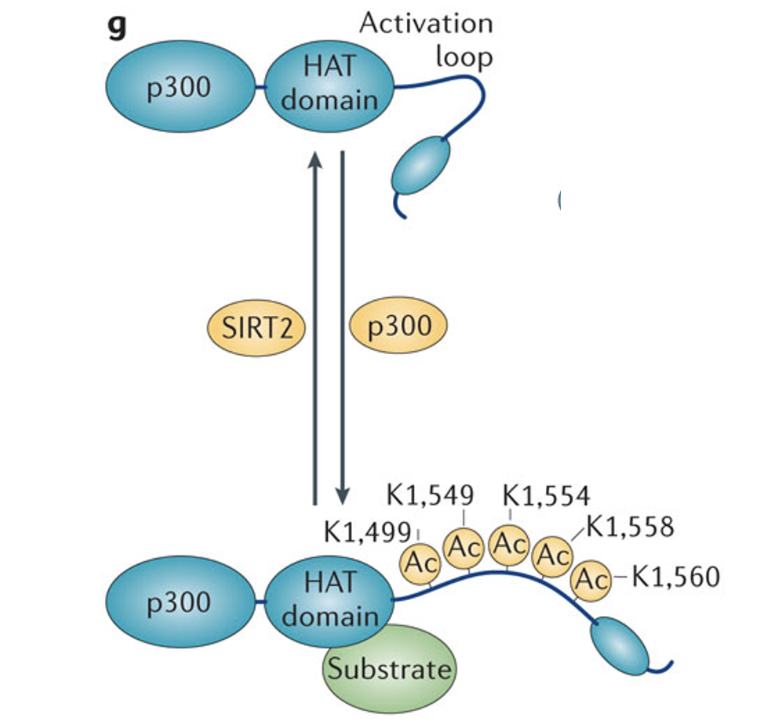
Explain autoacetylation of p300/CBP, including the activation loop, the hyperacetylated and hypoacetylated states, and the deacetylase that reverses it
p300/CBP family is well known example:
Contains 40 lysine residues in its activation loop
Protein is active when hyperacetylated
Protein is inactive when hypoacetylated
SIRT2 removes these marks and inactivates p300
Explain how HATs promote transcription by delivering TBP to the core promoter, and contrast the TFIID and SAGA routes
HATs are part of complexes that deliver TATA-binding protein (TBP) to core promoter:
As part of TFIID complex
TAF145 has HAT activity
SAGA (SPT-ADA-GCN5 acetyltransferase)
TFIID and SAGA are two routes to the same end

Define a bromodomain, explain why bromodomains occur in tandem arrays, and describe what the six bromodomains of PB1 do
Proteins with bromodomain recognize and bind to acetylated lysine
Bromodomain exists in multiples:
Number varies by organism: six in PB1, one or two in yeast Rsc
These may provide specific binding to different acetylated histone lysines
PB1 (Polybromo 1) can have six bromodomains:
Four domains bind H2A, H2B, H3, H4, respectively
The other two may provide stability to the complex by binding non-specifically to any acetylated lysine once the complex is formed by the first four bromodomains

Describe how bromodomain-containing proteins couple acetylation to nucleosome remodeling through Swi/Snf, and state what remains unknown about their sequence specificity
The bromodomain containing proteins form complex with other proteins. Alter chromatin
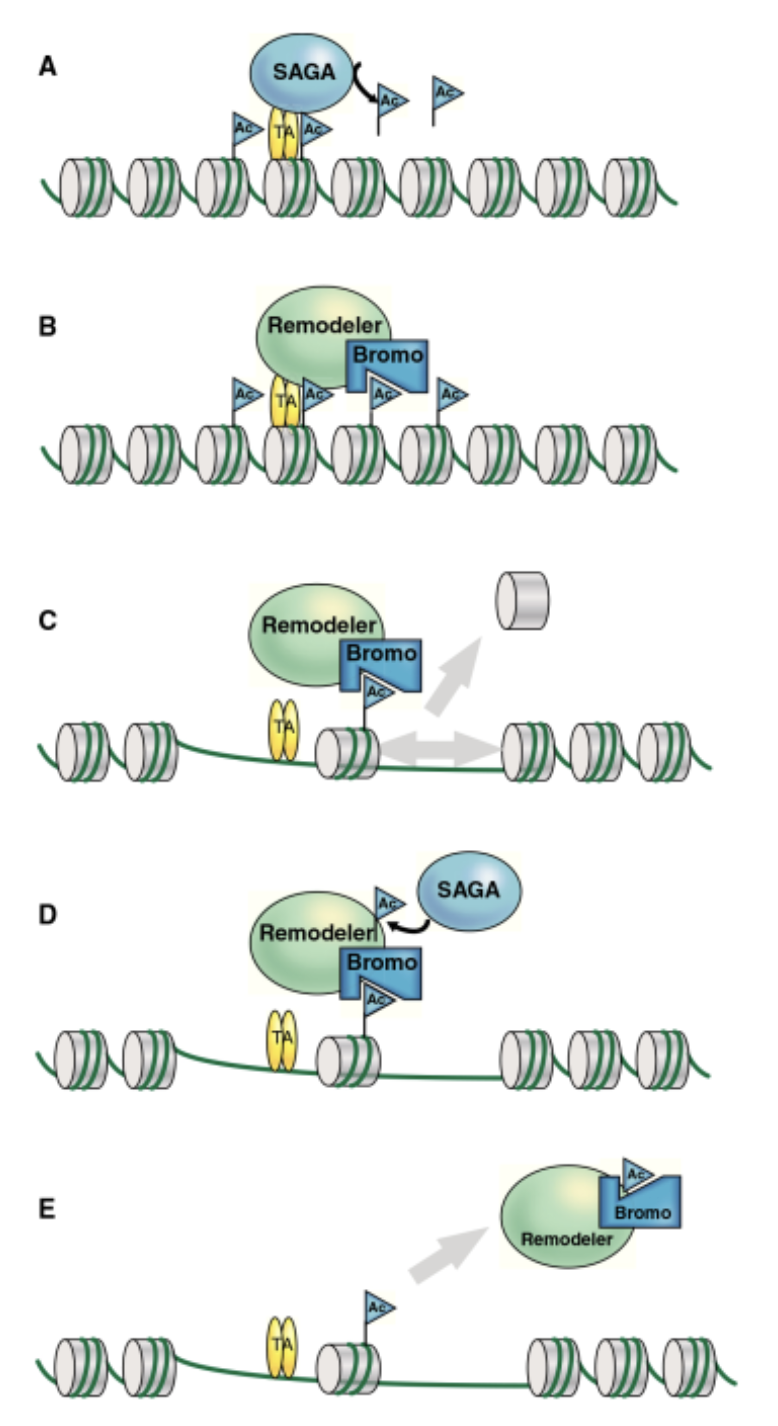
Swi/Snf complexes have bromodomain containing proteins that bind to acetylated lysine. Remodel nucleosomes
Knowledge about sequence dependent recognition by bromodomain containing proteins is still limited
Name the two HDAC families and the four classes, say which cofactor each family requires, and say where in the cell different HDACs are found
Two families:
Histone deacetylase family
Sir2 regulator family
Four classes
Class I, II, and IV belong to histone deacetylase family. These use zinc as a cofactor for deacetylation
Class III belong to Sir2 regulator family. These use Nicotinamide Adenine Dinucleotide (NAD+) as a cofactor for deacetylation

Explain why HDAC1, HDAC2 and HDAC3 have little activity alone, name the four complexes that activate them, give the four-protein core shared by Sin3 and NuRD, and explain how these complexes couple deacetylation to DNA methylation and ATP-dependent remodeling, from methylated CpG through MeCP2 and Sin3A to transcriptional silencing
Classes I, IIa, IIb and IV are the classical HDACs and use zinc
Class III are the sirtuins and use NAD+
Localization varies: nuclear, cytoplasmic, mitochondrial or nucleolar
Regulation is achieved by interaction with other proteins in a complex
HDAC1, 2 and 3 have very low enzymatic activity individually
These HDACs must be present in complexes with other proteins
HDAC1, 2 and 3 are found in four complexes: Sin3, NuRD, CoREST and NCoR/SMRT
Sin3 and NuRD share a common core of four proteins: HDAC1, HDAC2, RbAp48 and RbAp46
Involved in ATP-dependent remodeling – via Mi2 subunit
Binds to methylated DNA via MBD3
Presence of MBD allows deacetylation of histones of the nucleosomes bound to methylated DNA
NURD complex also binds to transcriptional repressors for specific genes
NURD is an example of how histone deacetylation, DNA methylation, and chromatin remodeling work together to suppress gene activity
Acts as a scaffold protein for HDAC complexes
Recruited by protein-protein interactions with sequence-specific DNA-binding proteins
Methyl-CpG binding proteins (e.g., MeCP2) and ATP dependent chromatin remodeling proteins also bind to Sin3 complex
MeCP2 at methylated CpG recruits Sin3A, HDACs and the BRM remodeler, silencing the gene

Explain how phosphorylation regulates HDACs, including why it activates HDAC1, HDAC2 and HDAC8 but inactivates HDAC4 by driving 14-3-3 binding and export to the cytoplasm
Phosphorylation activates HDAC1,
HDAC2 and HDAC8, but inactivates HDAC4
Dephosphorylation reverses each of these effects
Phosphorylation can affect localization of HDAC in the cell
Ex: By affecting its interaction with 14-3-3 protein
This affects the activity of HDAC
