Lecture 12 Sensing the Environment and Controlling Growth
 Call Kai
 Learn
Learn Practice Test
 Spaced Repetition
 Match
Match Flashcards
 Knowt Play
1/36

There's no tags or description
Looks like no tags are added yet.
Name | Mastery | Learn | Test | Matching | Spaced | Call with Kai | Chat |
|---|
No analytics yet
Send a link to your students to track their progress
37 Terms
How do plants sense the environment and develop in response?
Hormones and photoreceptors
Hormones
Chemical signals that act at very low concentrations at sites often far from where they are produced
Photoreceptors
Pigments associated with proteins that absorb light
Plant hormones
Auxin and ethylene
Auxin
Controls the direction and arrangement of apical growth, gravitropism, and apical dominance
Ethylene
Gaseous compound controls fruit ripening, leaf drop, germination, and the development of apical hook
Auxin functions
Orchestrates most plant growth, stimulates cell elongation
Auxin was discovered in the context of ___.
phototropism
Phototropism
response to light → stems bend toward light source
What is phototropism caused by?
Cell elongation stimulated by auxin
Where is the stimulus for phototropism initiated?
The tip of the growing stem; signal then travels down stem to cause bend
Conclusion of Darwin’s phototropism experiment
The signal moves down the shaded side of the shoot and causes it to bend
What happens when the mica barrier is inserted on the shaded side?
No bend
What happens when the mica barrier is inserted on the light side?
Bend
Auxin molecules congregate on what side of the plant?
The shaded side, causing elongation there → bend towards the sun
The biphasic effect of auxin
In roots, auxin inhibits cell elongation. In stem, auxin promotes growth.
Auxin contributes to ___.
gravitropism
Negative gravitropism
Upward gravitropic response of shoots

Positive gravitropism
Downward gravitropic response of roots
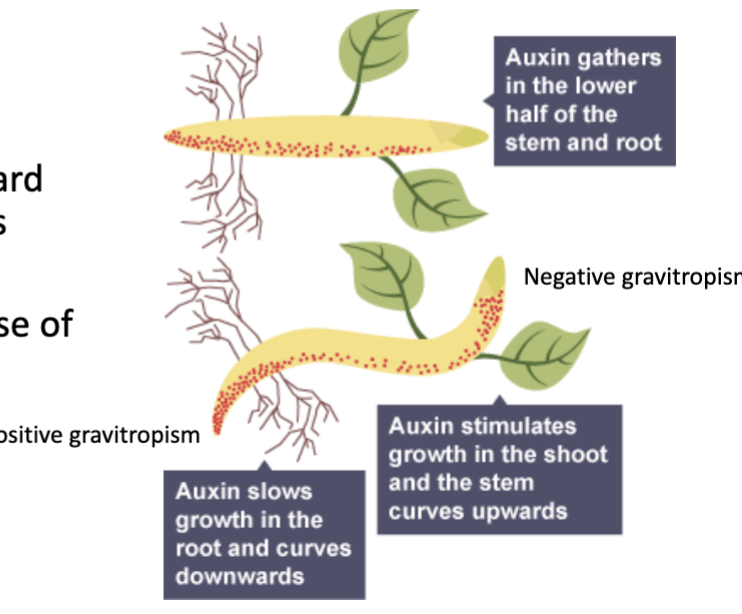
What explains the biphasic effect of auxin?
The acid growth theory of auxin-induced cell elongation
Auxin leads to ___.
apical dominance
Apical dominance
Apical buds inhibit the growth of axillary buds. Terminal bud produces auxin, prevents lateral buds from growing.
Examples of strong vs. weak apical dominance

Ethylene gas
Promotes leaf abscission and senescence, speeds ripening
Ethylene causes…
an increase in its own production.
Climacteric fruit
continue ripening after being harvested
Phytochromes
Photoreceptor; exists in two interconvertible isoforms (Pr and Pfr)
How do phytochromes interconvert?
Exposure to red light and exposure to far-red light
Active phytochrome
Pfr
Inactive phytochrome
Pr
Ratio of Pr and Pfr determines
Seed germination, flowering, shoot development
During daylight, ___ predominates
Pfr
In shade, ___ predominates
Pr
Phytochrome affects the plant by ___.
stimulating gene transcription.
Flowering time is synchronized by…
temperature and photoperiod (length of night)

Fruit ripening

Light-regulated chloroplast reorientation