Lesson 12: Atmospheric Moisture
 Call Kai
 Learn
 Practice Test
 Spaced Repetition
 Match
 Flashcards
 Knowt Play
1/61

There's no tags or description
Looks like no tags are added yet.
62 Terms
on average, a water molecule stays in the atmosphere () days
11 days
if all of the water vapor were to be precipitated, it would create () inch of water depth over the globe
1 inch
what are the sources of water vapor? (2)
evaporation and sublimation, evaporation is the biggest source
what are the sinks of water vapor? (2)
condensation and freezing/deposition (in form of precipitation, dew or frost)
condensation is the biggest sink
()% of water vapor is from oceans, ()% from land areas (including transpiration)
85% - oceans
15% - land areas
over land, more water () (or transpires) than run off
evaporates
what is water in a gas state?
invisible…
invisible water vapor
what is water in a liquid state?
r…
cloud…
rain, cloud droplets
what is water in a solid state?
s…
h…
i…
snow
hail
ice
what is latent heat?
energy released or absorbed as water changes state
latent = hidden
what changes of state absorb heat? (3) the most? the least?
melting
evaporation
sublimation
Most: sublimation
Least: melting
what changes of state release heat? (3) most? least?
freezing
condensation
deposition
Most: deposition
Least: freezing
what is deposition?
() to () without ever becoming liquid water first
() → ()
gas (water vapor) to solid (water crystals) without ever becoming liquid water first
gas → solid
what is freezing?
liquid water () heat and turns into a () such as ice, snow, or hail
() → ()
liquid water loses heat and turns into a solid such as ice, snow, or hail
liquid → solid
what is condensation?
the process where invisible water vapor in the air () down and turns back into () water droplets
() → ()
the process where invisible water vapor in the air cools down and turns back into liquid water droplets
gas → liquid
what is melting?
physical process where () water such as ice, snow, or glaciers absorbs () energy and changes into () water
() → ()
physical process where solid water such as ice, snow, or glaciers absorbs heat energy and changes into liquid water
solid → liquid
what is evaporation?
process where () water absorbs () energy and turns into invisible () called water vapor
() → ()
process where liquid water absorbs heat energy and turns into invisible gas called water vapor
liquid → gas
what is sublimation?
the process where ice or snow ( () water) turns directly into (…) without first () into liquid water
() → ()
the process where ice or snow (solid water) turns directly into water vapor (gas) without first melting into liquid water
solid → gas
latent heat () air when absorbed
cools
latent heat () surrounding air when released
heats
latent heat is the main source of energy for () and (), why?
() air stores plentiful ()
thunderstorms, hurricanes
moist air stores plentiful heat
what are the three ways to measure water vapor content?
vapor…
mixing…
precip…
vapor pressure (vp)
mixing ratio (w)
precipitable water (pw)
what is vapor pressure?
the () of atmospheric gas pressure provided by (…)
Actual amount of () in the air
the proportion of atmospheric gas pressure provided by vapor molecules
Actual amount of moisture in the air
More water = higher pressure since the more water that evaporates into the air, the more water vapor molecules there are to bounce around.
what is mixing ratio?
mass of (..) molecules in a () mass of air
mass of water vapor molecules in a unit mass of air
what is precipitable water?
() depth of water if it were () from the atmospheric () above a given location
equivalent depth of water if it were precipitated out from the atmospheric column above a given location
vapor pressure is the (…) in an air parcel due to (…)
partial pressure
water vapor
what are some characteristics of vapor pressure?
corresponds to () of molecules that are ()
average VP at MSL is about ()” Hg ( () mb) )
if water vapor is ()% of air molecules in parcel, it exerts ()% of air pressure; for P = 850 mb, that would be VP = () mb
corresponds to fraction of molecules that are H2O
average VP at MSL is about 0.5” Hg (15 mb)
if water vapor is 1% of air molecules in parcel, it exerts 1% of air pressure; for P = 850 mb, that would be VP = 8.5 mb
vapor pressure changes when:
water vapor is ()/() by phase changes
if the () or () of the air changes (vapor pressure is not (), so it does not remain () as parcels move up or down)
water vapor is added/removed by phase changes
the pressure or temperature of the air changes (vapor pressure is not conserved, so it does not remain constant as air parcels move up or down)
what are characteristics of mixing ratio (w)?
mass (grams) of (…) in a parcel with mass (kg) of (…)
typical value is about ()g/kg
changes when (…) concentration changes by () changes
conserved in () or () air, if no water vapor mass is added from or lost to the external environment (how could these happen? - () of parcel with surrounding air)
mass (grams) of water vapor in a parcel with mass (kg) of dry air
typical value is about 10g/kg
changes when water vapor concentration changes by phase changes
conserved in rising or sinking air, if no water vapor mass is added from or lost to the external environment (how could these happen? - mixing of parcel with surrounding air)
what are characteristics of precipitable water?
() amount of water vapor in column of air
reported in (…) depth (as if it had precipitated)
average value approximately () inch (2.5cm) equivalent depth of water - largest over () oceans
changes when water vapor is ()/() from the column (or layer) by () changes, () mixing or ()
total amount of water vapor in column of air
reported in liquid water depth (as if it had precipitated)
average value approximately 1 inch (2.5cm) equivalent depth of water - largest over tropical oceans
changes when water vapor is added/removed from the column (or layer) by phase changes, lateral mixing or advection
what are the 3 indirect measures of water vapor?
() point temperature
() point temperature
() humidity
dew point temperature
frost point temperature
relative humidity
what is dew point temperature?
() at which () forms from water vapor ()
temperature at which dew forms from water vapor (condensation)
what is frost point temperature?
() at which () forms from water vapor ()
temperature at which frost forms from water vapor (deposition)
what is relative humidity?
() level of water vapor relative to () conditions
RH increases as you () a parcel of air through () (adiabatic () ), () to a colder surface (could cause () or () to form), or radiational () loss (such as () )
proportional level of water vapor relative to saturated conditions
Amount of water vapor currently in the air compared to the maximum amount it can hold
RH increases as you cool a parcel of air through lifting (adiabatic expansion), conduction to a colder surface (could cause dew or frost to form) or radiational energy loss (such as night)
in Jan, where is the dryest air?
where the land is the farthest from the oceans (up in climate)
in Jan, what is the location with the most moisture in the air?
southern tip of florida, east coast (down in climate)
in Jul, where is the dryest air?
nevada/utah area (to our NW, Great Basin) because mountains block wind from carrying rain
in Jul, what is the location with the most moisture in the air? humidity?
southern tip of texas (southeastern US)
highest humidity along the coastlines (SE - warmest)
higher vapor pressures near () ocean areas
warm
what is saturation?
when () and sinks of () are balanced
saturation vapor pressure (SVP) and saturation mixing ratio (w) are the () capacity or amount of vapor (air is saturated)
SVP () exponentially with temperature
higher number of H20 molecules can exist over () (than over water) before saturation, so () is higher
at saturation, () = SVP and () = ws
when sources and sinks of water vapor are balanced
saturation vapor pressure (SVP) and saturation mixing ratio (w) are the maximum capacity or amount of vapor (air is saturated)
SVP increases exponentially with temperature
higher number of H20 molecules can exist over ice (than over water) before saturation, so SVP is higher
at saturation, VP = SVP and w = ws
what are characteristics of saturation vapor pressure?
() air can contain more water vapor than () air
saturation vapor amount () exponentially with air temperature
clouds form in () () air when mixed with () air, which () SVP
boiling of water occurs when the SVP () the air pressure of the environment, SVP = () mb for () degrees C
at a () air pressure (higher elevation), water will boil at a () temperature
warm air can contain more water vapor than cold air
saturation vapor amount increases exponentially with air temperature
clouds form in warm moist air when mixed with cold air, which reduces SVP
boiling of water occurs when the SVP equals the air pressure of the environment, SVP = 1013 mb for 100 degrees C
at a lower air pressure (higher elevation), water will boil at a cooler temperature
how does the air reach saturation?
when the air contains the () water vapor content
when the air is ()
when the air contains the maximum water vapor content
when the air is cooled
explain “when the air contains the maximum water vapor content”
any additional () added to the air must be balanced by molecules returning to () or ()
any additional moisture added to the air must be balanced by molecules returning to liquid or ice
what is saturation vapor pressure?
vapor pressure value at which () would occur
Vapor pressure value at which condensation would occur
what is saturation mixing ratio?
mixing ratio value at which () would occur
mixing ratio value at which condensation would occur
explain “when the air is cooled”
it cannot contain as much (…), and the excess water vapor must turn to () or ()
it cannot contain as much water vapor, and the excess water vapor must turn to liquid or ice
what is dewpoint temperature?
the temperature to which air must be () to produce () (reported in a () )
DP = (…), if the air is at (…) conditions
directly related to the (…) of air (i.e. dew point () as (…) increases
the temperature to which air must be cooled to produce saturation (reported in a METAR)
DP = air temperature, if the air is at vapor saturation conditions
directly related to the vapor content of air (i.e. dew point increases as vapor pressure increases
the dew point depression or spread () indicates how close to ()
small spread: () air
large spread: () air
the dew point depression or spread (T-DP) indicates how close to saturation
small spread: humid air
large spread: dry air
warming a parcel without adding water vapor (does/does not) change the dew point and why?
(…)
the actual moisture content remains ()
dew point measures the amount of (…) in the air, not the ambient (), so if you heat the air, the relative humidity () but the dew point stays the ()
DOES NOT
the actual moisture content remains unchanged
dew point measures the amount of water vapor in the air, not the ambient temperature, so if you heat the air, the relative humidity drops but the dew point stays the same
the upper limit of dew point temperature in a coastal area is typically the (…) and why?
(…) temperature
air cannot pick up more () from the ocean than the (…) dictated by that water temperature
sea surface temperature
air cannot pick up more moisture from the ocean than the saturation vapor pressure dictated by that water temperature
what is relative humidity?
a relative measure of (…) content
ratio of actual water vapor () to the total water vapor ()
a relative measure of water vapor content
ratio of actual water vapor content to the total water vapor capacity
what is the RH equation in terms of VP and SVP?

what is the RH when the air is saturated?
() = () so RH = ()%
VP = SVP so RH = 100%
RH is (…) to temperature
as temperature increases: the air’s capacity to hold moisture (), causing the relative humidity percentage to () - IF VP STAYS THE SAME
as temperature (): the air’s capacity to hold moisture (), causing the relative humidity percentage to () - IF VP STAYS THE SAME
if the temperature drops enough, the RH reaches ()% (the dew point), leading to () like fog or dew
inversely related
as temperature increases: the air’s capacity to hold moisture expands, causing the relative humidity percentage to decrease
as temperature decreases: the air’s capacity to hold moisture shrinks, causing the relative humidity percentage to increase
if the temperature drops enough, the RH reaches 100% (the dew point), leading to condensation like fog or dew
RH is (…) to SVP
SVP () exponentially with () temperature because warm air can () more water vapor than cold air
inversely related
SVP increases exponentially with increasing temperature because warm air can hold more water vapor than cold air
what time of day will the relative humidity be highest?
early morning hours around sunrise
air temperature will be at its COOLEST (lowest)
cooler air can hold much less water vapor than warm air
as the temperature drops overnight and nears the dew point, the air gets closer to its maximum moisture capacity (100% RH), often resulting in dew or dog
what time of day will the relative humidity be lowest?
()
the sun heats the ground and air the most during the (), which causes temperatures to reach their daily maximum
warm air can () much more water vapor than cold air
even if the actual amount of moisture in the air stays the same, the higher temperature () the air’s capacity, driving the relative humidity percentage ()
mid-to-late afternoon
the sun heats the ground and air the most during the afternoon, which causes temperatures to reach their daily maximum
warm air can hold much more water vapor than cold air
even if the actual amount of moisture in the air stays the same, the higher temperature increases the air’s capacity, driving the relative humidity percentage down
dew point is the best indicator of actual (…)
relative humidity varies with local (…)
actual water vapor content
local air temperature)
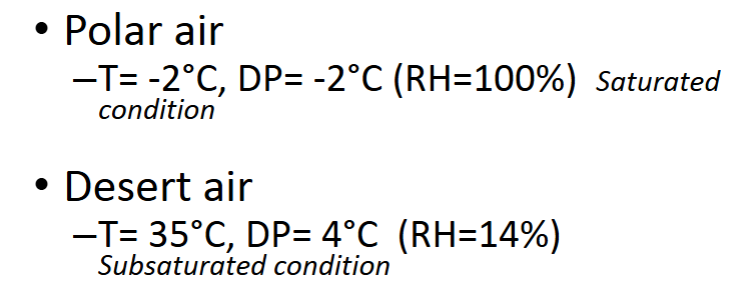
which is more humid and which one has higher vapor content?
the desert air parcel has higher vapor content because it has a higher dew point
the parcel with the higher value of RH is “more humid” so polar air
polar air (SATURATED condition): The air is saturated, meaning it holds as much water vapor as it can at that temperature.
desert air (SUBSATURATED condition): The air is unsaturated, but it contains more actual water vapor than the polar air.
what is the average molecular mass of dry air?
()
()% nitrogen at () grams/mole and ()% oxygen at () grams/mole
28.97
78% nitrogen at 29 grams/mole and 21% oxygen at 32 grams/mole
water molecules have a molecular mass of ()
18
moist air is () dense and has a () density altitude than drier air at the same temperature
water vapor molecules are () than the nitrogen and oxygen molecules they replace
aircraft performance can be slightly () in humid air due to () density
less dense, higher density altitude
water vapor molecules are lighter than the nitrogen and oxygen molecules they replace
aircraft performance can be slightly reduced in humid air due to reduced density