d.1 Gravitational fields
 Call Kai
 Learn
Learn Practice Test
 Spaced Repetition
 Match
Match Flashcards
 Knowt Play
1/24

There's no tags or description
Looks like no tags are added yet.
Name | Mastery | Learn | Test | Matching | Spaced | Call with Kai | Chat |
|---|
No analytics yet
Send a link to your students to track their progress
25 Terms
Newtons law of gravitation :
The gravitational force between two point masses is proportional to the product of the masses and inversely proportional to the square of their seperation.

A gravitational field is :
A regional of space where a mass experiences a force due to the gravitational attraction of another mass
The gravitational field strength at a point is defined as :
The force per unit mass experienced by a test mass at that point
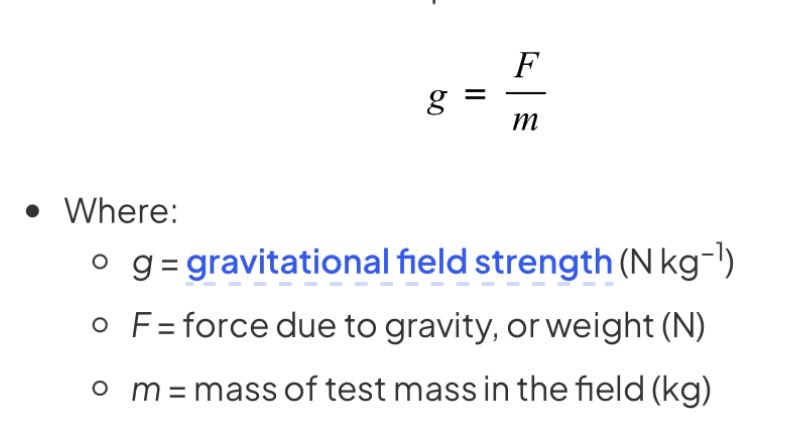
Factors that affect the gravitational field strength at the surface of a planet are:
radius
Mass
A body can be regarded as a point mass when:
A body covers a very large distance compared to its size
Gravitational potential at a point can be defined as :
The work done per unit mass in bringing a test mass from infinity to a defined point
Why is gravitational potential a negative value
it is defined as having a value of zero at infinity
Since gravitational force is attractive, work must be done ON a mass to reach infinity
(Work has to be done against the gravitational pull of the planet to take a unit mass away from the planet)
The gravitational potential energy near the earths surface is equal to

Work done in moving a mass is given by :-
this is because gravity is attractive there fore energy is needed to work against this force
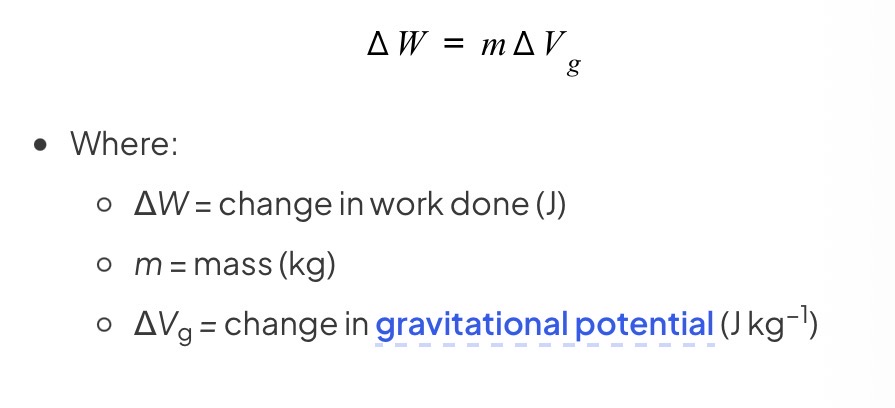
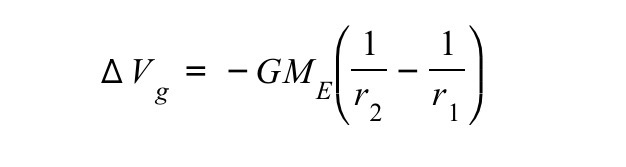
How to find (change in) gravitational potential at different points in the field
Equipotential lines are always :
horizontal straight lines
Parallel
Equally spaced
Keplers first law
The orbit of all planet is an ellipse , with the sun at one focus
Keplers second law
A line segment joining the sun to a planet sweeps out equal areas in equal time intervals
T1 = T2
A1 = A2
This also means the sun moves quicker when its closer to the earth

Keplers third law
For planets or satellites in a circular orbit about the same central body, the square of the time period is proportional to the cube of the radius of the orbit

Since a planet is travelling in circular motion, its orbital circumference is 2pi , the linear speed will be :

If the linear speed is equal to 2pi r / T

Escape speed is defined as
The minimum speed that will allow an object to escape a gravitational field with no further energy
Knowing the definition of escape speed, what equations do we use to work it out ?
This can be simplified
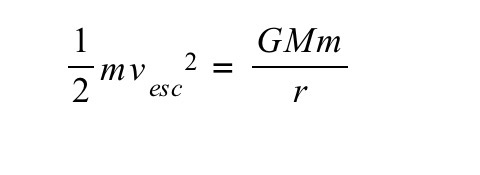
Why do rocket launched from earth not need to achieve escape velocity to reach their orbit around the earth
continuously given energy through fuel and thrust to help them move
So less energy is needed to achieve orbit than to escape from earths gravitational field
For a planet to stay in orbit what must be in equilibrium
Centripetal force and and the gravitational force

If the orbital radius of a satellite decreases what happens to its Ep and its Ek
Ek increases, and Ep decreases
What can viscous drag effect on a low-orbit satellite
height
Speed
Why do low-satellites experience drag
density of the air in the upper layers of the atmosphere is very low, but not zero
Satellites will experience a small dissipation of kinetic energy into thermal energy due to the friction between the air particles and surface of satellite
Define electric charge
The charge carried by an electric current of one ampere in one second