Lec2: Major Functional Components of CNS
 Call Kai
 Learn
 Practice Test
 Spaced Repetition
 Match
 Flashcards
 Knowt Play
1/61

Earn XP
Description and Tags
PHAR 111 - Halliwell
62 Terms

What is the blue label representing?
Ectoderm

What is the red label representing?
Mesoderm

What is the yellow label representing?
Endoderm

What does the circle label represent?
Notochord

What does the square label B represent?
Neural Tube

What does the square label A represent?
Neural Plate

What does the green portion of the picture represent?
Spinal Ganglion

What does the grey label pointing to the red portion of the picture represent?
Somite
What does the Ectoderm form?
NS and Skin
What does the Mesoderm form?
Cardiovascular and skeletal muscle
What does the Endoderm form?
Lungs, Digestive system, Pancreas, Liver
What forms the embryotic forebrain?
Prosencephalon
What forms the embryotic midbrain?
Mesencephalon
What forms the embryotic hindbrain?
Rhombencephalon
What does the Telencephalon turn into?
Cerebral Cortex, Basal Ganglia, Hippocampus, Olfactory Bulb, Basal forebrain
What does the Diencephalon turn into?
Dorsal Thalamus, Hypothalamus
What does the Mesencephalon turn into?
Midbrain (Superior and inferior colliculi)
What does the Metencephalon turn into?
Cerebellum, Pons
What does the Myelencephalon turn into?
Medulla
Failure to close neural tube at caudal end results in _______
Spina Bifida
Failure to close neural tube at rostral end results in _______
Anencephaly → No Forebrain = Death
Failure to close entire neural tube results in _______
Craniorachischisis = Death
What is the name of the flat “valleys” of the brain? How much of the surface area does it take up?
Gyri, 1/3
What is the name of the grooves/folds of the brain? How much of the surface area does it take up?
Sulci, 2/3
How do the two hemispheres of the brain communicate?
Corpus Collosum (Commissural Fibers)

What does 1 represent?
Frontal Lobe

What does 2 represent?
Central Sulcus

What does 3 represent?
Parietal Lobe

What does 4 represent?
Parietal-Occipital Sulcus

What does 5 represent?
Occipital Lobe

What does 6 represent?
Cerebrum

What does 7 represent?
Cerebellum

What does 8 represent?
Brain Stem

What does 9 represent?
Temporal Lobe

What does 10 represent?
Lateral (Sylvian) Fissure

What does 1 represent? What are its responsibilities?
Bronca’s Area; Speech

What does 2 represent? What are its responsibilities?
Pre-frontal Area; Planning, social behaviors, and predicting future outcomes

What does 3 represent? What are located here?
Frontal Lobe; Motor and Pre-motor areas

What does 4 represent? What cortex is located here and what are its responsibilities?
Parietal Lobe; Somatosensory cortex, responsible for receiving info from sensory nerves to brain

What does 5 represent? What cortex is located here and what are its responsibilities?
Visual Cortex; Occipital Lobe and receives info from eyes

What does 6 represent? What are its responsibilities?
Wernick’s area; Language comprehension

What does 7 represent? What is another name for this?
Auditory Complex; Superior Temporal Gyrus

What does 8 represent? What are its responsibilities?
Cerebellum; Motor Control, Balance, Acquisition of motor skills

What does 9 represent? What are its responsibilities?
Temporal Lobe; Emotion and Memory

What does A represent? What are its functions?
Pre-central Gyrus; Primary Motor Cortex (planning of movement)
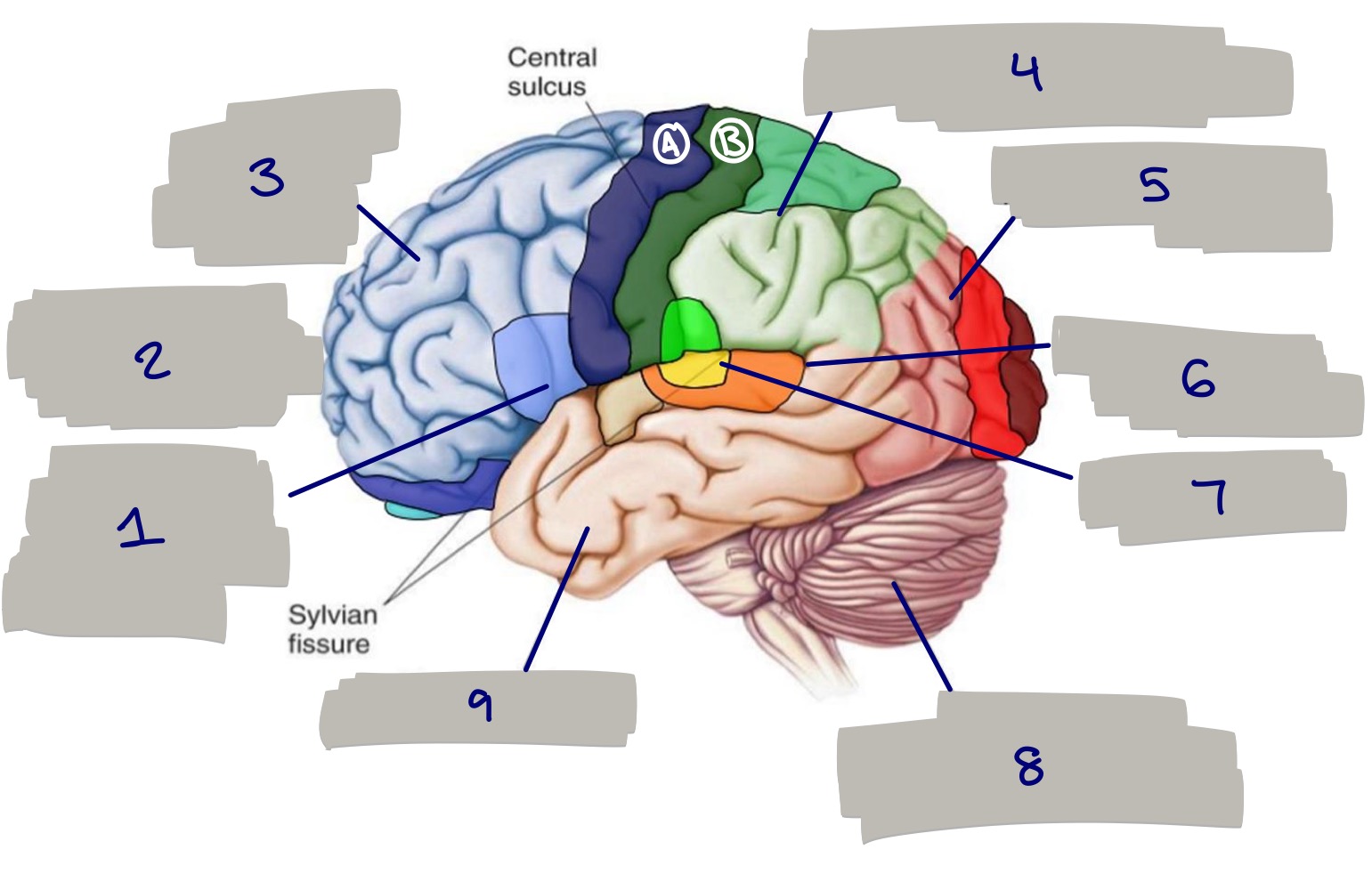
What does B represent? What are its functions?
Post-central Gyrus; Primary Somatosensory Cortex (Relay of info from body to brain)
How is grey matter organized?
Nuclei
How is white matter organized? Why is it white?
Tracts; Due to myelination of the axon fibers
What is the ultimate control and info processing center?
Cerebral Cortex
What are the axon fibers connecting the 2 cerebral hemispheres called?
Corpus Collosum
What relays messages between lower brain centers and cerebral cortex?
Thalamus
What acts as the major output tract of the hippocampus?
Fornix
What is linked to memory formation and is located in the temporal lobe?
Hippocampus
What is links emotions to memories?
Amygdala
What coordinates movement, balance, and support motor memories?
Cerebellum
What regulates the major autonomic functions such as heart rate, breathing, blood vessel function, sneezing, and coughing?
Medulla Oblongata
What acts as the pathway for neural fibers traveling to and from brain while also controlling simple reflexes?
Spinal Cord
What is involved in the control of breathing as well as sensations such as hearing, taste, balance, and reflex systems?
Pons
What is involved win motor movement (particularly the eye movements) and in auditory and visual processing?
Midbrain
What is the mastery endocrine gland?
Pituitary
What controls maintenance functions (like eating), helps govern endocrine system, Linked to emotion and reward, as well as setting circadian rhythms?
Hypothalamus
What are pyramidal tracts made of? Where do they originate? What is it called when they cross to the contralateral side of the body? Approximately where does this cross over occur?
Upper motor neurons; Motor cortex (Pre-central gyrus); Pyramidal Decussation; Occurs right underneath the Medulla