Anatomical Kinesiology (Chapter 5)
 Call Kai
 Learn
Learn Practice Test
 Spaced Repetition
 Match
Match Flashcards
 Knowt Play
1/36

There's no tags or description
Looks like no tags are added yet.
Name | Mastery | Learn | Test | Matching | Spaced | Call with Kai | Chat |
|---|
No analytics yet
Send a link to your students to track their progress
37 Terms
How does humeral movement relate to scapular movement?
Flexion/abduction → scapular elevation + upward rotation + abduction
Adduction/extension → scapular depression + downward rotation + adduction
Internal rotation/horizontal adduction → scapular abduction
External rotation/horizontal abduction → scapular adduction
What happens to the scapula during the lifting/pushing phase of a push-up?
Scapular protraction (abduction) — the scapula moves laterally away from the spine.
What muscle weakness can cause scapular winging?
Most commonly serratus anterior weakness/paralysis → medial winging, often due to long thoracic nerve injury.
Less commonly: trapezius and/or rhomboid weakness → lateral winging.
Why is the shoulder joint prone to instability?
Its wide range of motion requires significant laxity, which reduces stability.
↑ Mobility → ↓ Stability
Common problems: rotator cuff impingement, subluxations, and dislocations.
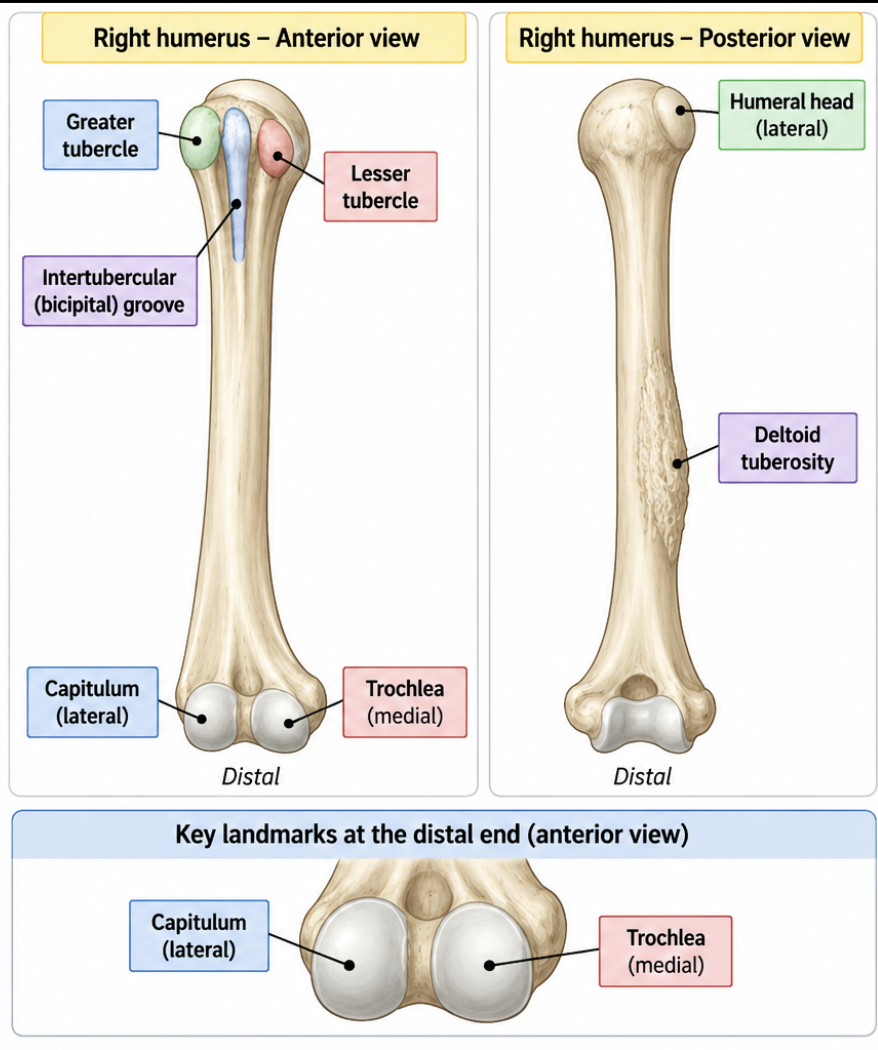
How do you determine if a humerus is the left or right humerus?
Step 1 — Anterior vs. posterior
Anterior → look for the intertubercular (bicipital) groove, where the long head of the biceps tendon runs.
Posterior → bicipital groove is not visible.
Step 2 — Medial vs. lateral
Humeral head = medial (faces toward the body/glenoid).
Greater tubercle = lateral.
Step 3 — Left vs. right
Orient the bone with the humeral head facing medially and the bicipital groove anteriorly.
Then determine which side of the body it fits.
Key check: Head = medial; bicipital groove = anterior.
What type of joint is the glenohumeral joint?
Multiaxial ball-and-socket (enarthrodial) joint.

What is the function of the glenoid labrum?
Slightly enhances stability of the glenohumeral joint.
What is a SLAP tear?
Superior Labrum Anterior to Posterior tear = the superior glenoid labrum is torn from anterior → posterior.
What is the role of the glenohumeral ligaments?
Provide shoulder stability, especially anteriorly and inferiorly. The inferior glenohumeral ligament is particularly important for stability.
Most shoulder dislocations/subluxations occur anteriorly or anteroinferiorly.
What is the difference between a shoulder dislocation and subluxation?
Dislocation = complete separation of the humeral head from the glenoid.
Subluxation = partial/incomplete separation; some joint contact remains.
Why are the glenohumeral joint ligaments relatively lax?
They remain lax through most of the ROM and become taut near extreme ranges of motion, allowing high shoulder mobility at the cost of stability.
Think: “soggy diaper” → loose/slack normally, but gets pulled tight at the extremes of motion.

Why is it difficult to determine the exact ROM of the glenohumeral joint?
Because glenohumeral movement is accompanied by shoulder girdle/scapular movement, making it difficult to isolate the exact ROM of the glenohumeral joint alone.
Shoulder joint + shoulder girdle movement → greater total ROM.
Pure glenohumeral movement alone → much lower ROM.
The accompanying shoulder girdle/scapular movement makes the shoulder’s overall ROM much greater.
What is the pure glenohumeral ROM for abduction and adduction?
Abduction: 90–95°
Adduction: 0° in anatomical position; up to 75° anterior to the trunk.

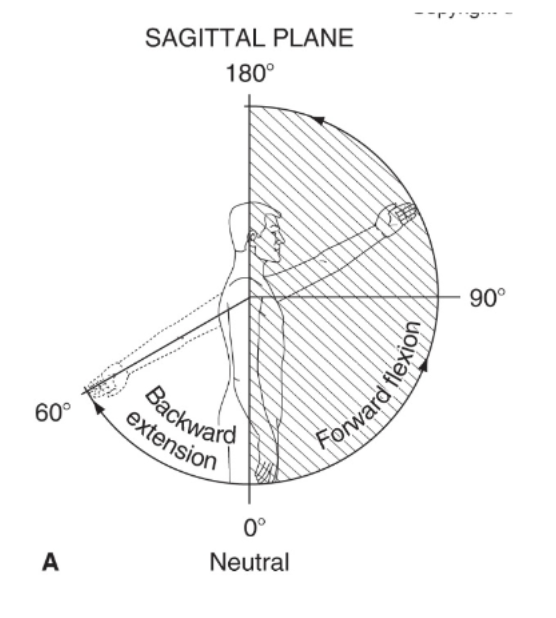
What is the pure glenohumeral ROM for flexion and extension?
Flexion: 90–100°
Extension: 40–60°
What is the pure glenohumeral ROM for internal and external rotation?
Internal rotation: 70–90°
External rotation: 70–90°

What is the pure glenohumeral ROM for horizontal abduction and adduction?
Horizontal abduction: 45°
Horizontal adduction: 135°

Why is the glenohumeral joint frequently injured, and what instability patterns are common?
Shallow glenoid fossa
Lax ligamentous structures
Lack of muscle strength/endurance
Anterior or anteroinferior subluxations/dislocations = common
Posterior dislocations = rare
Posterior instability = somewhat common
What are the rotator cuff muscles, and what is their main role at the glenohumeral joint?
SITS = Supraspinatus, Infraspinatus, Teres minor, Subscapularis
Attach around the front, top, and back of the humeral head
Allow humeral rotation
Stabilize/maintain the humeral head within the glenoid fossa while larger muscles move the humerus
Rotator cuff is frequently injured
What is GIRD, and why is it important?
GIRD = Glenohumeral Internal Rotation Deficit
Difference in internal rotation ROM between throwing vs. nonthrowing shoulder
20% GIRD in overhead athletes → higher injury risk
Stretching to regain internal rotation may:
Improve performance
Reduce likelihood of injury
Which shoulder joint movements pair with which shoulder girdle movements?
Abduction → Upward rotation
Adduction → Downward rotation
Flexion → Elevation + upward rotation
Extension → Depression + downward rotation
Internal rotation → Abduction (protraction)
External rotation → Adduction (retraction)
Horizontal abduction → Adduction (retraction)
Horizontal adduction → Abduction (protraction)
Scapulohumeral rhythm = coordinated movement of the glenohumeral joint + scapula to produce total shoulder ROM.
Scapulohumeral rhythm = coordinated movement of the glenohumeral joint + scapula to produce total shoulder ROM.
Key ratio = 2:1
2° glenohumeral motion
1° scapular motion
Example: 170–180° total abduction ≈
95° glenohumeral abduction
60° scapular upward rotation
25° scapular elevation
Key idea: GH + scapular movements are synergistic, not necessarily sequential. The 2:1 ratio may vary between individuals.
movments…
What is the difference between glenohumeral abduction and adduction?
Abduction → humerus moves upward/laterally out to the side, away from the body.
Adduction → humerus moves downward/medially toward the body from an abducted position.
What is the difference between glenohumeral flexion and extension?
Flexion → humerus moves straight anteriorly (forward).
Extension → humerus moves straight posteriorly (backward).
What is the difference between glenohumeral horizontal adduction and horizontal abduction?
Horizontal adduction → humerus moves across/toward the chest in the horizontal (transverse) plane.
Horizontal abduction → humerus moves away from the chest in the horizontal (transverse) plane.
What is the difference between glenohumeral external and internal rotation, and what scapular movements accompany them?
External rotation → humerus rotates laterally, away from midline
→ Scapular adduction (retraction)
Internal rotation → humerus rotates medially, toward midline
→ Scapular abduction (protraction)
What is the difference between diagonal abduction and diagonal adduction of the shoulder?
Diagonal abduction → humerus moves diagonally away from the midline.
Diagonal adduction → humerus moves diagonally toward the midline.
Intrinsic vs. extrinsic glenohumeral muscles
Intrinsic glenohumeral muscles:
Originate on the scapula or clavicle
Deltoid
Coracobrachialis
Teres major
Rotator cuff group:
Subscapularis
Supraspinatus
Infraspinatus
Teres minor
Extrinsic glenohumeral muscles:
Latissimus dorsi
Pectoralis major
Which glenohumeral muscles are anterior vs. superior?
Anterior:
Pectoralis major
Coracobrachialis
Subscapularis
Superior:
Deltoid
Supraspinatus
Which glenohumeral muscles are superior vs. posterior?
Superior:
Deltoid
Supraspinatus
Posterior:
Latissimus dorsi
Teres major
Infraspinatus
Teres minor
What nerves innervate the shoulder joint muscles shown on this slide?
All shoulder joint muscles are innervated by branches of the brachial plexus.
Lateral pectoral nerve:
Roots: C5, C6, C7
Innervates pectoralis major, clavicular head
Medial pectoral nerve:
Roots: C8, T1
Innervates pectoralis major, sternal head
Thoracodorsal nerve:
Roots: C6, C7, C8
Innervates latissimus dorsi
What nerves innervate the deltoid, teres minor, and subscapularis?
Axillary nerve:
Roots: C5, C6
Innervates:
Deltoid
Teres minor
Sensory:
Lateral patch of skin over the deltoid region of the arm
Upper subscapular nerve:
Roots: C5, C6
Innervates:
Subscapularis

What nerves innervate the subscapularis, teres major, supraspinatus, and infraspinatus?
Lower subscapular nerve:
Roots: C5, C6
Innervates:
Subscapularis
Teres major
Suprascapular nerve:
Roots: C5, C6
Innervates:
Supraspinatus
Infraspinatus
What are the roots, motor function, and sensory function of the musculocutaneous nerve?
Musculocutaneous nerve:
Roots: C5, C6, C7
Motor:
Coracobrachialis
Sensory:
Radial aspect of the forearm

What are the actions of the deltoid muscle fibers?
Anterior fibers:
Abduction
Flexion
Horizontal adduction
Internal rotation
Middle fibers:
Abduction
Posterior fibers:
Abduction
Extension
Horizontal abduction
External rotation

What are the actions of the upper and lower fibers of the pectoralis major?
Upper fibers (clavicular head):
Internal rotation
Horizontal adduction
Flexion
Assists with abduction once arm is abducted 90°
Adduction when arm is below 90° of abduction
Lower fibers (sternal head):
Internal rotation
Horizontal adduction
Extension from a flexed position
Adduction
Memory tip:
Upper fibers = “UP and ACROSS”
Lower fibers = “DOWN, BACK, and ACROSS”
Both share: internal rotation + horizontal adduction

What are the actions of the latissimus dorsi?
Adduction
Extension
Internal rotation
Horizontal abduction
Memory tip:
Adduction = arm moves toward the body
Extension = arm moves backward
Internal rotation = humerus rotates inward
Horizontal abduction = arm moves backward in the horizontal plane
