L17/C7: Carbohydrates
 Call Kai
 Learn
 Practice Test
 Spaced Repetition
 Match
 Flashcards
 Knowt Play
1/22

Earn XP
Description and Tags
Biochemistry I
23 Terms
Carbohydrates or saccharides
most abundant biological molecules
essential components of living organisms
Monosaccharide
a single saccharide
can associate to form very diverse polymers, which can either be linear or branched, and include different types of monosaccharides (different chemical properties)
aldehyde or ketone derivatives of straight chain polyhydroxyl alcohols containing at leas three carbon atoms
Oligosaccharide
few linked monosaccharides; they can be associated with proteins (glycoproteins) or lipids (glycolipids)
Polysaccharides
consist of many monosaccharides connected via glycosidic bonds
ex: cellulose and glycogen
can be Homopolysaccharides or Heteropolysaccharides
structure and placement controlled enzymatically
are also known as glycans
can form branched and well as linear polymers
exo- and endo- glycosidases are enzymes that will hydrolyze monosaccharide units in much the same way that exo and endo- peptidases cleave peptide bonds in proteins
Aldoses
The carbonyl group is an aldehyde (CHO)
Ketoses
The carbonyl group is a ketone (CO)
D-sugars
those that have the same stereochemical configuration at the asymmetric center farthest from their carbonyl group as does D-glyceraldehyde
much more prevalent than L-sugars, so D-prefix might be omitted from common sugars (ex: Glucose and Fructose)
Epimers
Sugar molecules differing in stereochemical configuration at only one carbon atom
particular case of diastereomers
Pyranose
The cyclic six-membered ring form of sugars
Furanose
The cyclic five-membered ring form of sugars
a Anomer
OH down, OH opposite side of ring from CH2OH (hydroxymethyl)
B-anomer
OH up, OH same side of ring from CH2OH (hydroxymethyl)
Glycosidic Bond
The bond linking the anomeric carbon to the oxygen of the OH substituent
can either be in the a or B anomeric configuration and can be linked through the 1-2, 1-4, 1-6 linkage
Reducing Sugar
Those bearing an unlinked anomeric alcohol group
can reduce an oxidizing agent
Non-reducing sugar
The anomeric alcohol group is linked with another sugar or molecule
cannot reduce an oxidizing agent
Cellulose structure
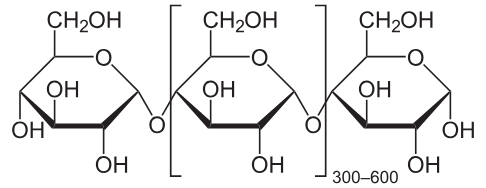
polymer of glucose units linked by B-D-glucose (1,4)

Starch
A mixture of a-amylose and amylopectin that plants synthesize for energy reserve
a-amylose
linear polymer of several thousand glucose residues connected via a(1-4) bonds
polymer forms a left-handed helix
Amylopectin
Mainly a(1-4) glucose with occasional a(1-6) branches every 24-30 glucoses
Glycogen
Storage polysaccharide of animals
structurally similar to amylopectin, but more highly branched
Glycosaminoglycans
unbranched polysaccharides that compose a gel-like matrix used to fill extracellular spaces (particularly connective tissue)
can be associated with proteins in the extracellular matrix to form proteoglycans
proteoglycans form highly hydrated gels and serving as shock absorber and lubricant
Peptidoglycan (Bacterial Cell Wall)
mostly impermeable to drugs and stabilize bacteria against hypotonic (salt gradients) and osmotic shock
composed of disaccharide with amino acid chain and pentaglycine bridge
D-amino acids render them resistant to proteases, which are specific for L-amino acids
Glycoproteins
oligosaccharide modifications for proteins can have critically important biological implications
protein structure and biological stability
recognition events
virus infection
immune recognition
antigenic determinants (blood type)
modifications of proteins by polysaccharide units have specific or less specific requirements
Sequence: Asn-X-Ser/Thr for N-linked oligosaccharides
Secondary or Tertiary structure for O-linked oligosaccharides, accessibility dictated