Flashcards AP Biology Cell Cycle, Mitosis, and DNA Replication
 Call Kai
 Learn
 Practice Test
 Spaced Repetition
 Match
 Flashcards
 Knowt Play
1/56

There's no tags or description
Looks like no tags are added yet.
57 Terms
What is the cell cycle?
The life of a cell from its formation until it divides, involving mitosis and cytokinesis.
What are the two main processes of eukaryotic cell reproduction?
Mitosis and cytokinesis.
What does mitosis produce?
Two genetically identical daughter cells.

What is cytokinesis?
The division of the cytoplasm following mitosis.

What is the purpose of the cell cycle in unicellular organisms?
To reproduce and make more of themselves.
What is the purpose of the cell cycle in multicellular organisms?
To make more cells from a fertilized egg, for growth, or for repair.
What is chromatin?
DNA associated with histone proteins, allowing for protein synthesis and DNA replication.
What forms when chromatin condenses?
Chromosomes.
What are sister chromatids?
Duplicated copies of a chromosome joined together at the centromere.
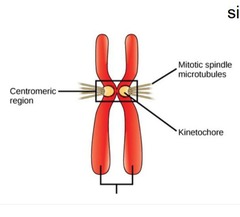
What is the centromere?
The region on each sister chromatid where they are most closely attached.
What is a kinetochore?
Proteins attached to the centromere that link each sister chromatid to the mitotic spindle.
What is a genome?
All of a cell's genetic information (DNA).
How many chromosomes do humans have?
46 chromosomes (2n=46).
What are homologous chromosomes?
Two chromosomes (one from each parent) that are the same length and carry genes controlling the same characteristics.
What are somatic cells?
Body cells that are diploid (2n) and divide by mitosis.
What are gametes?
Reproductive cells that are haploid (n) and divide by meiosis.
What are the phases of the cell cycle?
G1, S, G2, mitosis, and cytokinesis.
What occurs during the G1 phase?
The cell grows and carries out normal functions.
What occurs during the S phase?
DNA replication and chromosome duplication.
What occurs during the G2 phase?
Final growth and preparation for mitosis.
What are the five stages of mitosis?
Prophase, prometaphase, metaphase, anaphase, and telophase.

What happens during prophase?
Chromatin condenses, nucleoli disappear, and the mitotic spindle begins to form.
What happens during prometaphase?
The nuclear envelope fragments and microtubules attach to kinetochores.
What happens during metaphase?
Sister chromatids align at the metaphase plate.

What happens during anaphase?
Sister chromatids separate and move to opposite ends of the cell.
What happens during telophase?
Two daughter nuclei form and chromosomes become less condensed.
How does cytokinesis occur in animal cells?
A cleavage furrow appears due to a contractile ring of actin filaments.
How does cytokinesis occur in plant cells?
Vesicles from the Golgi form a cell plate in the middle of the cell.
What is binary fission?
The process by which prokaryotic cells replicate their DNA and divide.

What is the purpose of the cell cycle?
To regulate cell growth and division.
What are the two types of chromosomes in human cells?
Maternal chromosomes and paternal chromosomes.
What does 2n=2 represent in cell division?
It indicates that there are 2 daughter cells, each with 2 chromosomes.
What is the G1 checkpoint responsible for?
It checks for cell size, growth factors, and DNA damage.

What happens if a cell receives a 'Stop' signal at the G1 checkpoint?
The cell enters a nondividing state known as G0 phase.
What is the G2 checkpoint's function?
It checks for completion of DNA replication and DNA damage.
What occurs if DNA damage cannot be repaired at the G2 checkpoint?
The cell will undergo apoptosis (programmed cell death).
What does the M (Spindle) checkpoint check for?
It checks for microtubule attachment to chromosomes at the kinetochores.
What are cyclins?
Proteins that regulate the cell cycle by varying in concentration at different stages.
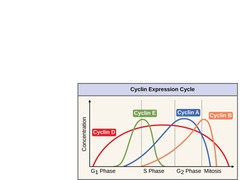
What are cyclin-dependent kinases (CDKs)?
Enzymes that remain constant in concentration but are activated by specific cyclins.
What is the role of growth factors in the cell cycle?
They stimulate cell growth and activate CDKs to progress through the cell cycle.
What is contact inhibition?
A mechanism where cells stop dividing when they come into contact with other cells.

What is anchorage dependence?
The requirement for cells to be attached to other cells or the extracellular matrix to divide.
How do normal cells differ from cancer cells regarding checkpoints?
Normal cells follow checkpoints, while cancer cells evade them.
What is a benign tumor?
A mass of abnormal cells that do not spread and are not considered cancerous.
What is a malignant tumor?
A mass of cancerous cells that can spread to other parts of the body.
What is metastasis?
The process by which cancer cells spread from the original tumor to other parts of the body.
What is the purpose of DNA replication?
To ensure each daughter cell has a complete copy of genetic information.

What is the semiconservative model of DNA replication?
Each daughter DNA molecule consists of one old strand and one newly made strand.
What is the role of helicase in DNA replication?
It unwinds the DNA double helix at the replication fork.
What is the function of RNA primase during DNA replication?
It adds an RNA primer to the 3' end of the template DNA to initiate replication.
What are Okazaki fragments?
Short segments of DNA synthesized on the lagging strand during DNA replication.
What enzyme replaces RNA primers with DNA nucleotides?
DNA polymerase I.
What is the function of DNA ligase?
It joins Okazaki fragments together to form a continuous DNA strand.
What is the directionality of DNA strands?
DNA strands are antiparallel, running in opposite directions (5' to 3' and 3' to 5').
What is the role of topoisomerase in DNA replication?
It relieves strain caused by twisting ahead of the replication fork.
What happens at the origins of replication?
DNA strands are separated, opening a replication bubble.
What is the significance of multiple replication bubbles in eukaryotes?
They speed up the copying of long DNA molecules.