Ch. 13 Light and Geometrical Optics
 Call Kai
 Learn
 Practice Test
 Spaced Repetition
 Match
 Flashcards
 Knowt Play
1/5

There's no tags or description
Looks like no tags are added yet.
6 Terms
Electromagnetic Waves
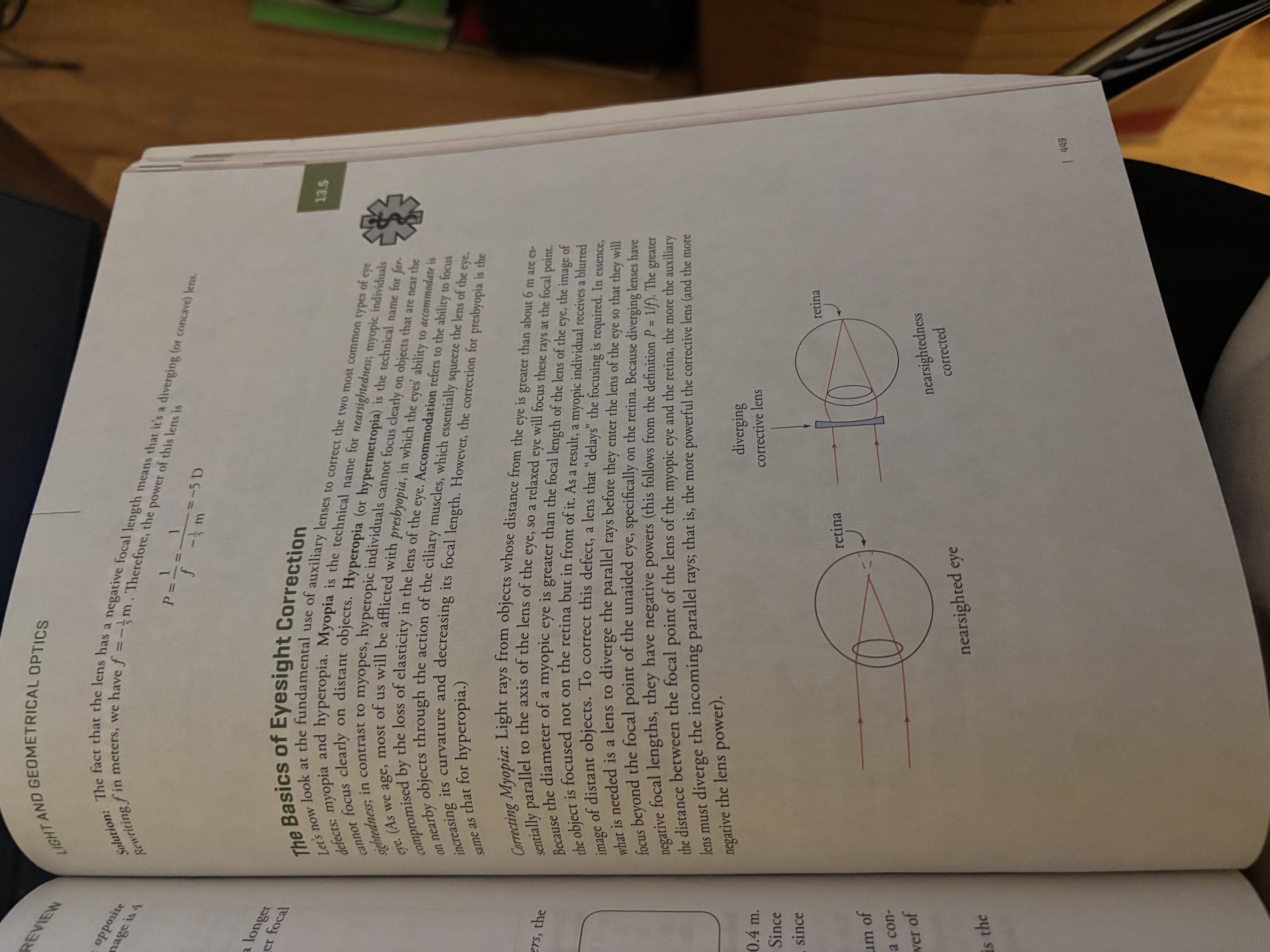
Electromagnetic waves are self-propagating transverse waves consisting of oscillating electric and magnetic fields that are perpendicular to each other and to the direction the wave travels.
oscillating electric charge generates an electromagnetic (EM) wave, composed of oscillating and magnetic fields
The oscillating electric and magnetic fields oscillate with the same frequency at which the electric charge that created the wave oscillated.
the electric and magnetic fields oscillate with each other, perpendicular to each other and to the direction of propagation. Therefore, EM waves are transverse waves.
-the direction in which the wave’s electric field oscillates is called the direction of polarization of the wave.
Most EM waves have electric fields oscillating in all perpendicular directions to propagation equally and are thus unpolarized.
Do electro-magnetic waves require a material medium to propagate?
Unlike waves on a rope or sound waves, electromagnetic waves do not require a material medium to propagate; they can travel through empty space (vacuum).
When an EM wave travels through vacuum, its speed is constant.
An electromagnetic (EM) wave travels at a constant speed in a vacuum (c=3.00×10⁸ m/s) because its speed is dictated entirely by the fundamental electrical and magnetic properties of empty space itself, rather than the wave's frequency, wavelength, or source.
No Medium Interactions: In a vacuum, there is no matter (such as atoms or electrons) to absorb, scatter, or interact with the wave. When EM waves pass through a material medium like glass or water, they interact with charged particles, causing the apparent wave speed to drop. Free space lacks this interference.
All electromagnetic waves, regardless of frequency, travel through vacuum at this speed (c=3.00×10⁸ m/s).
The most important equation for waves, v = λf, is also true for electromagnetic waves. For EM waves traveling through vacuum, v=c, so the equation becomes c = λf.
Frequencies of Electromagnetic Waves
The frequencies for electromagnetic waves span a huge range, and different ranges have been given specific names. This assignment of names to specific regions based on frequency (or wavelength) is known as the electromagnetic spectrum and is shown here.
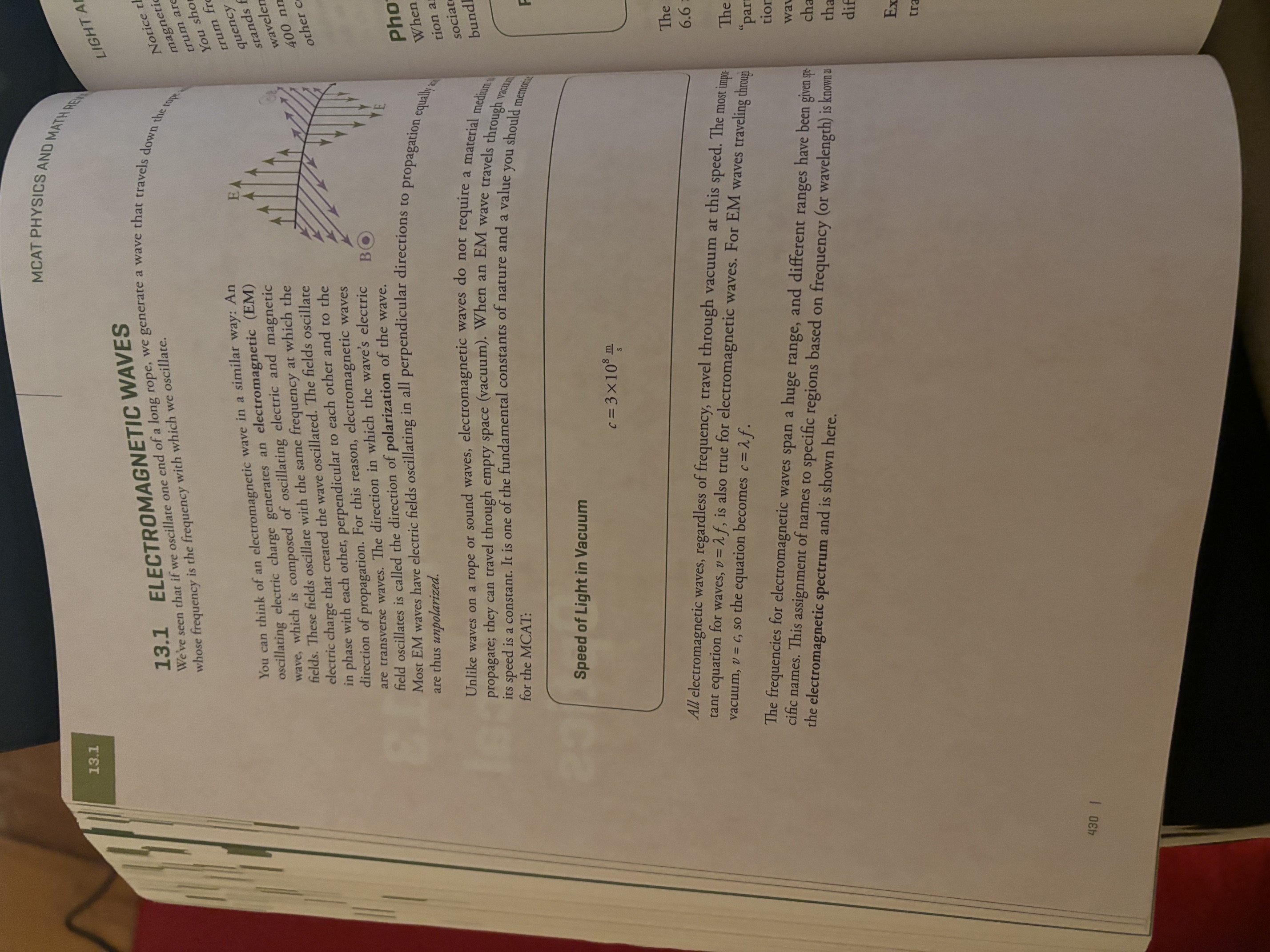
Notice that visible light occupies only a small part of the electromagnetic spectrum (1. EM waves of different frequencies compose the spectrum). When waves from all over the visible spectrum are mixed together, the resulting light is perceived as white.
Colors from lowest frequency to highest frequency
You should memorize the order of colors of the visible spectrum from the lowest frequency to highest frequency: ROYGBV, which stands for red, orange, yellow, green, blue violet. In terms of wavelengths, violet light has a wavelength (in vacuum) of about 400nm and red light has a wavelength of about 700 nm; other colors are in between.
Photons
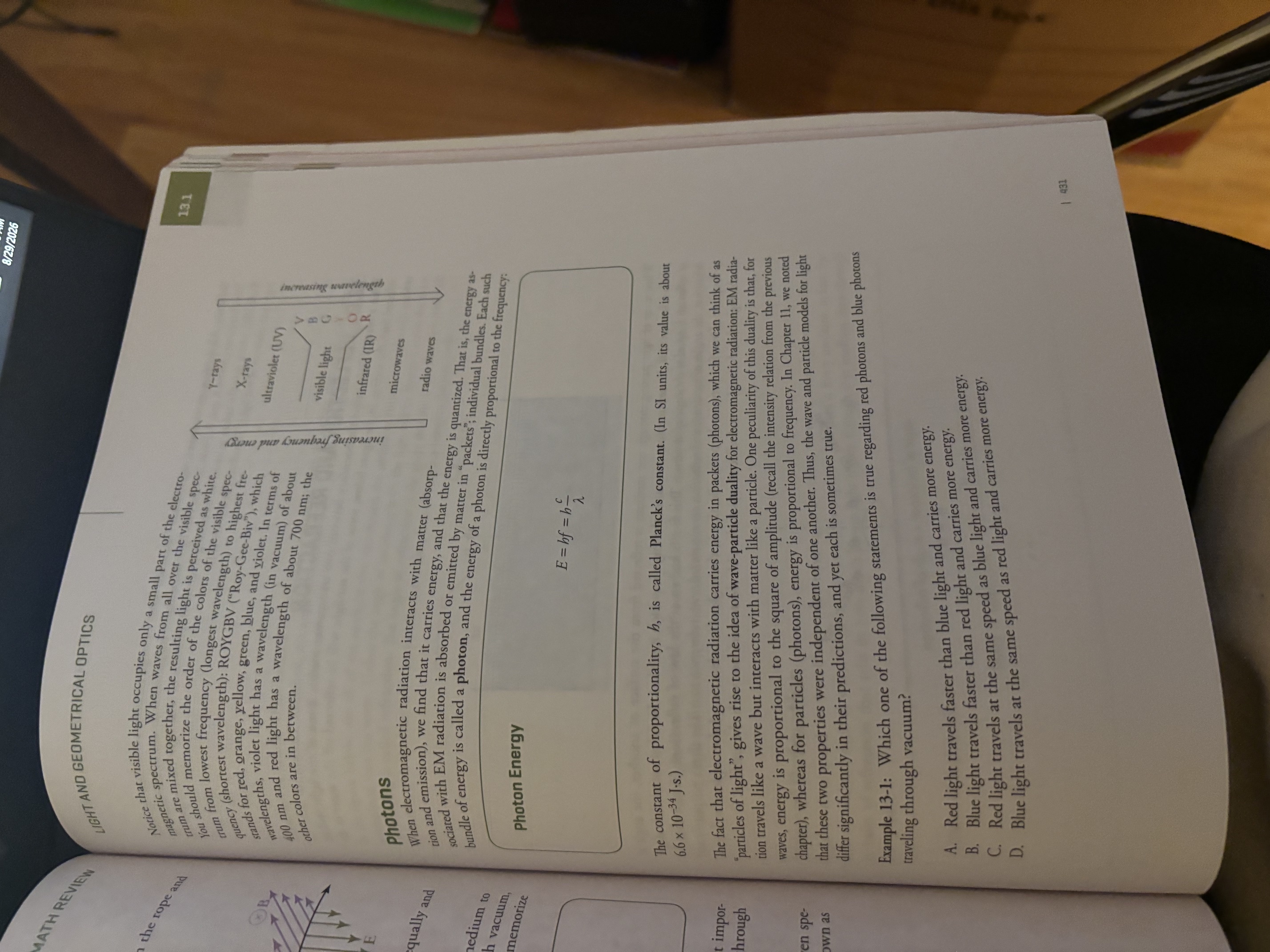
When electromagnetic radiation interacts with white matter (absorption and emission), we find that it carries energy, and that the energy is quantized. That is, the energy associated with EM radiation is absorbed or emitted by matter in “packets”; individual bundles. Each such bundle of energy is called a photon, and the energy of a photon is directly proportional to the frequency.
Photon energy: E=hf=h c/λ
The constant of proportionality, h, is called Planck’s constant. (In SI units, its value is about 6.6×10⁻³⁴ J⋅s.
The fact that electromagnetic radiation carries energy in packets (photons), which we can think of “particles of light”, gives rise to the idea of wave-particle duality for electromagnetic radiation: EM radiation travels like a wave but interacts with matter like a particle. One peculiarity of this duality is that, for waves, energy is proportional to the square of amplitude, whereas for particles (photons), energy is proportional to f
Wave–particle duality is a core principle of quantum mechanics stating that fundamental entities—such as photons (light) and electrons (matter)—exhibit both wave-like and particle-like properties depending on how they are measured or observed.
Example 13-1
Which one of the following statements is true regarding red photons and blue photons traveling through vacuum?
A. Red light travels faster than blue light and carries more energy
B. Blue light travels faster than red light and carries more energy
C. Red light travels faster at the same speed as blue light and carries more energy
D. Blue light travels at the same speed as red light and carries more energy.
Reflection and Refraction
beam of light strikes the boundary between two transparent media
some of the light will be reflected from the surface (some of the sunlight will be reflected off the water in the tank).
when a ray of light passing through one medium is reflected from the surface of another medium, the angle at which it bounces off the new medium is equal to the angle at which it strikes.
law of reflection states that when a ray of light bounces off a smooth surface, the angle of incidence is equal to the angle of reflection.

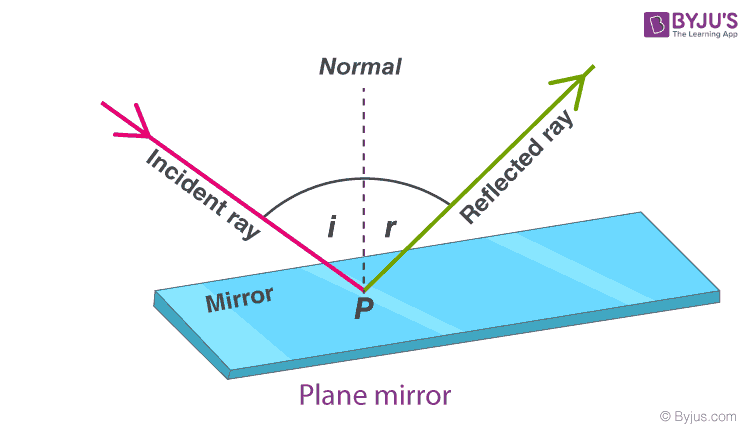
• Angle of Incidence: The angle between the incoming wave and the normal line (an imaginary line drawn perpendicular, or at a 90° angle, to the surface.
• Angle of Reflection: The angle between the reflected wave and the same normal line.
• The Normal Line: The reference line used to measure both angles, never the surface itself.
• The Plane: The incident ray, the reflected ray, and the normal line all lie in the exact same flat plane

Example 13-2
In the figure above, assume that a ray of sunlight strikes the water, making an angle 60° with the surface. What is the angle of reflection?
A. 15°
B. 30°
C. 60°
D. 90°
Solution: If the incident ray makes an angle of 60° with the surface, then it makes an angle 30° with the normal. Therefore, the angle of incidence is 30°. By the law of reflection, the angle of reflection is 30° also. Choice B is the answer.
Refraction
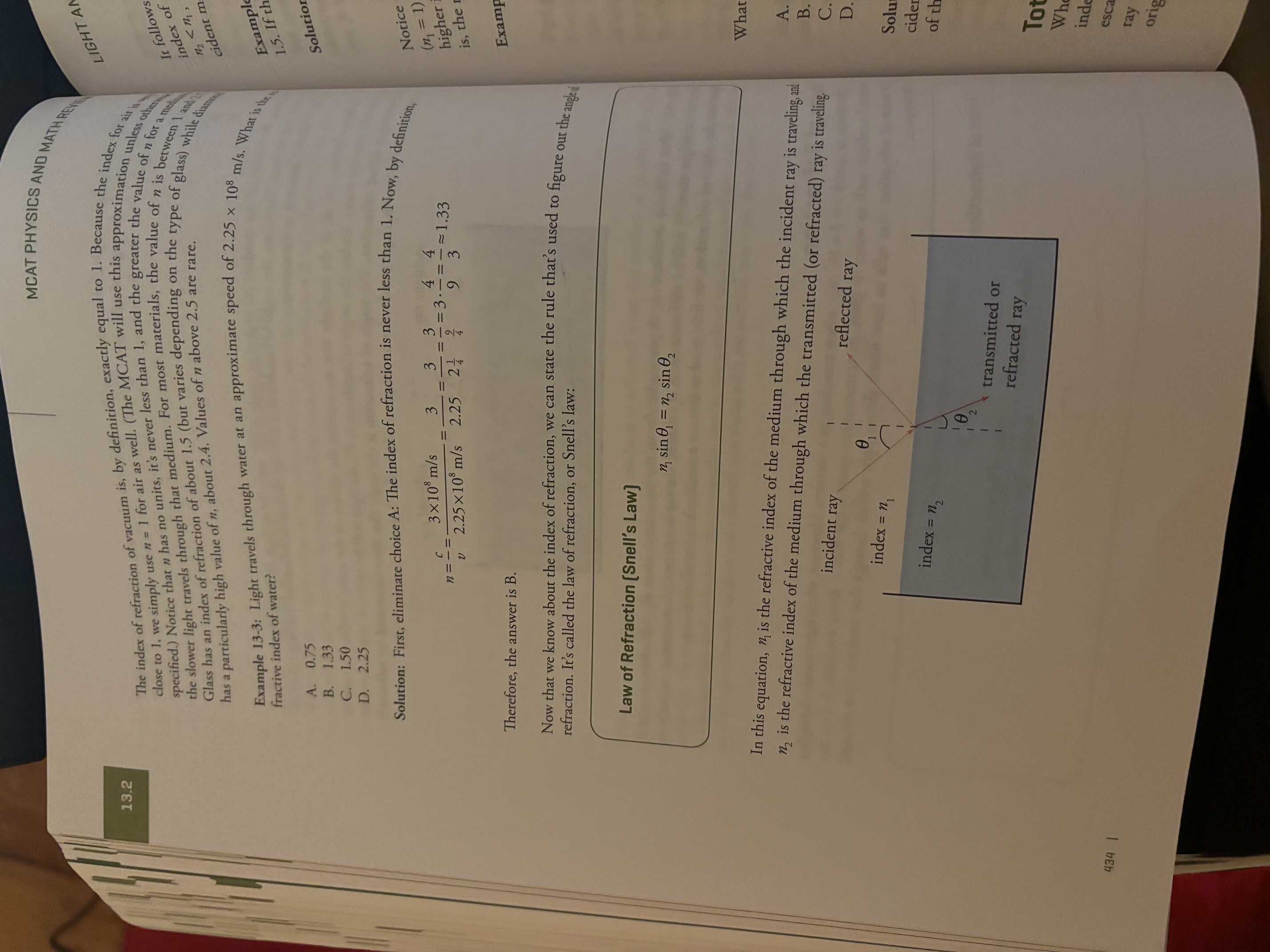
In the figure below, not all of the sunlight that encounters the surface of the water is reflected. Unless the angle of incidence is 0°, the light will be bent as it enters the water.
Refraction is the bending or redirection of a wave—such as light, sound, or water—when it passes at an angle from one medium into another and changes speed.
The angle of refraction: is the angle that the transmitted (for refracted) ray makes with the line that’s perpendicular to the plane of interface between the two media.
If θ1=0° (that is, if the incidence ray is perpendicular to the boundary), then θ2=0°. However, if θ1 if any other angle, then θ2 will be different from θ1; that is, the ray bends as it’s transmitted. In order to figure out the angle of refraction, we first need to discuss a medium’s index of refraction.
Index of Refraction
Please notice a difference:
refraction is light bending
angle of refraction is the angle that the transmitted ray makes with the line that’s perpendicular to the plane
the index of refraction is how much light slows down in material (this makes sense because refraction of the bending of light in material)
Light travels at speed c=3.0×10⁸ m/s when traveling in a vacuum (a region of space devoid of matter).
However, when light travels through a material medium such as water or glass, its transmission speed is less than c.
Every medium has multiples of refraction that tells us how much slower light travels through that medium than through empty space.
index of refraction= speed of light in vacuum/speed of light in refraction
n=c/v
the index of refraction in a vacuum is equal to 1.
Because the index of refraction for air is very close to 1, we simply use n=1 for air as well. (The MCAT will use approximation unless otherwise specifed).
Notice that n has no units, it’s never less than one, and the greater the value of n for a medium, the slower light travels through that medium.
For most materials, the value of n is between 1 and 2.5. Glass has an index of refraction of about 1.5 (but varies depending on the type of glass) while diamond has a particularly high value of n, about 2.4.
Example 13-3: Light travels through water at an approximate speed of 2.25×10⁸ m/s. What is the refractive index of water?
n=c/v
n= 3.0×10⁸ m/s /2.25×108 m/s=
2.25 (the decimal is to the hundreths place)
2.25= 225/100= (reduce by the greatest common factor, 4)= 9/4.
3/ 9/4= (when dividing fractions, multiply by the reciprocal)= 3/1 × 4/9= 12/9, 12/9 (reduce by greatest common factor, 3)= 4/3
4/3 is closest to 1.33, so the answer is 1.33
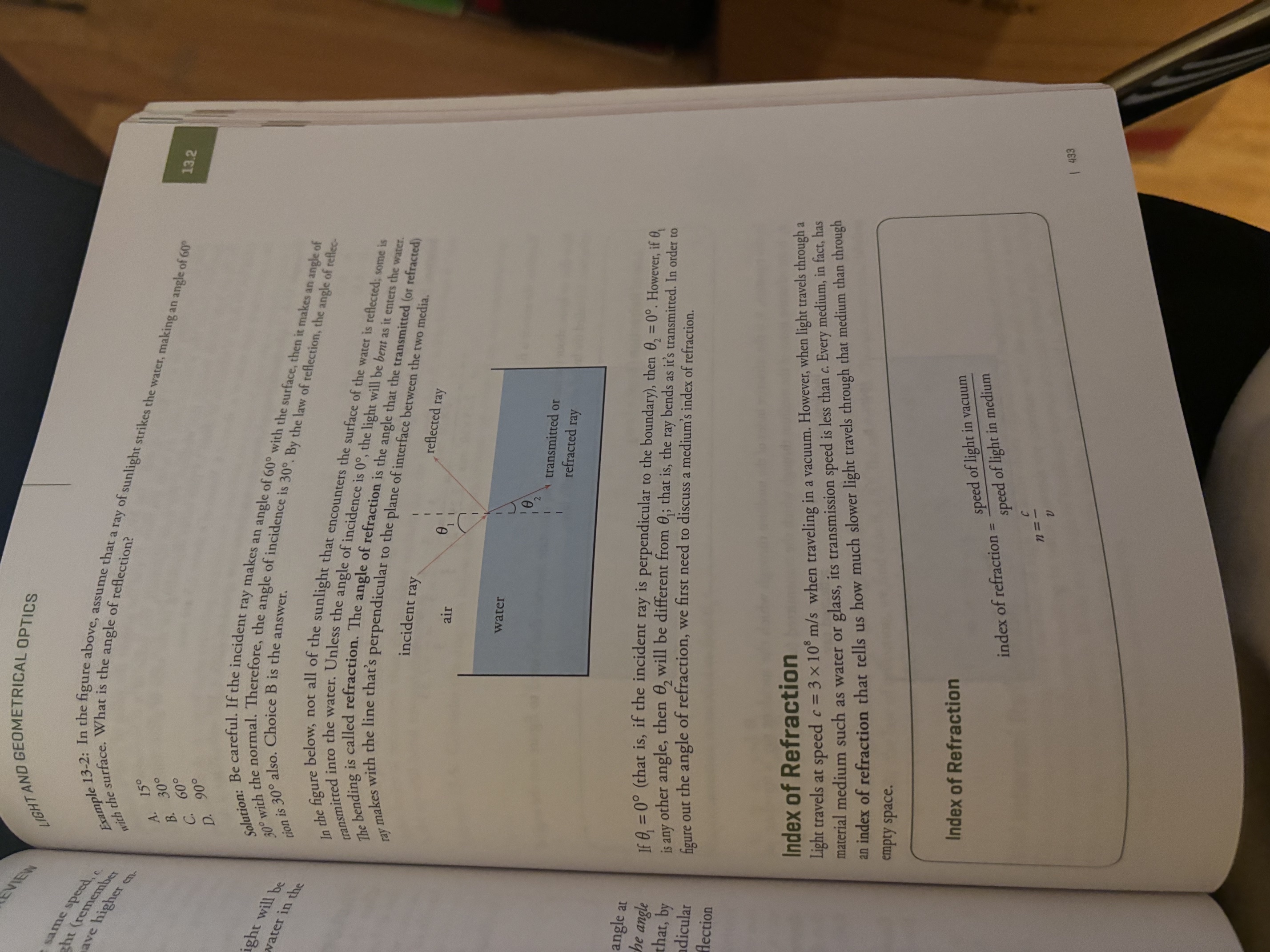
Law of Refraction (Snell’s Law)
n1sinθ1= n2sinθ2
n1 is the refractive index of the medium through which the incident ray is traveling
n2 is the refractive index of the medium through which the transmitted (or refracted) ray is traveling.
It follows from Snell’s law that if if n2>n1, then θ2<θ1. That is, if the transmitting medium has a higher index of refraction than the incident medium, then the ray will bend toward the normal.
-relationship, the higher n2, the more the angle of refraction θ2 bends toward the normal.
Similarly, if n2<n1, then θ2>θ1. That is, if the transmitting medium has a lower index of refraction than the incident medium, then the ray will bend away from the normal. You should memorize both of these facts.
Example 13-4, 13-5 come back.

Total Internal Refraction
When a light ray traveling in a medium of high refractive index approaches a medium of lower refractive index (for example, a light ray traveling in a water towards the interface with the air), it may or may not escape into the second medium. If the ray’s angle of incidence exceeds a certain critical angle, the light ray will undergo total internal reflection: All of the incident ray’s energy will be reflected back into it’s original medium; there will be no refracted ray.
In optics, the critical angle is the angle of incidence inside a denser medium at which a light ray refracts at 90° along the boundary, above which total internal reflection occurs.
-light is traveling through water first.
Total internal reflection is the complete reflection of a wave—such as light—back into its original medium when it hits a boundary with a second medium at a steep enough angle instead of refracting out.
Critical Angle for Total Internal Reflection
sinθcrit= n2/n1
In this equation, n1 is the refractive index of the medium through which the incident ray is traveling, and n2 is the refractive index of the medium on the other side of the boundary.
The angle θcrit is the critical angle. What this means is that if the angle of incidence, θ1 > θcrit, then total internal reflection will occur. (If θ1 just happens to equal θcrit, then the refracted beam skims along the boundary with θ2= 90°.)
However, if θ1 <θcrit, then total internal reflection will not occur. (If θ1 just happens to equal θcrit, then the reflected beam skims among the boundary with θ2= 90 degrees.

Notice that there can be a critical angle for total internal reflection only if n1 is greater than n2. For example, a beam of light incident in the air and striking the surface of the water can never experience total internal reflection because n1< n2. In other words, there’ll be some reflection and some refraction, as usual. In this case, some of the light’s intensity will always be transmitted into the water.
Example 13-6
Diffraction
Simply put, waves, whether they’re water waves, sound waves, EM waves, etc., don’t always travel in a single direction when they encounter an obstruction.
Wave diffraction is the spreading and bending of waves when they pass through an opening or around the edge of an obstacle. It happens to all types of waves—including light, sound, water, and matter waves—without changing their wavelength, frequency, or speed.
This redistribution of the wave’s intensity is known as diffraction. Water waves bend around a rock sticking up out of the water, for example. The “obstruction” can even be a hole. For example, water or light incident on a hole in a barrier will pass through and spread out beyond the barrier.
These effects are observed when the size of the object or opening is comparable to the wavelength of waves.

Polarization
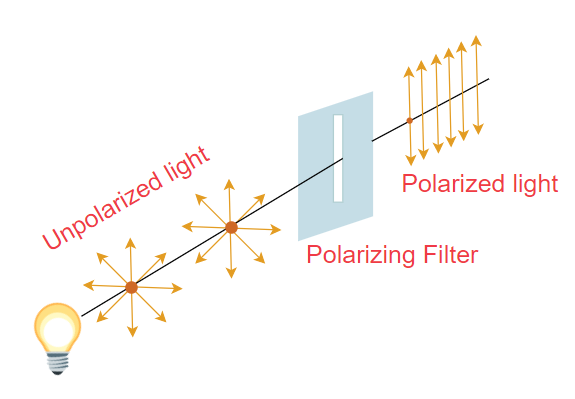
Naturally, the electric field components of the waves in a beam light vibrate in all planes.
Polarized light is light whose direction of polarization has been restricted somehow. For example, all the waves in a beam of plane polarized light have their electric field components vibrating in a single plane.
It is possible to transform unpolarized light into polarized light by several methods. One method is the use of a polarizing filter. The filter has a polarization axis, so that when unpolarized light strikes the filter, only the portion of the waves vibrating in that direction pass through while the portion of the waves vibrating perpendicular to the axis absorbed. The light that emerges is now polarized in direction of the axis and has half the intensity of the original unpolarized light.
In optics, polarization is the orientation of the electric field's oscillation in a light wave as it travels through space. Light is a transverse wave, meaning its electric field vibrates perpendicular to the direction the wave moves. Natural light from the sun or a standard bulb is usually unpolarized (oscillating randomly in many directions), whereas polarized light follows a defined pattern.
If polarized light passes through a second polarizer, the amount of light that pass through or is absorbed depends on the angle between the direction of polarization of the incident light and the axis of polarization. As an example, if vertically polarized light is incident upon horitally polarizing filter, none of the light will pass through.

d



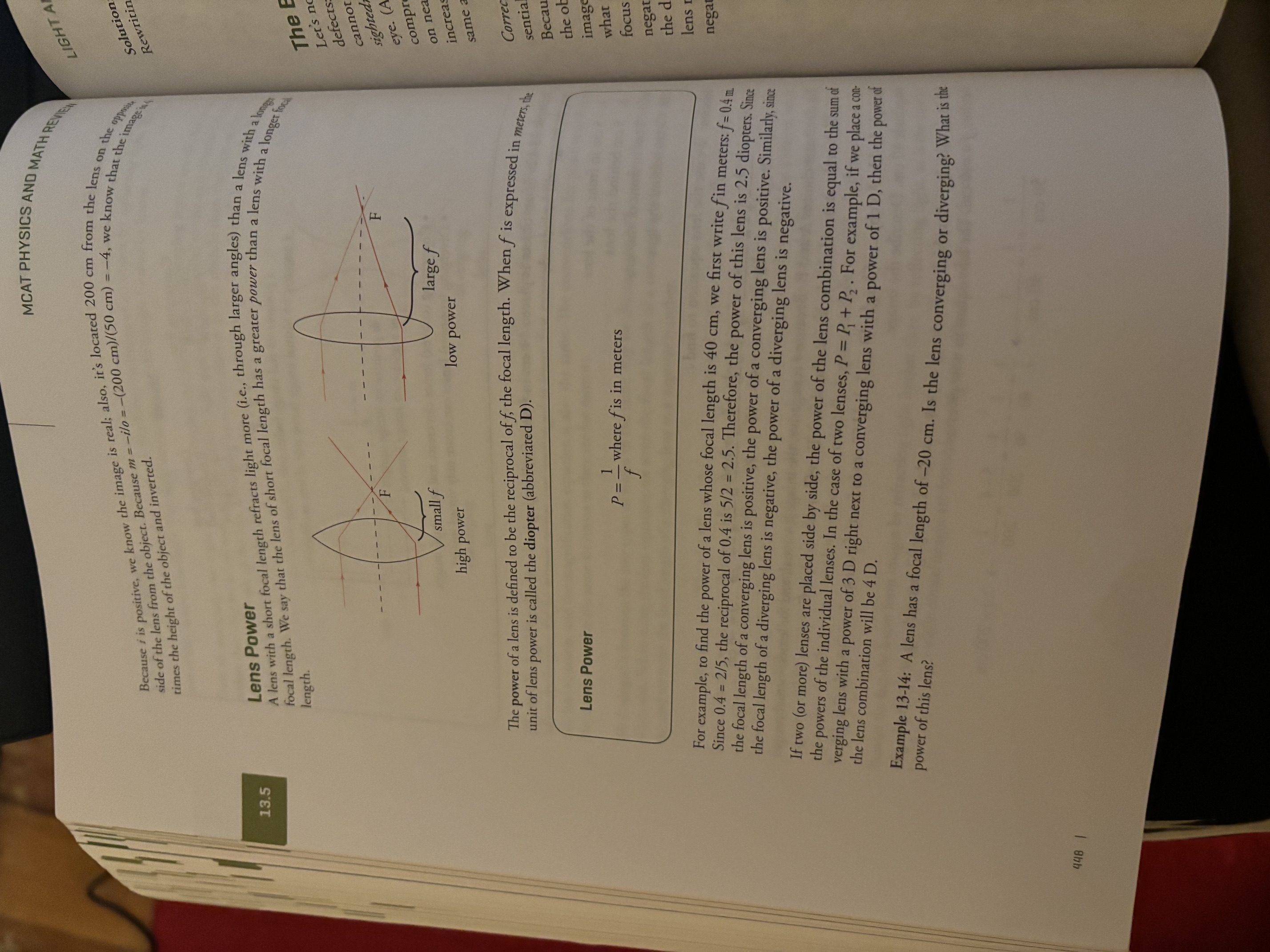
Len’s power