L23 - Reproduction 2
 Call Kai
 Learn
 Practice Test
 Spaced Repetition
 Match
 Flashcards
 Knowt Play
1/48

There's no tags or description
Looks like no tags are added yet.
49 Terms
What is Puberty?
Puberty is the activation of reproductive capacity
Puberty may occur before the ideal time for planned breeding
What is the Basic Hypothalamic–Pituitary–Gonadal Pathway in Females?
Hypothalamus → GnRH → Anterior pituitary → FSH + LH → Ovary
FSH: supports follicular growth
LH: supports steroid production, ovulation, and luteal development
Estradiol + progesterone: provide feedback to the brain/pituitary
Why does the pattern of reproductive hormone release matter?
Hormone pulses → maintain ongoing reproductive signaling
LH surge → initiates the ovulatory cascade

What hormone is primarily associated with a growing follicle?
Estradiol. A growing follicle contains an oocyte and is an important source of estradiol

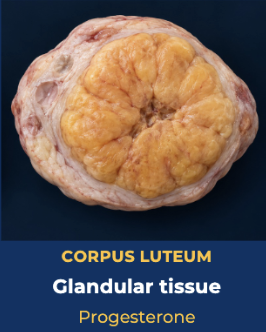
What hormone is primarily associated with the corpus luteum (CL)?
Progesterone. After ovulation, follicular cells reorganize to form the progesterone-producing CL
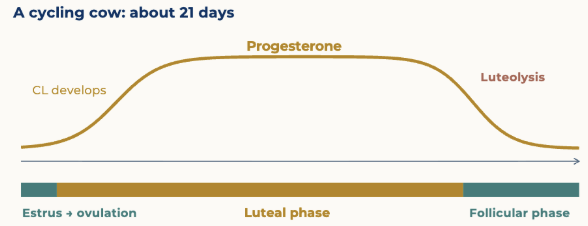
What are the Two Major Phases of the Bovine Reproductive Cycle?
Luteal phase: metestrus + diestrus → functional CL → progesterone maintained
Follicular phase: proestrus + estrus → progesterone falls as luteal function ends
What happens when Progesterone is HIGH during the reproductive cycle?
A functional CL maintains high progesterone, which restrains the ovulatory surge
Follicles can still grow during this time
What happens when Progesterone Falls after Luteolysis?
Low progesterone allows estradiol from a mature follicle to produce positive feedback → LH surge → OVULATION
Can follicles grow without ovulating?
Yes
During earlier follicular waves, dominant follicles can grow but usually regress under high luteal progesterone
After luteolysis, falling progesterone allows an appropriate dominant follicle to complete development and ovulate
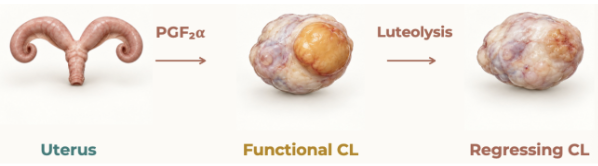
What does PGF₂α do in a nonpregnant cycle?
It resets the nonpregnant cycle by causing progesterone to fall, allowing the next ovulation
What is the difference between Estrus and Ovulation?
Estrus: sexual receptivity
Ovulation: release of the oocyte
They are different events. In cattle, ovulation generally follows the end of standing estrus
How can reproductive cycle timing differ among species?
Cow: cycle commonly repeats about every 21 days (~3 weeks)
Dog: intervals between estrus periods are usually months, with a prolonged luteal phase followed by anestrus
What are the Basic Functions of the Major Regions of the Female Reproductive Tract?
Ovary: oocytes + hormones
Oviduct: gamete transport + site of fertilization
Uterus: supports gestation
Cervix + vagina: protection + passage

How does Ovarian Structure relate to Function?
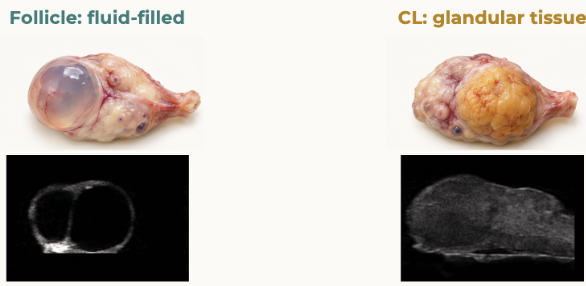
Follicle: fluid-filled → associated with estradiol
Corpus luteum: glandular tissue → associated with progesterone
How does the Function of the Cervix change during pregnancy versus birth?
Pregnancy: closure helps protect the uterine environment
Birth: dilation permits passage through the birth canal

What is the overall Function of the Male Reproductive System?
To produce and deliver viable gametes to the female reproductive tract
Where does Spermatogenesis occur?
In the seminiferous tubules of the testes

What are the major roles of Sertoli and Leydig cells?
Sertoli cells: “nurse” developing sperm; support/protect spermatogenesis
Leydig cells: produce androgens, especially testosterone

What is the Basic Hormonal Pathway Controlling Male Reproduction?
Hypothalamus → GnRH → Anterior pituitary → FSH + LH
LH → Leydig cells → testosterone
FSH → Sertoli cells → supports sperm development
Testosterone is taken up locally by Sertoli cells to help support spermatogenesis

How does Negative Feedback Regulate Male Reproductive Hormones?
Sertoli cells → inhibin → ↓ FSH
Leydig cells → testosterone → negative feedback → ↓ LH

Why can increasing circulating androgens decrease male fertility?
Increased circulating androgens can increase negative feedback, reducing gonadotropin signaling
As a result, testosterone concentration within the testes can fall, and fertility can decrease
What is Cryptorchidism?
Testicular (trans-abdominal) “migration” to inguinal ring (not androgen sensitive) and scrotal descent (androgen sensitive)

Why must the Testes remain at a Lower Temperature?
Spermatogenesis requires a lower temperature
Temperature regulation involves the pampiniform plexus, cremaster muscle, tunica dartos, and scrotum
What three basic features can be evaluated in Semen?
Concentration: number of sperm cells
Motility: proportion that are moving
Morphology: structural quality/appearance of sperm
What is a major difference between Spermatogenesis and Oogenesis?
Males continue producing sperm from germ cells, whereas females are born with their oocytes and do not regenerate them in the manner males continually produce sperm
What happens to oocytes before puberty?
Oogonia form prenatally, enter meiosis, and pause.
After puberty, hormonal signaling allows selected oocytes to resume meiosis.

What allows the oocyte to complete its final meiotic division?
Fertilization provides the signal for completion of the final meiotic division, with extrusion of an additional polar body
What are Assisted Reproductive Technologies (ART)?
Techniques that provide clinical assistance to reproductive processes. - -
Artificial insemination
Embryo transfer
Ovum pick-up/in vitro embryo production
IVF
ICSI
Coning
What is Artificial Insemination (AI)?
An assisted reproduction technique used to introduce semen into the female reproductive tract and expand male genetic influence
What AI approaches are mentioned in the lecture?
Intrauterine
Artificial Vaginal
Transcervical (TCI)
Laparoscopic
Surgical insemination

What is Embryo Transfer (ET)?
Embryos are collected from a genetically valuable female and transferred into a recipient/surrogate uterus, allowing increased maternal genetic influence without requiring the donor to carry the pregnancy
What are potential uses of Embryo Transfer?
Increase the genetic contribution of valuable females
Obtain offspring from genetically valuable animals that have become subfertile from injury/disease
Allow import/export of embryos and increase genetic variation in a population
What is Ovum Pick-Up (OPU)?
Oocytes are collected from follicles of a live animal's ovary and used for in vitro embryo production
What is the difference between IVF and ICSI?
IVF: oocyte is mixed with sperm
ICSI: one sperm cell is injected into the oocyte
What is the basic sequence of OPU and in vitro embryo production described in the lecture?
Visualize ovarian follicles
Collect oocytes
Prepare/mature oocytes
Fertilize using IVF or ICSI
Embryo production
What is the basic concept behind Cloning?
Nuclear material is removed from a recipient oocyte and replaced withdonor nuclear material/cells, after which the reconstructed cell is stimulated to begin embryo development
What is the big-picture FEMALE reproductive hormonal pathway?
GnRH → FSH/LH → Follicle (Ovary)→ Estradiol → LH surge→ Ovulation → CL → Progesterone → Luteolysis → ↓ Progesterone → next OVULATION
What is the big-picture MALE reproductive hormonal pathway?
GnRH → FSH/LH → Sertoli + Leydig → Sperm + Testosterone → Negative feedback
What hormonal change allows ovulation in the bovine cycle?
Luteolysis → ↓ progesterone→ mature follicle estradiol produces positive feedback → LH surge→ OVULATION
How does puberty connect the major concepts of this lecture?
Puberty activates reproductive capacity, enabling production of functional gametes
Those gametes can unite through normal reproduction or reproduction can be assisted through ART
Female Hormonal Control SUMMARY
GnRH → FSH/LH → Follicle → Estradiol → LH surge → Ovulation → CL → Progesterone
Hormone | Source | Target / Action | Main Result |
GnRH | Hypothalamus | Anterior pituitary | Stimulates FSH + LH |
FSH | Anterior pituitary | Ovary/follicle | Follicular growth |
LH | Anterior pituitary | Ovary | Steroid production, ovulation + luteal development |
Estradiol | Growing follicle | Brain + pituitary | Feedback; mature follicle can promote LH surge |
Progesterone | Corpus luteum | Brain + pituitary | High P₄ restrains ovulatory surge |
PGF₂α | Uterus | Corpus luteum | Luteolysis → ↓ progesterone |
Follicular vs. Luteal Phase SUMMARY
Follicle = Estradiol
CL = Progesterone
Follicular Phase | Luteal Phase | |
Stages | Proestrus + estrus | Metestrus + diestrus |
Main ovarian structure | Follicle | Corpus luteum (CL) |
Main hormone | Estradiol | Progesterone |
Progesterone | ↓ Low/falling | ↑ High |
LH surge? | Can occur | Restrained |
Major outcome | Ovulation | Maintains luteal environment |
High vs. Low Progesterone SUMMARY
Luteolysis → ↓ Progesterone → Estradiol positive feedback → LH SURGE → OVULATION
Progesterone HIGH | Progesterone LOW |
Functional CL present | After luteolysis |
Ovulatory surge restrained | Estradiol can produce positive feedback |
Follicles can still grow | LH surge can occur |
Dominant follicle may regress | Dominant follicle can ovulate |
Estrus vs. Ovulation SUMMARY
Estrus ≠ Ovulation
Estrus | Ovulation | |
Definition | Sexual receptivity | Oocyte release |
What are you observing? | Behavior | Ovarian event |
Cow example | Stands to be mounted | Generally follows end of standing estrus |
Female Reproductive Tract SUMMARY
Structure | Main Function |
Ovary | Oocytes + reproductive hormones |
Oviduct | Gamete transport + site of fertilization |
Uterus | Supports gestation |
Cervix | Protection + regulated passage |
Vagina | Passage |
Male Hormonal Control SUMMARY
LH → Leydig → Testosterone
FSH → Sertoli → Sperm
Hormone | Source | Target / Action | Main Result |
GnRH | Hypothalamus | Anterior pituitary | Stimulates FSH + LH |
FSH | Anterior pituitary | Sertoli cells | Supports sperm development |
LH | Anterior pituitary | Leydig cells | ↑ Testosterone |
Testosterone | Leydig cells | Sertoli cells + reproductive system | Supports spermatogenesis |
Inhibin | Sertoli cells | Pituitary | ↓ FSH |
Sertoli vs. Leydig Cells SUMMARY
Sertoli Cells | Leydig Cells | |
Location | Seminiferous tubules | Interstitial tissue |
Think... | Nurse cells | Hormone-producing cells |
Stimulated by | FSH | LH |
Main role | Support/protect developing sperm | Produce testosterone |
Hormonal product emphasized | Inhibin | Testosterone |
Feedback | Inhibin → ↓ FSH | Testosterone → ↓ LH |
Female vs. Male Reproductive Endocrinology SUMMARY
Female | Male | |
Starting signal | GnRH | GnRH |
Pituitary hormones | FSH + LH | FSH + LH |
FSH mainly supports | Follicular growth | Sertoli cells/sperm development |
LH mainly supports | Ovulation + luteal development | Leydig cells |
Major steroid emphasized | Estradiol + progesterone | Testosterone |
Gamete | Oocyte | Sperm |
Gamete production pattern | Finite oocyte pool | Ongoing sperm production |
Assisted Reproductive Technologies SUMMARY
ART | What happens? | Think... |
Artificial Insemination (AI) | Semen introduced into female reproductive tract | Male genetics |
Embryo Transfer (ET) | Donor embryo → recipient uterus | Maternal genetics |
Ovum Pick-Up (OPU) | Oocytes collected from ovarian follicles | Collect oocytes |
IVF | Oocyte + sperm are mixed together | Fertilization in vitro |
ICSI | One sperm injected into oocyte | Direct injection |
Cloning | Donor nuclear material transferred into an oocyte with its nuclear material removed | Nuclear transfer |