Lecture 13: Wavelength Separators
 Call Kai
 Learn
 Practice Test
 Spaced Repetition
 Match
 Flashcards
 Knowt Play
1/43

There's no tags or description
Looks like no tags are added yet.
44 Terms
Dispersing Systems
Separate/disperse radiation as a function of frequency, energy, wavelength, etc.
Types of spatially dispersive systems
Monochromator, polychromator, spectrometer, spectrograph
Monochromator
single colour device
Polychromator
Multiple wavelength device
Spectrometer
detector needed, ID
Spectrograph
2D information (wavelength and intensity)
Image forming/transfer optics
lenses, mirrors
Dispersion optics
prisms, gratings

What does the first optic (L1) do?
collects light from the source, focuses light into the entrance slit, (de)magnifies light from source

What does second optic (M1) do?
collimates/makes divergent rays parallel
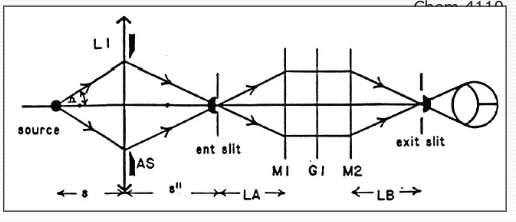
What does dispersion optic (G1) do?
separates rays based on frequency

What does third optic (M2) do?
refocuses light onto exit slit, detector placed after
Snell’s Law
n1sin(theta1)=n2sin(theta2)
What does refractive index (n) vary with?
wavelength
Critical angle
when theta1 and theta 2 =90,
theta 1> theta c
no light transmitted (all reflected)
Total internal reflectance
basis of fiber optics, ATR
Prism
separation in space
Maximum Resolving Power
R=d(dn/dwavelegnth)
Where does max resolving power occur?
minimum deviation angle (D), light inside prism parallel to base
Diffraction
every point where plane wave encounters object, creates spherical wave. Most pronounced when obstacle ~ wavelength
Huygens-Fresnel Principle
Every point on a propagating wavefront acts as a source of secondary spherical wavelets, and the new wavefront at any subsequent time is the result of the mutual interference of these wavelets
Double-slit experiment
collimated, monochromatic beam interacts with two slits, each slit creates propogating spherical waves, which interfere constructively and destructively
Braggs Law
need to type equation
Braggs law eq (write)
m=diffraction order, d=spacing between slits (normal incidence of light)
Diffraction Grating
optic with multiple, evenly space obstacles, best if obstacle and spacing ~ wavelegnth
Transmission Grating
obstacles=slits/holes
Reflection grating
obstacles=reflective grooves
Diffraction grating equation
write equation
Equation for non-normal incidence
equation write out
Resolving power for grating
R=mN, N=# of grooves (obstacles)
Plate Factor (P)
wavelegnth/f tan
Free Spectral Range (FSR)
delt wavelegnth=wavelenth/m=wavelegnth²/dsintheta
Transmission Grating
Can involve refraction, used in high-res applications
Ruled grating
mechanically formed grooves
Blazed (sawtooth) gratings
angled faces improve efficiency in certain order, angle of zero order based on grating normal, diffraction based on groove normal
Blaze angle
angle of groove wrt grating surface
Equation for echellette
write eq
Czerny-Turner Monochromator
uses planar grating, EMR dispersed across a plane
Czerny-Turner spectrograph
x axis-wavelegnth, y axis=vertical position
Rowland Circle
utilizes curved grating has diameter=radius of curvature of grating, results in focal curve, slit placed anywhere on rowland circle is imaged somewhere else on circle
Echelle Grating
large spacing (d) and also larger order
Problems with chelle grating
FSR very small, overlap of orders occurs and can’t distinguish overlapping orders
Cross/pre-dispersion
Normal grating or prism in one direction (poor res), echelle in other dimension (high res)