Unit 1a: The Brain
 Call Kai
 Learn
Learn Practice Test
 Spaced Repetition
 Match
Match Flashcards
 Knowt Play
1/36

There's no tags or description
Looks like no tags are added yet.
Name | Mastery | Learn | Test | Matching | Spaced | Call with Kai | Chat |
|---|
No analytics yet
Send a link to your students to track their progress
37 Terms
The Brainstem
the oldest and innermost region of the brain that is responsible for automatic survival functions. It begins where the spinal cord swells and enters the skull.

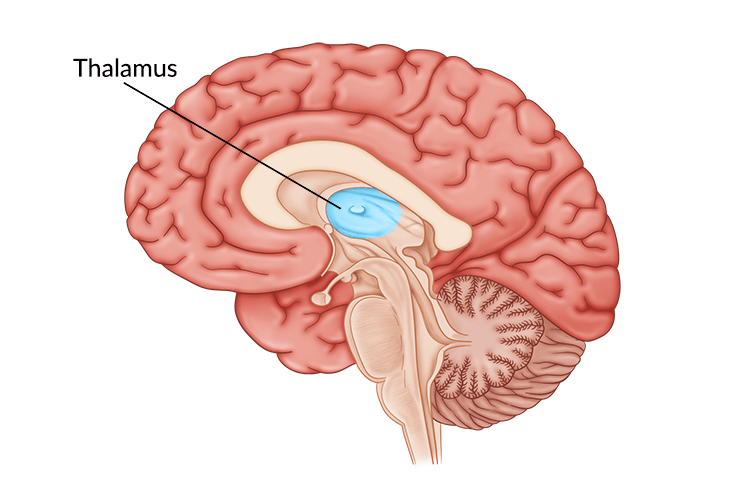
Thalamus
the brain’s sensory switchboard located on the top of the brainstem. It directs messages to the sensory receiving areas in the cortex. It also transmits replies to the cerebellum and medulla. The sense of smell (olfaction) does not go through the thalamus.
The Reticular Activating System
a nerve network in the brainstem that plays an important role in controlling arousal. *Remember: say the name and function together – reticularousal.

Pons
manage vital unconscious processes and sensory signals
sleep and dreams
remember: ponzzzzzzz

Medulla
part of the brainstem that controls heartbeat and breathing. *Remember the 2 Ls: life and love for heartbeat and breathing.

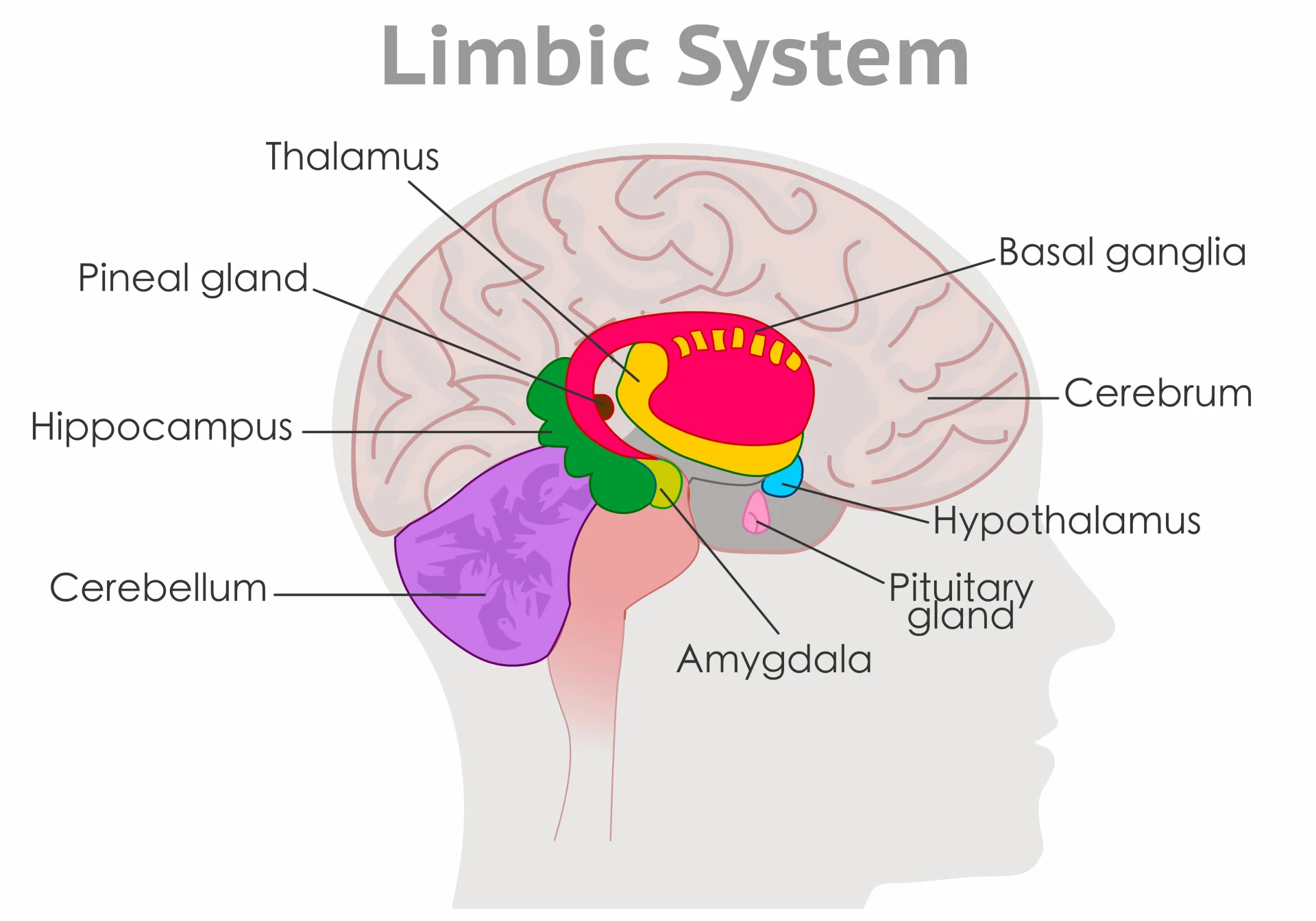
Limbic System
The doughnut-shaped system of neural structures at the border of the brainstem and cerebral hemispheres that is associated with emotions (such as fear and aggression) and drives (such as those for food and sex).
Hippocampus
the part of the limbic system responsible for memory and learning.
*Remember you do a lot of learning and memorization at a college CAMPUS .

Amygdala
two almond-shaped neural clusters in the limbic system that are linked to emotions, especially fear, rage, and aggression. *Remember: Amy – grrrrrrrr

Hypothalamus
located in the limbic system that lies below (hypo) the thalamus. It is responsible for the regulation of body maintenance such as eating, drinking, and body temperature. *Remember: if your body temperature drops, you get hypothermia.

Pituitary Gland
master endocrine gland located in the limbic system

Cerebral Cortex
the thin layer of interconnected neural cells that forms a surface layer on the cerebral hemispheres (like bark on a tree). It is the body’s ultimate control and information processing center. It is what makes humans upper-level thinking beings as opposed to animals.

Frontal Lobe
the portion of the cerebral cortex that lies just behind the forehead that is involved in speaking, muscle movements, and in making plans and judgments. It also includes the motor cortex. *Remember: when you misspeak or do something wrong, you hit your forehead…doh!

Motor Cortex
the area at the back of the frontal lobes that controls voluntary movements.

Parietal Lobe
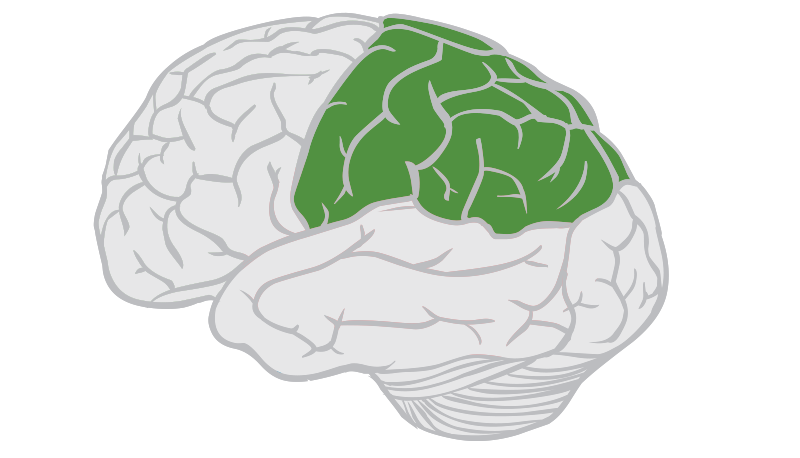
the portion of the cerebral cortex between the frontal and occipital lobes that deals with body sensations. It includes the (somato) sensory cortex.
(Somoto) Sensory Cortex
the area at the front of the parietal lobe that registers and processes body sensations.

Occipital Lobe
the portion of the cerebral cortex at the back of the brain that includes the visual cortex for vision.

Visual Cortex
the area of the occipital lobe that receives visual information from the eyes.

Temporal Lobe
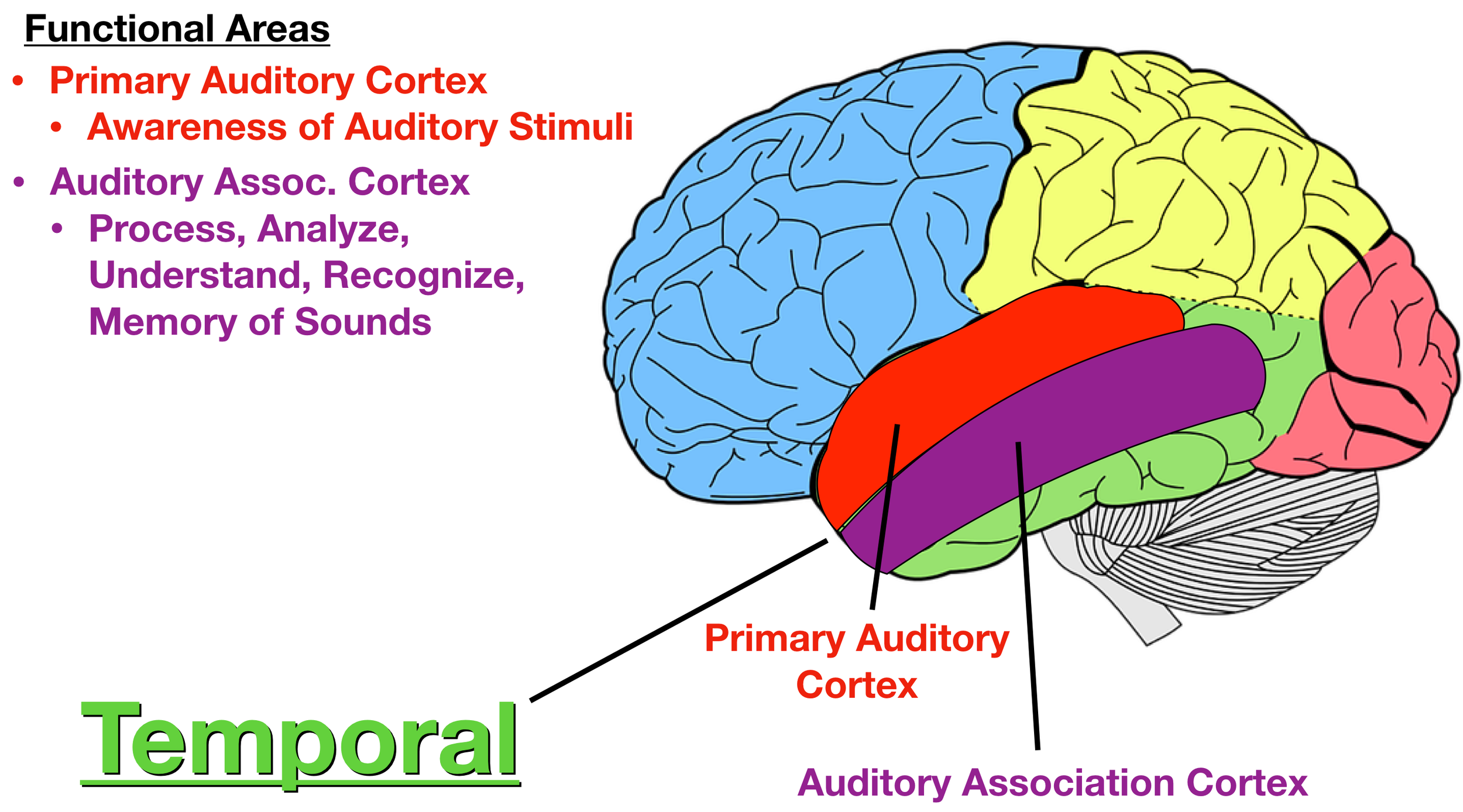
the portion of the cerebral cortex that lies roughly above the ears that includes the auditory cortex for hearing (audition). *Remember: the temporal lobes are near the temples.

Auditory Cortex
the area of the temporal lobe that receives auditory information from the ears.
Contralateral Hemispheric Organization
each hemisphere of the brain controls the opposite side of the body.
Lesion
tissue destruction that is naturally or experimentally caused to help study regions and functions of the brain.
Plasticity
the brain’s ability to modify itself after tissue damage.
EEG (electroencephalogram)
an amplified recording of the waves of electrical activity that sweep across the brain’s surface.
fMRI (functional MRI)
a technique for revealing blood flow and, therefore, brain activity by comparing successive MRI scans. fMRI scans show PET scan
PET scan
uses small amounts of radioactive glucose to focus on activity in the body.
Glial Cells
“glue cells” in the cortex that guide neural connections, provide nutrients and insulating myelin, and mop up ions and neurotransmitters.
Association Areas
the areas of the cerebral cortex involved in higher mental functions such as learning, remembering, thinking, and speaking. *Remember: the association areas let people make associations between things. Ex. my stomach is growling, I must be hungry.
Broca’s Area
an area of the left frontal lobe that controls the muscle movements involved in speech. Damage to this area impairs speaking. *Remember Congresswomen Gabby Giffords*
Wernicke’s Area
an area of the left temporal lobe that is involved in language comprehension. Damage to this area impairs understanding.
Angular Gyrus
an area of the left occipital lobe that transforms visual representation into an auditory code.
Aphasia
impairment of language usually caused by damage to the Broca’s Area or the Wernicke’s Area.
Neurogenesis
the formation of new neurons.
Corpus Callosum
the large band of neural fibers that connect the left and right hemispheres to carry messages between them. If the corpus callosum is severed, the two hemispheres cannot communicate.
Split Brain
a condition in which the two hemispheres of the brain cannot communicate.This is caused by the severing of the corpus callosum.
Alien Hand Syndrome
a rare neurological disorder that causes hand movement without the person being aware of what is happening or having control over the action. This usually occurs after a person has had the two hemispheres of the brain surgically separated, as in split-brain surgery.
Cognitive Neuroscience
the interdisciplinary study of the brain activity linked with cognition (including perception, thinking, memory and language).
Dual Processing
the principle that information is often simultaneously processed on separate conscious and unconscious tracks.