GenChem Exam 1 (Original)
 Call Kai
 Learn
Learn Practice Test
 Spaced Repetition
 Match
Match Flashcards
 Knowt Play
1/40

Name | Mastery | Learn | Test | Matching | Spaced | Call with Kai | Chat |
|---|
No analytics yet
Send a link to your students to track their progress
41 Terms
Number of wave cycles (peaks or troughs) that pass a specified point in space per unit time; inversely proportional to wavelength.
Frequency(v)
Distance between two consecutive peaks or troughs in a wave; inversely proportional to frequency
Wavelength(λ)

0 lone pairs, 2 bonds
Shape, Angle, and Hybridization?
Linear, 180, sp

0 lone pairs, 3 bonds
Shape, Angle, and Hybridization?
Trigonal planar, 120, sp2

1 lone pair, 2 bonds
Shape, Angle, and Hybridization?
Bent/angular, <120, sp2

0 lone pairs, 4 bonds
Shape, Angle, and Hybridization?
Tetrahedral, 109, sp3

1 lone pair, 3 bonds
Shape, Angle, and Hybridization?
Trigonal pyramid, <109, sp3

2 lone pairs, 2 bonds
Shape, Angle, and Hybridization?
Bent/angular, <109, sp3

0 lone pairs, 5 bonds
Shape and Angle?
Trigonal bipyramid, 90 and 120

1 lone pair, 4 bonds
Shape and Angle?
Seesaw, <90 and <120

2 lone pairs, 3 bonds
Shape and Angle?
T-shape, <90

3 lone pairs, 2 bonds
Shape and Angle?
Linear, 180

0 lone pairs, 6 bonds
Shape and Angle?
Octahedral, 90
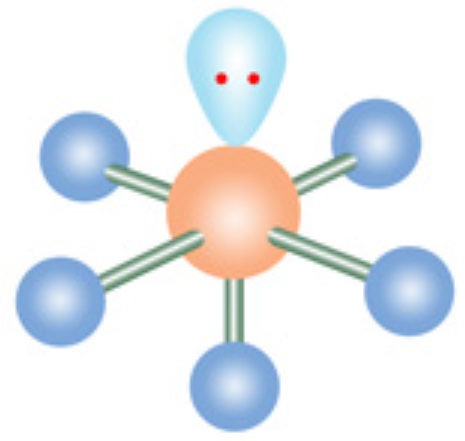
1 lone pair, 5 bonds
Shape and Angle?
Square pyramid, <90

2 lone pairs, 4 bonds
Shape and Angle?
Square planar, 90

3 lone pairs, 3 bonds
Shape and Angle?
T-shape, <90
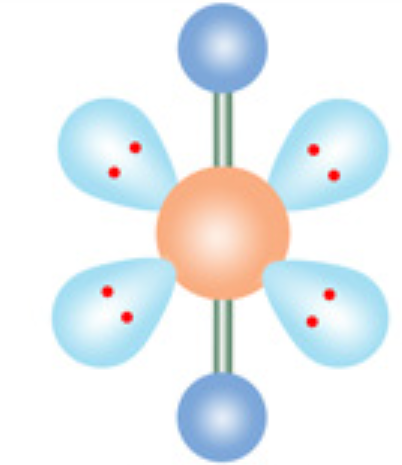
4 lone pairs, 2 bonds
Shape and Angle?
Linear, 180
Orbitals that have the same energy.
Degenerate orbitals
Spherical region of space with high electron density; describes orbitals with l = 0.
s orbital
Dumbbell-shaped region of space with high electron density; describes orbitals with l = 1.
p orbital
Region of space with high electron density that is either four lobed or contains a dumbbell and torus shape; describes orbitals with l = 2.
d-orbital
Multi-lobed region of space with high electron density; describes orbitals with l = 3.
f orbital
State in which the electrons in an atom, ion, or molecule have the lowest energy possible.
Ground state
Rule stating that it is impossible to exactly determine both momentum and the position of a particle at the same time. The uncertainty principle is a consequence of quantum particles exhibiting wave–particle duality.
Heisenberg uncertainty principle
Every orbital in a sub-shell is singly occupied with one electron before any one orbital is doubly occupied, and all electrons in singly occupied orbitals have the same spin.
Hund’s rule
Specifies that no two electrons in an atom can have the same value for all four quantum numbers.
Pauli exclusion principle
Quantum number specifying the shell an electron occupies in an atom.
Principle quantum number(n)
Quantum number distinguishing the different shapes of orbitals.
Angular momentum quantum number (l)
Quantum number signifying the orientation of an atomic orbital around the nucleus.
Magnetic Quantum Number (ml)
Number specifying the electron spin direction, either +1/2 or −1/2.
Spin quantum number(ms)
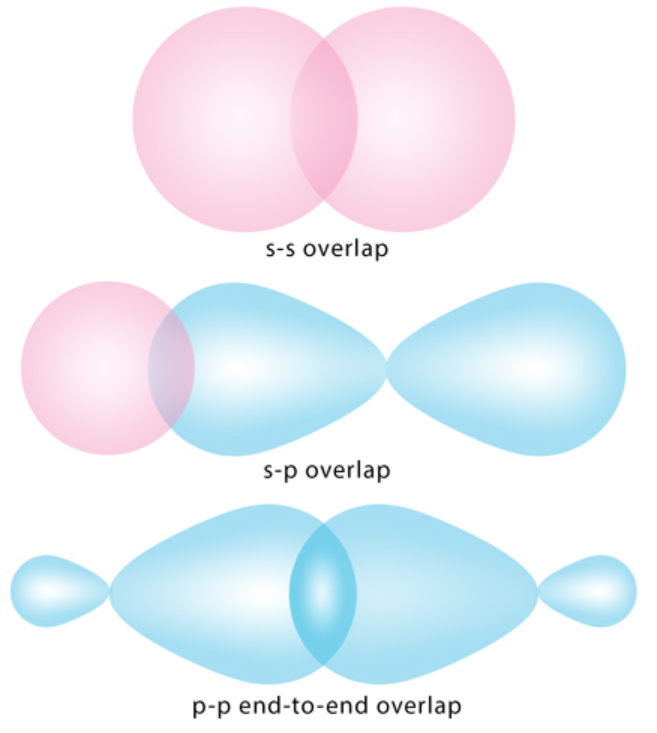
What bond is this?
Sigma bond
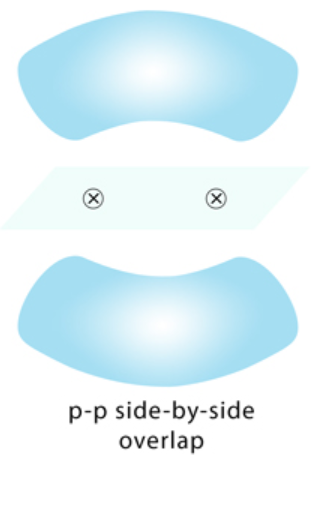
What bond is this?
Pi bond

Sigmapx Bond

Sigmapx Star Bond

Pi Bond

Pip Star Bond
List IMF’s from weakest to strongest.
London dispersion, Induced dipole-dipole, dipole-dipole, Hydrogen, Ion-dipole, Ion-ion
List IMF’s from strongest to weakest.
Ion-ion, Ion-dipole, Hydrogen, Dipole-dipole, Induced dipole-dipole, London dispersion

Model of the atom in which there is one electron.
Bohr Model
What is this formula?
Valence electrons-(number of bonds+lone pairs)
Formal Charge
As bonds degree increases they get?
Shorter