Time Value of Money : Finance

0.0(0)
Studied by 0 people
call kaiCall Kai
learnLearn
examPractice Test
spaced repetitionSpaced Repetition
heart puzzleMatch
flashcardsFlashcards
GameKnowt Play
Card Sorting

1/7

encourage image

There's no tags or description

Looks like no tags are added yet.

8 Terms

1
New cards

Time Value of Money (TVM)

The time value of money is the principle that money available today is worth more than the same amount in the future, because it can be invested to earn a return.

  • Core principle: £100 today is worth more than £100 received in one year's time.

  • Reason: Money today can earn interest or investment returns.

  • Present value (PV): The value today of money received in the future.

  • Future value (FV): The value an investment will grow to in the future.

  • Discounting: Calculates the present value of future cash flows.

  • Compounding: Calculates how money grows over time as interest earns further interest.


2
New cards

Compound Interest

Compound interest is interest calculated on both the original amount invested and the interest already earned. This means your money grows faster over time because you earn interest on interest.

  • Principal (PV): The original amount invested or borrowed.

  • Future (FV): The future amount returned

  • Interest rate (r): The percentage earned or charged per period.

  • Number of periods (n): How many periods interest is compounded for.

  • Compounding effect: Interest earned is added to the balance, so future interest is calculated on a larger amount.

  • Long-term effect: The longer money compounds, the greater the potential growth, assuming a positive interest rate.
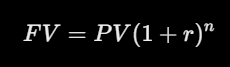

<p>Compound interest is interest calculated on both the original amount invested and the interest already earned. This means your money grows faster over time because you earn interest on interest.</p><ul><li><p>Principal (PV): The original amount invested or borrowed.</p></li><li><p>Future (FV): The future amount returned</p></li><li><p>Interest rate (r): The percentage earned or charged per period.</p></li><li><p>Number of periods (n): How many periods interest is compounded for.</p></li><li><p>Compounding effect: Interest earned is added to the balance, so future interest is calculated on a larger amount.</p></li><li><p>Long-term effect: The longer money compounds, the greater the potential growth, assuming a positive interest rate.</p></li></ul><p></p>
3
New cards

Future Value of Cash Flows

The future value of cash flows (PMT) calculates how much a series of regular payments will accumulate to in the future, assuming each payment earns interest over time.

  • Each payment earns interest for a different amount of time.

  • Assumes payments are made at the end of each period (ordinary annuity).

  • A higher interest rate, payment amount or number of periods increases the future value.


  • FV = Future value of the payments

  • PMT = Regular payment made each period

  • r = Interest rate per period (decimal)

  • n = Number of payment periods


<p>The <strong>future value of cash flows (PMT)</strong> calculates how much a series of regular payments will accumulate to in the future, assuming each payment earns interest over time.</p><ul><li><p>Each payment earns interest for a different amount of time.</p></li><li><p>Assumes payments are made at the <strong>end of each period</strong> (ordinary annuity).</p></li><li><p>A higher interest rate, payment amount or number of periods increases the future value.</p></li></ul><p></p><ul><li><p><strong>FV</strong> = Future value of the payments</p></li><li><p><strong>PMT</strong> = Regular payment made each period</p></li><li><p><strong>r</strong> = Interest rate per period (decimal)</p></li><li><p><strong>n</strong> = Number of payment periods</p></li></ul><p></p>
4
New cards

Present Value of Multiple Cash Flows

Present value (PV) of multiple cash flows calculates what a series of future payments or receipts is worth today, by discounting each cash flow back to the present using an interest or discount rate.

<p><strong>Present value (PV) of multiple cash flows</strong> calculates what a series of future payments or receipts is worth today, by discounting each cash flow back to the present using an interest or discount rate.</p>
5
New cards

Ordinary Annuity vs. Annuity Due

An annuity is a series of equal payments made at regular intervals over a period of time.

The difference between an ordinary annuity and an annuity due is when the payments are made.

  • Ordinary annuity: Payments made at the end of each period.

  • Annuity due: Payments made at the beginning of each period.

  • FV of ordinary annuity: PMT x (((1+r)^n) - 1)/r

  • FV of annuity due: Ordinary annuity FV × (1+r)

  • Annuity due has a higher FV because payments earn interest for longer.


6
New cards

Present Value of Level Cash Flows

The Present Value (PV) of Level Cash Flows is the value today of a series of equal cash payments received or paid at regular intervals in the future.

  • PMT: Equal payment per period.

  • i: Discount rate per period.

  • n: Number of payments.

  • Higher discount rate: Lower present value.

  • More payments: Higher present value, assuming positive payments and a non-negative discount rate.


<p>The <strong>Present Value (PV) of Level Cash Flows</strong> is the value today of a series of equal cash payments received or paid at regular intervals in the future.</p><ul><li><p><strong>PMT:</strong> Equal payment per period.</p></li><li><p><strong>i:</strong> Discount rate per period.</p></li><li><p><strong>n:</strong> Number of payments.</p></li><li><p><strong>Higher discount rate:</strong> Lower present value.</p></li><li><p><strong>More payments:</strong> Higher present value, assuming positive payments and a non-negative discount rate.</p></li></ul><p></p>
7
New cards

EAR

The Effective Annual Rate (EAR) is the actual annual interest rate earned or paid after taking into account the effect of compounding.

  • Nominal rate: Advertised annual interest rate before adjusting for compounding.

  • Compounding frequency: How often interest is added to the balance.

  • More frequent compounding: Higher EAR, assuming the same positive nominal rate.

  • Purpose: Compare loans and investments with different compounding frequencies.


  • EAR = Effective Annual Rate

  • (r_nom) = Nominal annual interest rate

  • m = Number of compounding periods per year


<p>The <strong>Effective Annual Rate (EAR)</strong> is the actual annual interest rate earned or paid after taking into account the effect of <strong>compounding</strong>.</p><ul><li><p><strong>Nominal rate:</strong> Advertised annual interest rate before adjusting for compounding.</p></li><li><p><strong>Compounding frequency:</strong> How often interest is added to the balance.</p></li><li><p><strong>More frequent compounding:</strong> Higher EAR, assuming the same positive nominal rate.</p></li><li><p><strong>Purpose:</strong> Compare loans and investments with different compounding frequencies.</p></li></ul><p></p><ul><li><p><strong>EAR</strong> = Effective Annual Rate</p></li><li><p>(r_nom) = Nominal annual interest rate</p></li><li><p><strong>m</strong> = Number of compounding periods per year</p></li></ul><p></p>
8
New cards

APR

The Annual Percentage Rate (APR) is the annual cost of borrowing money, expressed as a percentage.

  • Definition: Annual cost of borrowing, expressed as a percentage.

  • Includes: Interest and certain additional fees.

  • Purpose: Allows borrowers to compare different credit products.

  • Commonly used for: Credit cards, loans and mortgages.

  • Higher APR: Generally means borrowing is more expensive.


<p>The <strong>Annual Percentage Rate (APR)</strong> is the annual cost of borrowing money, expressed as a percentage.</p><ul><li><p><strong>Definition:</strong> Annual cost of borrowing, expressed as a percentage.</p></li><li><p><strong>Includes:</strong> Interest and certain additional fees.</p></li><li><p><strong>Purpose:</strong> Allows borrowers to compare different credit products.</p></li><li><p><strong>Commonly used for:</strong> Credit cards, loans and mortgages.</p></li><li><p><strong>Higher APR:</strong> Generally means borrowing is more expensive.</p></li></ul><p></p>



