CH 220: Recrystallization & Arenes
 Call Kai
 Learn
Learn Practice Test
 Spaced Repetition
 Match
Match Flashcards
 Knowt Play
1/34

There's no tags or description
Looks like no tags are added yet.
Name | Mastery | Learn | Test | Matching | Spaced | Call with Kai | Chat |
|---|
No analytics yet
Send a link to your students to track their progress
35 Terms
Recrystallization: 3 Solvent Rules
Cold = compound poorly soluble at room temperature.
Hot = compound soluble near the solvent’s boiling point.
Impurity solubility should ideally be temperature-independent.
Recrystallization: Solvent rules EXTRA
An impurity that is soluble at both temperatures remains dissolved while the product crystallizes; an impurity insoluble at both can be filtered away.
Recrystallization: Base →
water
Recrystallization: Neutral →
methanol
Recrystallization: Sequence of procedure
crude solid → minimum hot solvent → solid just dissolves → cool slowly → crystals form → cold wash/vacuum filtration → dry → mass + melting point
Recrystallization: Why not too much (hot) solvent
Too much solvent means the product may remain dissolved even after cooling, causing lower recovery.
Recrystallization: Washing Neutral crystals →
~5 mL cold methanol
Recrystallization: Washing Base crystals →
cold water
Recrystallization: The solvent to wash is cold because…
the desired compound should be poorly soluble in cold solvent, so you can wash contaminants away while minimizing product loss.
Melting range =
temperature where first liquid appears → temperature where final solid disappears.
Impurities for melting point…
generally broaden the melting range and lower the onset of melting.
The recrystallized sample is purer because
its melting range became narrower. Its melting-point region remained similar because it is still the same compound.
Recrystallization: Identity comes from
comparing the purified melting range with known/reference values.
Percent Recovery Formula
(mass recovered / theoretical mass available) * 100

Recrystallization: Why cool slowly before using ice during recrystallization?
Allows better/purer/orderly crystal formation; immediately forcing it cold can produce poor/small crystals and hurt purification quality
Slow cooling → molecules have time to arrange into an organized crystal lattice.
Very Fast cooling → rapid precipitation/nucleation → many small, less orderly crystals → greater chance of trapping impurities.
Ice is used afterward to decrease solubility further and maximize recovery.
Recrystallization: Why heat a melting-point sample only 1–2°C/min?
Gives the sample time to equilibrate with the apparatus so the melting range is measured accurately.
to maintain thermal equilibrium and accurately observe the temperatures where melting begins and ends.
Arenes: Overall Reaction
It is a free-radical substitution in which H is replaced by Br.

Arenes: Mechanism Steps
Initiation
Propagation 1
Propagation 2
Termination

Arenes: Termination possibilities (3)
Br2
R-Br
R-R

Arenes: Second step significance
The second step of propagation regenerates the Br radical, which is why the chain propagates.
Arenes: Aromatic H
H directly attached to an aromatic-ring carbon (red)

Arenes: Aliphatic H
H attached to an sp³ carbon in the alkyl portion (blue)

Arenes: Benzylic H
H on an sp³ carbon directly adjacent to the aromatic ring (yellow)

Arenes: Heirarchy for H’s
aromatic < aliphatic < benzylic
within benzylic positions: 1° < 2° < 3°
Arenes: why the heirarchy of H’s
Radical stability
Removing the most reactive hydrogen produces the most stable radical.
Arenes: Toluene (radical produced, relative reaction speed)
1° benzylic
THIRD

Arenes: Ethylbenzene (radical produced, relative reaction speed)
2° benzylic
SECOND
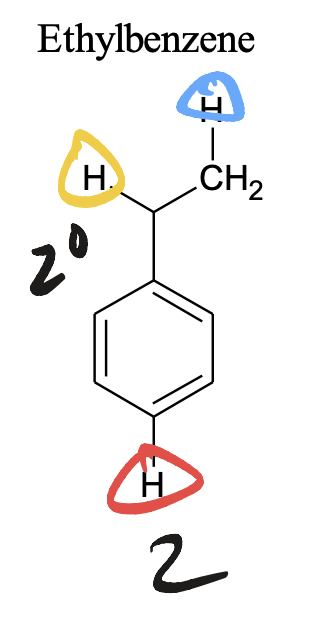
Arenes: Isopropylbenzene (radical produced, relative reaction speed)
3° benzylic
FASTEST/ FIRST

Arenes: t-Butylbenzene (radical produced, relative reaction speed)
Aliphatic radical (no benzylic H available)
SLOWEST/ FOURTH

Arenes: Compound heirarchy
isopropylbenzene > ethylbenzene > toluene > t-butylbenzene
Arenes: Statistical factor
how many hydrogens of each type are available. Propane has 6 primary H and 2 secondary H, so a purely statistical reaction would predict roughly a 3:1 primary:secondary product ratio.
Arenes: Energy factor
different hydrogens have different intrinsic reactivities because abstraction creates radicals of different stability. More stable radicals form preferentially.
Arenes: Observed product distribution =
availability of H's (statistical factor) + energetic preference for forming the more stable radical (energy factor).
Arenes: actual chlorination distribution is about ___, rather than the statistical 75/25 expectation
45% primary / 55% secondary
Arenes: Bromination distribution
Even more selective: the professor gives roughly 97% secondary / 3% primary for propane.