social psych ch. 9,11
 Call Kai
 Learn
 Practice Test
 Spaced Repetition
 Match
 Flashcards
 Knowt Play
1/124

There's no tags or description
Looks like no tags are added yet.
125 Terms
group
two or more people who interact & depend on each other for needs & goals leading to influence
dyad
group of two
Why do people want to be in groups
evolution, success
belongingness
distinctiveness
Groups can be an important part of ____
self-concept
Groups can establish ____
social norms (implicit or explicit rules)
A college is not considered a group because ____
there are too many people that every student would not be interdependent on one another
What influences group behavior/function/how individuals act in a group?
social norms
social roles
group cohesiveness
group diversity
social roles
shared expectations in a group about how particular people are supposed to behave in certain positions
social norms
specify how all group members should act
being too dedicated can ____
lead to fraud or cover up wrongdoings
how people act because of social roles depends on _____
how people construe those roles and what they mean/how to behave
group cohesiveness
qualities that bind members together and promote relationships
increased group cohesion =
increased participation & increased performance (if not overpowering)
Group diversity
how diverse is the composition of the group
Reasons for homogeneity of groups
groups attract people who are similar to them
groups operate in ways that encourage similarity in members
Homogenous groups are often more____
cohesive
increased group diversity =
increased performance but possibly less cohesion
What is the impact of the presence of others on performance
If the task is simple, it can improve performance. If the task is difficult, it can worsen performance
social facilitation
when the presence of others causes people to perform better/worse on simple/difficult tasks

What is the mechanism behind social facilitation?
Being around others leads to arousal which makes it harder to perform complex/new tasks
How does the presence of other causes arousal?
other people cause you to be alert/vigilant
others make you apprehensive about being evaluated
distract from task at hand
alertness/vigilant is what kind of arousal?
mild arousal
evaluation apprehension
concern about being judge, feel like people are judging you causes arousal
distractions due to presencecause ___
divided attention/conflict which produces arousal and social facilitation
social loafing
when people are in the presence of others & indiv performance can not be evaluated, perform worse on simple tasks they don’t care about and better on complex tasks that are important because of relaxation
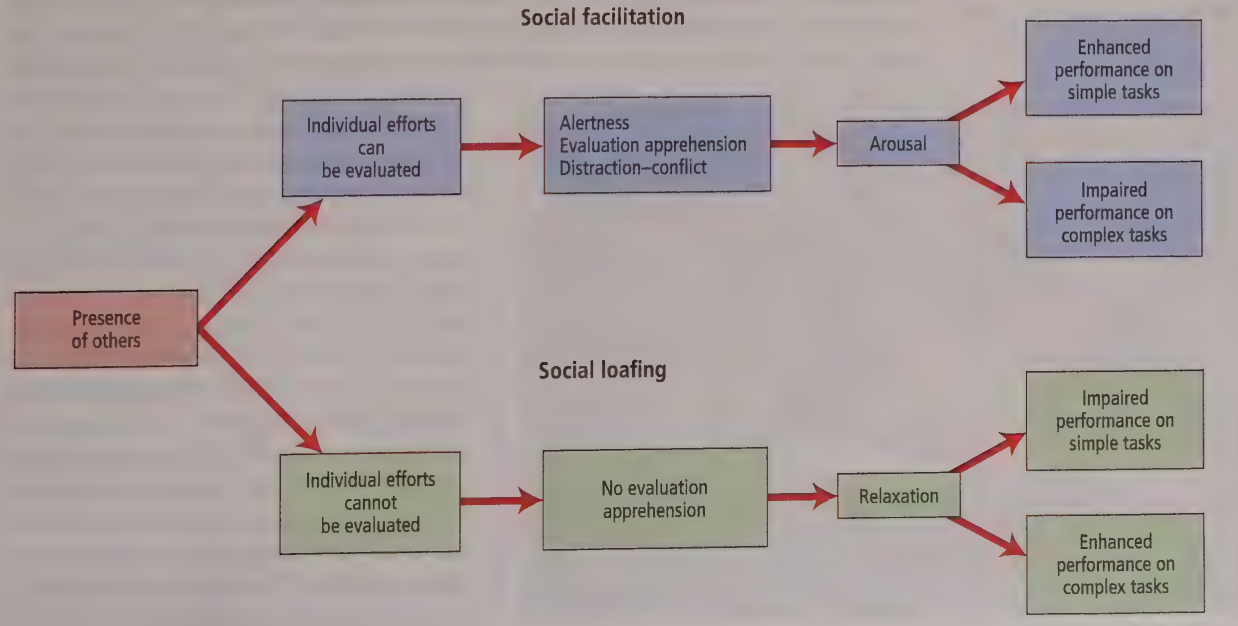
if there is no possibility of individual evaluation
decreased evaluation apprehension
Who tends to socially loaf more, men or women?
Men
relational interdependence
tendency to focus on/care about personal relationships w/ others
Who socially loafs more, western or asian cultures?
Western since asians tend to have interdependence view of self?
deindividuation
lessened normal constraints on behavior when people can not be identified
What is an example of deindividuation?
Mob mentality
Deindividuation makes people:
less accountable for their actions
increase obedience to group norms
process loss
any aspect of group interaction that inhibits good problem solving
Things that can cause process loss
failure to share unique information
groupthink
What are the conclusions from failure to share unique information?
groups tend to focus on shared information more
groups share unique info later in the discussion
groups should not share initial opinions to avoid loss of info
groups should assign people to areas of expertise
transactive memory
the combined memory of a group that is more efficient than the memory of individual members
groupthink
decision process where group cohesion/solidarity is MORE important than considering facts
groupthink is more likely when:
group is highly cohesive
group is isolated from contrasting opinions
ruled by distinctive leader
high stress
poor decision precedures

symptoms of groupthink
group feels invunerable
self-censorship

Risky shift
a switch in decision when a group makes riskier decisions than alone
group polarization
tendency for groups to make decisions that are more extreme than initial inclinations of group
What is the persuasive arguments interpretation of group polarization?
Individuals find out other arguments from the group and become more extreme as a result
What is the social comparison interpretation of group polarization?
people choose a side depending on how people initally present emotionally
great person theory
the idea that certain key personality traits make a person a good leader
What the leadership styles?
transactional leaders
transformational leaders
Transactional leaders
leaders who set clear short-term goals and reward people who meet them
ex. if you do this I’ll give you this
Transformational leaders
leaders who inspire followers to focus on common, long-term goals
contingency theory of leadership
leadership effectiveness depends on how task/relationship-oriented the leader is and how much control they have
theory considers the followers, the situation, leader characteristics
task-oriented leaders
leaders who are concerned w/ getting things done over feelings
relationship-oriented leaders
leaders who are more concerned with workers’ feelings
What situations are task-oriented leaders best suited for?
high-control work situations - leadership position is powerful and work is structured/well defined (Amazon)
low-control work situations - leader is not perceived as powerful & work is not clearly defined (phofest)
What situations are best suited for relationship-oriented leaders?
Moderate-control work situations - work is good but there is more to be done (some favorable factors, some not)
agentic traits
assertive, controlling, dominant, independent
Who is traditionally associated with agentic traists?
Men
communal traits
concern w/ welfare of others, warm, helpful, affectionate
Who is traditionally associated with communal traits?
women
“glass ceiling”
unspoken barrier that prevents women from getting leadership positions
“glass cliff”
when women are more likely to be put in charge for high risk scenarios as a leader
autonomous leadership
being indept. of one’s superiors and spending time working alone
social dilemma
conflict where the best action for individuals in the group can have harmful effects on everyone (Panera Cares)
prisoner’s dilemma
The outcome of your choice depends on what the other person chooses

What are things that can change the results of the prisoner’s dilemma?
interact with the other person in the future → more cooperative
change the norms by showing symbols/name of game → depends
Tit-for-Tat strategy - leads to trusting response
let individuals (not groups) play → more likelihood of cooperating
tit-for-tat strategy
initially acting cooperactively but responding the way your opponent did in the previous trial
What are other social dilemmas besides the prisoner’s experiment?
harvesting dilemma - overfishing
contributions dilemma - public goods, give some (NPR
Explain the truck experiment
Two truck companies compete for shorter route and can initially make a moderate profit, but profit declines if one or both companies threaten/actually block the short path. There was no trust.
negotiation
form of communication between opposing sides in conflict where offers & counteroffers are made to reach a solution
integrative solution
solution where parties make trade-offs, conceding on issues that are not important to one but important to the other
What happens when people have more at stake in a negotiation?
They become more biased in perceptions of other party, less trusting, and overlook common interests
Which type of communication is the best for trust?
Face-to-face
People will take on roles in a group based on:
personal goals, personality, group identity
What was the Stanford Prison Experiment?
showed the influence of social roles on behavior/thought
students were assigned as prisoners or guards and became more entranced in roles as time went on
What were problems on validity with the guards of SPE?
knew desired results
were given specific instructions
How did guard training lead to demand characteristics?
Demand characteristics is when participants change behaviors to match what they think the experiments want. By telling guards specific instructions, participants could guess purpose of SPE
What are other problems w/ SPE?
unrealistic situation; prewritten, nonacademic conclusions
What did Triplett experiment w/ fishing line show?
Showed that people influence behavior. Children competing tended to have faster winding times than when alone.
What is a “dominant response”?
The most likely outcome based on the difficulty of the task
Mere presence creates____
arousal for conspecifics (same species)
distrations cause____
attentional conflicts & cognitive overload that affects performance
What did Ringelmann’s experiement w/ pulling show?
As the group size increases, productivity per person decreases


coordination loss
productivity decreases due to imperfectly coordinated effort
The Myer & Bishop experiment on prejudice groups shows_____
group polarization can change individual opinions to be more extreme due to informational or normative influence
what is the harvesting dilemma
Aka commons, resource, take-some dilemma, Taking too much from a shared resource benefits the individual in the short term but harms the group in the long term.
what is contributions dilemma
aka public goods, give some; situation where individuals must decide whether to contribute to a shared resource that benefits everyone, even those who do not contribute.
How do you “solve” the dilemmas?
coercion with rules or punishments (EPA fines)
appeals to a group identity (save water for the community)

prosocial behavior
any act performed with the goal of benefitting another person
altruism
helping is selfless; end-state is increasing welfare of another


kin selection
idea that behaviors that help a genetic relative are favored by natural selection
ex. passes ur genes on through relatives’ survival
In a fire people are more likely to search for…..
family members rather than friends (does not apply to nonlife threatening situations)
norm of reciprocity
expectation that helping others increases likelihood of them helping back

What may have developed to upregulate reciprocity?
Emotion of gratitude - positive feelings of feeling helped by others
How do evolutionary psychologists believe that prosocial group behavior developed?
Groups that help each other increase the survival odds compared to groups that don’t leading to a possible gene effect
Altruistic behavior can be based on _____
self-interest
social exchange theory
people engage in prosocial actions when cost/benefit equation allows it

Personal benefits to helping others:
relieving personal distress
social approval
increased feelings of self-worth
Personal costs to helping someone:
loss of time
physcial danger
negative feelings
social exchange theorists argue….
prosocial behavior is done for a benefit and people weigh the costs
empathy
ability to imagine experience & emotions of another person
empathy-altruism hypothesis
idea that when we feel empathy for a person we will attempt to help that person for altruistic reasons regardless of potential gain

Explain the carol experiment
This was an experiment to determine if people act out of altruism or self-interest. When empathy is high people will help regardless the cost. When empathy is low, people will help based on social exchange costs and benefits.
What are 3 motives to prosocial behavior:
helping is an instinctive reaction (evolutionary psych)
helping is in self-interest (social exchange theory)
feelings of empathy → selfless giving (empathy-altruism hypothesis)