Test 3: Art History Exam
 Call Kai
 Learn
 Practice Test
 Spaced Repetition
 Match
 Flashcards
 Knowt Play
1/20

There's no tags or description
Looks like no tags are added yet.
21 Terms
Jacques-Louis David – The Oath of the Horatii (1784)
Three brothers swear to defend Rome against Alba.
Represents civic duty, patriotism, loyalty, and sacrifice.
Sisters are distressed because of family relationships between the opposing cities.
Strong lines, order, balance, reason, archaeological precision, and Greco-Roman influence
Neoclassicism

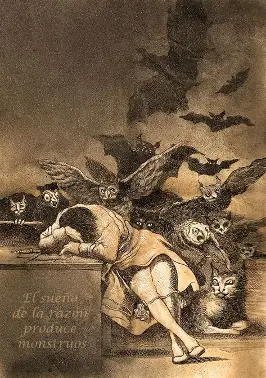
Francisco de Goya – The Sleep of Reason Produces Monsters (1799)
From Los Caprichos.
When reason sleeps, monsters emerge.
Criticizes ignorance, superstition, and corruption.
Emphasizes Enlightenment values of logic and reason
Caspar David Friedrich – Wanderer above the Sea of Fog (1818)
Lone figure looking over a foggy landscape.
Nature represents emotion, contemplation, and self-discovery.
Demonstrates the sublime and humanity's relationship with nature
Romantacism

Théodore Géricault – The Raft of the Medusa (1818–1819)
Based on the 1816 shipwreck of the Medusa.
Approximately 150 people were abandoned on a raft; only 10 survived after 13 days.
Became a political scandal symbolizing France's incompetent leadership.
Dramatic movement, suffering, despair, and powerlessness.
Captures false hope as survivors signal for rescue
Romanticism

J.M.W. Turner – Snow Storm: Hannibal and His Army Crossing the Alps (1812)
Nature is the protagonist, not Hannibal.
Natural forces overwhelm human figures.
Demonstrates the power of nature
Romanticism

Gustave Courbet – The Stone Breakers (1848)
Depicts poor laborers breaking rocks for roads.
Connects to socialist politics and the working class.
Ordinary subject matter presented on a monumental scale.
Shows poverty, difficult labor, and human misery.
Uses rough, crude paint application

John Everett Millais – Christ in the House of His Parents (c. 1849)
Associated with the Pre-Raphaelite Brotherhood.
Emphasizes optical realism and minute details.
Combines realism with symbolism.
Tools symbolize Christ's future Passion.
Controversial for its realistic depiction of religious figures.

Édouard Manet – Olympia (1863)
Depicts a modern-day prostitute, not a goddess.
Direct, confrontational gaze.
Unidealized body.
Accepted into the Salon in 1865.
Influenced by Titian's Venus of Urbino (1534).
Challenges traditional representations of female nudes
Impressionism

Mary Cassatt – In the Lodge (1878)
Sophisticatedly dressed woman at the theater.
Man in background looks at her.
Explores gender and the gaze.
Woman is an observer rather than simply an object being observed.
Impressionism

Claude Monet – Impression, Sunrise (1872)

Edgar Degas – Little Dancer of Fourteen Years (c. 1880)

Neoclassicism
Movement inspired by ancient Greece and Rome.
Emphasizes reason, order, simplicity, proportion, harmony, and civic virtue.
Reaction against Rococo
Salon Exhibition
Official public art exhibitions.
Artists displayed work; critics reviewed it on behalf of the public.
Important for artistic recognition
Romanticism
Movement c. 1800–1850.
Emphasizes emotion, imagination, intuition, nature, and individual experience.
Rejects Neoclassical reason and order.
Daguerreotype
Early photographic process announced in 1839 by Louis Daguerre.
Realism
Began in France in the 1840s.
Honestly represents modern life, ordinary people, and working-class experiences.
Reaction against academic art
Avant-garde
Originally a military term for the front of an advancing army.
In art, means experimenting and introducing new ideas.
Courbet was one of the first artists to call himself avant-garde
Haussmannization
Modernization of Paris beginning in 1853 under Baron Haussmann.
Created grand boulevards, wider streets, sewage systems, and better sanitation.
Improved policing and surveillance and supported commerce.
Flâneur
Observer of modern urban life.
Can see without being seen.
Remains separate from the crowd.
Associated with Charles Baudelaire.
Impressionism
Group of artists who organized independent exhibitions.
Women participated as equal members.
Explored modern life and changing urban experiences.
Post-Impressionism
idk yet