2. Colony structure and life cycle
 Call Kai
 Learn
Learn Practice Test
 Spaced Repetition
 Match
Match Flashcards
 Knowt Play
1/94

There's no tags or description
Looks like no tags are added yet.
Name | Mastery | Learn | Test | Matching | Spaced | Call with Kai | Chat |
|---|
No analytics yet
Send a link to your students to track their progress
95 Terms
What three characteristics make termites eusocial? (3)
Cooperative care: Colony members help raise the young.
Overlapping generations: Parents and offspring live together.
Reproductive division of labour: Some individuals reproduce; others perform supporting roles.
What is the difference between a termite colony and a termite nest?
Colony: The interacting social group.
Nest: The physical structure or space occupied.
What is the difference between a developmental stage and a caste?
Developmental stage: Where an individual is in its development.
Caste: Its specialised form and role within the colony.
What are the three broad developmental outcomes for immature termites? (3)
-Workers or worker-like individuals.
-Soldiers.
-Reproductives.
Important: The available pathways depend on the species and developmental stage. (Find picture)

Why should a termite life-cycle diagram identify the species or group it represents?
Developmental pathways differ between termite groups. One diagram does not accurately represent every species.

Explain the life cycle on Subterranean termite life cycle like Coptotermes

What are the king’s and queen’s roles in normal sexual reproduction?
King: Supplies sperm through mating.
Queen: Produces and lays eggs.
Where does fertilisation normally occur in termites?
Inside the female, before the eggs are laid.
How does the development of male and female termites differ from the usual pattern in ants?
Termites: Males and females normally develop from fertilised eggs.
Ants: Females develop from fertilised eggs; males usually develop from unfertilised eggs
What are the main appearance features of termite eggs? (3)
Size: Small relative to workers.
Shape: Oval or elongated.
Colour: Pale. (Find picture)

How are the eggs of Mastotermes darwiniensis (giant northern termite) arranged?
In attached groups called egg pods. (Find picture)

What does “brood” mean in a termite colony?
Eggs and developing young.
Who cares for termite eggs as a colony develops?
During establishment: The founding king and queen.
After the workforce develops: Mainly workers or worker-like individuals.
What are the main activities involved in termite egg care? (3)
Carrying eggs.
Grouping eggs in protected areas.
Grooming eggs.
How can grooming help protect termite eggs?
Saliva can supply substances involved in egg recognition and antibacterial protection.
What hatches from a termite egg?
A small, pale immature termite called a Larva. It is not yet a fully developed soldier or reproductive.
How are “larva” and “nymph” commonly used in specialist termite literature?
Larva: An early immature termite.
Nymph: An immature termite on the winged reproductive pathway, usually with wing buds.
Important: Terminology varies between references.
Why does the word “larva” in termite literature not mean complete metamorphosis?
Termites develop without a pupal stage, even when their early immature stages are called larvae.
What four factors influence termite egg and immature development? (4)
Species.
Temperature.
Food supply.
Colony conditions and brood care.
Why should you avoid memorising one egg-hatching time for all termites?
Hatching time varies between species and environmental conditions.
What type of metamorphosis do termites undergo?
Incomplete metamorphosis, also called hemimetabolous development.
What is the basic developmental sequence leading to a mature termite reproductive?
Egg → immature stages → mature reproductive.
There is no pupal stage. (Find picture)
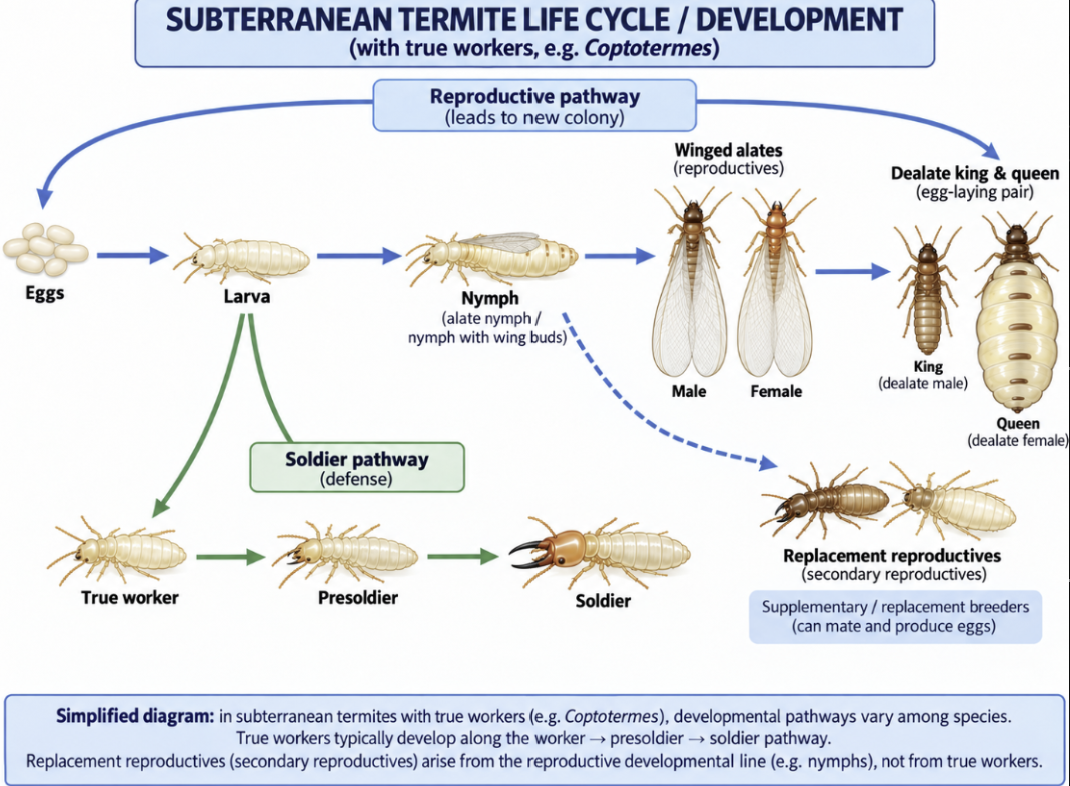
Why must termites moult to grow?
Their existing outer covering cannot expand indefinitely, so it must be replaced
What is the difference between moulting, ecdysis and an instar?
Moulting: Replacing the outer covering.
Ecdysis: Shedding the old covering.
Instar: The developmental stage between successive moults.
Why is a newly moulted termite vulnerable?
Its new outer covering is soft and has not yet hardened. (Find picture)
What two broad outcomes can a termite moult produce? (2)
Growth while remaining in the same general role.
Development into a different form, such as a presoldier or reproductive.
What is developmental plasticity?
The ability to follow different developmental pathways rather than one fixed sequence.
Why does a termite worker not necessarily become an alate?
Its developmental options depend on the species and the pathway it has entered.
How can moulting affect gut protists in termites that depend on them?
Protists can be lost around moulting and then regained through interactions with nestmates.
What is proctodeal trophallaxis?
Direct transfer of material from one termite’s hindgut to another termite’s mouth. (Find picture)
Why can proctodeal trophallaxis be important after moulting?
Direct transfer of material from one termite’s hindgut to another termite’s mouth. (Find picture)
Why can proctodeal trophallaxis be important after moulting?
It can restore gut microorganisms needed for digestion.
How do chitin synthesis inhibitor baits affect termites?
They disrupt formation of the new cuticle, preventing successful moulting.
Why do chitin synthesis inhibitor baits act slowly rather than causing immediate knockdown?
Their lethal effects depend on developmental processes, particularly moulting.
What two types of individual can perform termite worker duties? (2)
True workers: Individuals on a specialised worker developmental pathway.
Pseudergates: Worker-like immature individuals with relatively flexible developmental options.
How do true workers and pseudergates differ in future development?
True workers: Generally have more restricted developmental options.
Pseudergates: May retain the ability to become soldiers or reproductives, depending on the species.
Why is appearance alone insufficient to reliably distinguish true workers from pseudergates?
They can look very similar; the distinction depends on their developmental pathway.
What are the four broad areas of termite worker activity? (4)
Feeding: Obtain, process and distribute food.
Care: Tend brood and reproductives.
Construction: Build, maintain and repair protective structures.
Grooming: Clean and maintain nestmates.
Why do workers cause much of the feeding damage in termite-infested timber?
They obtain and process timber as food for the colony.
What is trophallaxis?
Transfer of food or other digestive material between colony members.
Why is trophallaxis important to dependent colony members?
It supplies nourishment to individuals that cannot obtain enough food independently.
How can age influence worker task allocation in studied subterranean termites?
Younger workers: Tend to work nearer the nest.
Older workers: Tend to forage farther away.
Why should worker task allocation not be treated as a fixed roster?
Workers can change their activities when colony conditions change, including when older foragers are lost.
What performs the worker role in Cryptotermes brevis (West Indian drywood termite), and what can those individuals become?
Worker role: Pseudergates.
Possible development: Soldiers or reproductive-pathway nymphs that later become alates.
What are the three broad soldier defence forms described in the textbook? (3)
Mandibulate: Enlarged jaws.
Nasute: A projecting snout for chemical defence.
Head-blocking: A modified head that obstructs narrow passages. (Find picture)

What is the typical developmental sequence leading to a termite soldier?
Suitable immature or worker-stage individual → presoldier → soldier.
The starting stage depends on the species. (Find picture)
What is a presoldier?
A transitional form developing soldier features before becoming a fully hardened soldier.
How many moults typically occur in the transition through presoldier to soldier? (2)
First moult: Into the presoldier stage.
Second moult: Into the soldier stage.
Which hormone is particularly important in soldier differentiation?
Juvenile hormone—a hormone involved in regulating insect development.
How can existing soldiers influence further soldier production?
Their presence can affect worker hormone levels and suppress additional soldier differentiation.
Why do soldiers depend heavily on workers for nourishment?
Their specialised defensive structures can limit independent feeding.
What is the reproductive status of ordinary termite soldiers?
They are a specialised, non-reproductive caste.
What do major and minor soldiers in Schedorhinotermes represent?
Two soldier forms within a colony.
They are not separate species, and a minor soldier does not necessarily grow into a major soldier. (Find picture)

What are primary termite reproductives?
The original founding king and queen, usually derived from alates.
What does “primary” describe in the term primary reproductive?
The reproductive’s origin and founding role.
What is the usual transition from alate to primary reproductive?
Alate disperses → sheds its wings → becomes a dealate → may establish a colony as a king or queen. (Find picture)
Why can a termite queen’s egg production increase as the colony grows?
More workers can feed her and care for a larger brood.
What is physogastry?
Great enlargement of the abdomen, particularly in an established termite queen. (Find picture)

How can a newly established queen differ from a mature physogastric queen?
Newly established queen: Relatively small abdomen.
Mature physogastric queen: Greatly enlarged abdomen.
The degree of enlargement varies between species. (Find picture)

What is the king’s continuing reproductive role?
Producing sperm and mating repeatedly during the colony’s life.
How does the typical reproductive role of a termite king differ from that of a male ant?
Termite king: Remains a reproductive member of the colony.
Male ant: Generally dies after mating.
Why might an established termite colony have more than its original king and queen?
Some species develop additional reproductives as the colony grows or founders are lost.
How is colony activity coordinated without a king or queen issuing commands?
Through interactions, chemical signals and responses to local conditions.
What are the main stages in the winged reproductive pathway?
Reproductive-pathway nymph with wing buds → alate → dealate after wing shedding.
A dealate may become a founding reproductive. (Find picture)
What three features help alates function outside the nest? (3)
Wings: Allow flight.
Eyes: Provide vision.
Body covering: Generally darker and more protective than that of workers.
Why do termite colonies produce alates?
To disperse potential founders that may establish new colonies.
When does a colony begin producing alates?
Once sufficiently developed; the timing depends on the species and conditions.
What four environmental factors can influence termite flight timing? (4)
Temperature.
Humidity.
Wind conditions.
Light levels.
What conditions are often associated with conspicuous termite flights in Queensland?
Warm, humid conditions.
The season and time of day vary between species.
How do termite alates shed their wings?
Wings break at predetermined points, leaving short wing bases. (Find picture)
What does finding a dealate confirm?
It has shed its wings.
It does not confirm successful mating or colony establishment.
Why does finding one alate indoors not prove an established infestation?
It may be a dispersing individual that entered from elsewhere.
What is the difference between replacement and supplementary reproductives? These are from Secondary reproductive
Replacement: Take over after an existing reproductive dies or is lost.
Supplementary: Add reproductive activity while existing reproductives remain.
What does “secondary reproductive” generally describe?
A reproductive that develops within an established colony rather than founding it through the usual dispersal process.
What is a neotenic reproductive?
A sexually functional termite retaining some immature features, without completing the fully winged alate stage. (Find picture)