ch 9 grammaire
 Call Kai
 Learn
 Practice Test
 Spaced Repetition
 Match
 Flashcards
 Knowt Play
1/32

There's no tags or description
Looks like no tags are added yet.
33 Terms
what can you use to do comparison with adjectives
plus(larger) , aussi(same), moins(less)
these are places infront of the adjective, que (qu’) follows the adjective if both terms (people, place, things) of the comparision are mentioned
Ce canapé est aussi petit que l’autre
This couch is as small as the other one
Je cherche à acheter un plus grand canapé.
Im looking to buy a larger couch.
Ces lampes sont aussi chères que les autres.
These lamps are as expensive as the other ones.
Je cherche à acheter des lampes moins chéres.
Im looking to buy less expensive lamps
how does adjective agreement and position in the comparative work
as always adjectives agree in grammatical gender and number with the noun they describe
adjectives appear before the noun (such as grand), or after the noun (such as cher) retain that position in the comparative
comparative vs superlative
Comparative adjectives compare two things (often with than), while superlative adjectives show the highest or lowest degree in a group of three or more (usually with the)
when making comparision between people, how can pronouns be used
they can be used in place of nouns.
subject pronouns are used, as always, for the grammatical subject of the sentence, but stressed pronouns (pronouns accentués) must be used after que (qu’) .
When comparing people in French, use subject pronouns (je, tu, il, ils) before the verb, but stressed pronouns (moi, toi, lui, eux) after que (than). For example, Il est plus extraverti qu'eux (He is more outgoing than them), NOT qu'ils.
Il est plus extraverti qu’eux (= ses frères).
He is more outgoing than they (his brothers) are.
Il est plus extraverti qu’elles (= ses sœurs).
He is more outgoing than they (his sisters) are.
eux meanign
theym but all men
what is teh differnce between subject pronounds and stressed pronouns
je moi
tu toi
il lui
elle elle
on soi
nous nous
vous vous
ils eux
elles elles
how to do comparison using bon
like all other adjectives, these must agree in grammatical gender and number with the houn, they modify.
Cette cuisinière est meilleure/ aussi bonne/moins bonne que l’autre.
the stove is better than/as good as/ not as good as the other one.
Ces chaises sont pires (plus mauvaises)/ aussi mauvaises/ moins mauvaises que les autres.
These chairs are worse than/ as bas as/ not as bad as the other ones.
what is the comparison version of bon
meilleur
what is the comparison version of mauvais
pire (worse)
plus mauvais is also used
you can use mauvais when using aussi or moins prior
How to do superlative
when saying somone is the most or the least, use the definite article (le la l’, les) then plus or moins. The definite article is also used before meilleur and pire in the superlative
Elle est la plus intelligente. | She is the smartest. |
Il est le moins timide. | He is the least shy. |
Cette pièce est la plus belle. | This room is the prettiest. |
Ce restaurant est le meilleur. | This restaurant is the best. |
formual Le / La / Les + plus / moins + adjective
how do you expresse in or of in superlative construction
use de. (t can become du, de la, de l', or des)
Ces meubles sont les pires du magasin.
These pieces of furniture are the worst in the store.
Ces meubles sont les moins chers de magasin.
These pieces of furniture are the least expensive in the store.
Cette pièce est la plus belle de la maison.
This room is the prettiest (one) in/of the house.
Cette pièce est la meilleure pour se relaxer.
This room is the best (one) to relax in
what is superlatve construction
(a grammatical structure used to show that a person, place, thing, or action has the highest (or lowest) degree of a quality within a group of three or more)
when do you use de in superlatives
You use de when you want to specify the group or place that something is the most or least within.
de can mean in, of, or among in English when you're making superlatives.
cher
expensive think the singer, shes expensive
How does the adjective agreement and position in the superlative
adjectives that appear before or after the noun retain that position in the superlative
but if the adjective follows the noun, the definite article must be repeated.
Adjective position | Superlative structure |
|---|---|
Before noun | le/la/les + plus/moins + adjective + noun |
After noun | le/la/les + noun + le/la/les + plus/moins + adjective |
which adjectives go before or after the noun
BANGS = Beauty, Age, Newness, Goodness, Size → Before the noun.
Numbers → Also generally before the noun.
Most other adjectives → After the noun.

la plus ensoleillée
la moins décorée
le plus lourd
le moins usé
le meileur
est le moins utilisé
what is the imparfait
it is a past tense verb form used to express what one used to do on a regular (or habitual) baiss in the past
Noun allions au lac en été.
We used to go to the lake in the summer.
Je faisais souvent du sport avec mes amies.
I often played sports with my friends.
How do you form the imparfait
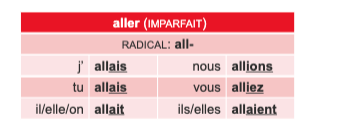
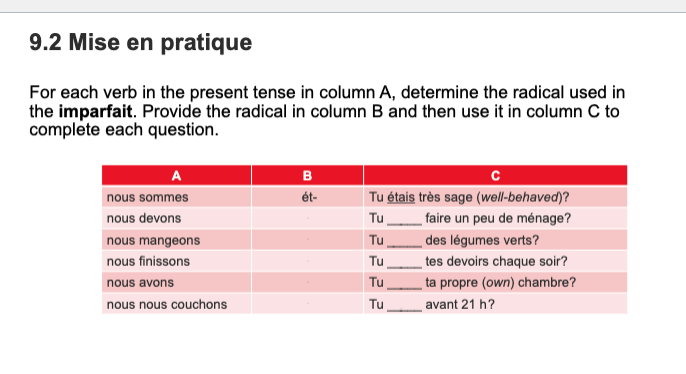
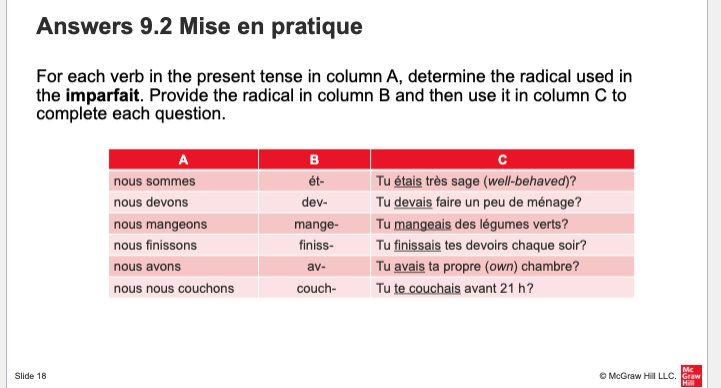
use the stem of the nous form of that verb (ex aller, allons, all-) followed by the imparfait endings, for both irregular or regular
ais. ions
ais iez
ait aient
aller imparfait
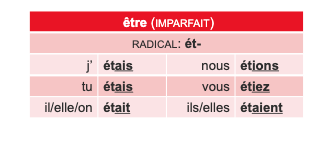
être impartfait
this is the only irregular stem ét-
How do you talk about the past using the imparfait
its is describing a reoccurring event/task done in the past that is no longer done
Quand j’étais enfant, je jouais souvent dehors avec mes amis.
When I was a child, I often played outside with my friends.
Quand j’étais jeune, mon meilleur ami habitait la même rue.
When I was young, my best friend lived on the same street.
En famille, nous regardions souvent la télé ensemble.
At home, we often watched TV together.
Pendant les vacances, nous rendions visite à mes cousins.
During the holidays, we used to visit my cousins.
what are the three conditions of imparfait
The imparfait has three main uses:
Past habits: What you used to do regularly.
Past descriptions/states: What someone or something was like.
Ongoing past actions: What was happening at a particular moment in the past.
what is the pas progressive
Describes an action that was ongoing or in progress at a specific moment in the past.
In English, it is expressed as was/were + verb-ing.
Example:
Je regardais la télé. = I was watching TV.
Je dormais quand il a appelé. = I was sleeping when he called.
French rule: The imparfait is used to express the past progressive, often describing an ongoing action that was interrupted by another event in the passé composé.
How to use imparfait to describe general conditions
it can be used to describe the ongoing state of being, or state of mind, a general doncition
Vous étiez malade? You were sick?
Il faisait très beau! The weather was really nice!
Nous avions faim! We were hungry
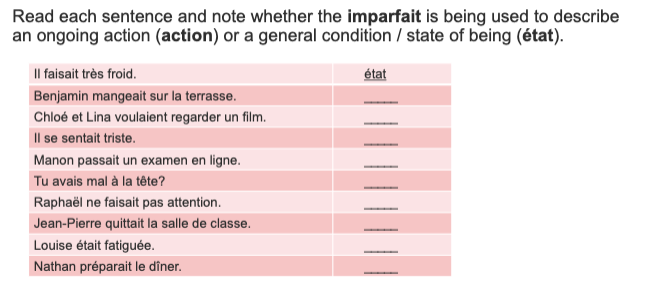

passe compose vs imparfait
verbs can appear in either passe compose or the imparfait
the difference between the two does not represent a difference in tense, bu instead a difference in the way a past event is viewed
When focusoning on an actions completion, you use the passé composé’ when focusing on its habitual or ongoing nature, you use the imparfait
pierre a fait un promenade ce matin
pierre faisait une promenade tous les jours
a midi, pierre faisait une promenade; moi, je faisais la sieste!
How to use passe compose and imparfait together in an interrupted action
There is an ongoing action (expressed in imparfait) and then that is interrupted by a specific action (expressed in passé composé)
Je rangeais ma chambre quand ma mère est entrée.
I was tidying up my room when my mother came in.
a case where distinction is evident, whn the sentecnes describe completed actions and provide as its cause a stae of mind or state of being
You would express the completed action in passe compose
You would express the state of mind or state of being in imparfait.
Caroline n’est pas allée en cours parce qu’elle était malade.
Caroline did not got ot class because she was sick
How would you tell a story about the past, when to use PC or IMp
ongoing or habitual actions in the past as well as past state of mind and states of being, are usually descriptive statements that constitute the background of a story and are expressed using Imparfait (background = imp)
completed actions usually advance the plot of a story, constituting the foreground, and are expressed using the passé compose.

Practice for telling a story
# | Verb | Answer | Tense |
|---|---|---|---|
1 | décider | a décidé | Passé composé |
2 | vouloir | voulait | Imparfait |
3 | arriver | sommes arrivés | Passé composé |
4 | être | étaient | Imparfait |
5 | regarder | regardais | Imparfait |
6 | avoir | avait | Imparfait |
7 | descendre | ai descendu | Passé composé |
8 | tomber | suis tombé(e) | Passé composé |
Last year, for winter vacation, my family decided to rent a chalet in Gryon, Switzerland, because everyone wanted to go skiing.
When we arrived at the chalet in the evening, the owners were already there to welcome us.
The next morning, I was looking out my bedroom window. There was already a lot of snow in the mountains!
Later that day, I skied down a difficult slope too quickly when, all of a sudden, I fell—and hard! Ouch!
when does descendu use avoir
DESCENDRE with AVOIR
When someone goes down something directly, use avoir.
J'ai descendu une piste.
→ I went down a ski slope.
Here, une piste is the direct object.
How do we know?
Ask: I went down WHAT?
Answer: Une piste (a ski slope).
Because there's a direct object, we use avoir.