Reefs
0.0(0)
Studied by 0 people Call Kai
 Learn
Learn Practice Test
 Spaced Repetition
 Match
Match Flashcards
 Knowt Play
Card Sorting
1/9

Earn XP
Description and Tags
Stromatolites, Stromatoporoids, sponges, corals & bryozoa
Last updated 8:08 PM on 3/17/23
Name | Mastery | Learn | Test | Matching | Spaced | Call with Kai | Chat |
|---|
No analytics yet
Send a link to your students to track their progress
10 Terms
1
New cards
What environments did stromatolites grow in?
Saline (prevent animal grazing), muddy environments so cyanobacteria could draw in sediment to form the stromatolites.
2
New cards
What do spicules do in sponges?
act as a scaffold to support soft tissue, which enhances fossilization potential
3
New cards
What mineral do the spicules of sponges produce?
Silica
4
New cards
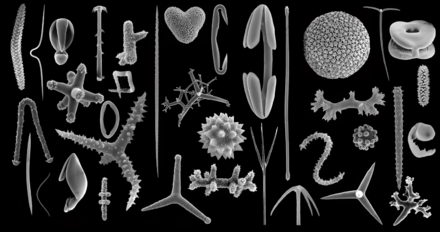
Name each of the types of Spicules in sponges
Monaxons, Triaxons, Tetraxons, Desmas, Polyaxons, Microscleres
5
New cards
This has a sophisticated structure
Stromatoporoid
6
New cards
What symmetry do the rugose corals possess?
Circular symmetry
7
New cards
Name the growth forms of rugose corals
ceratoidal, discoidal, cylindrical, scolecoidal, pyramidal, calceoloidal.
8
New cards
What body term can be applied to both mollusks and tabulate corals (also reduced in corals)?
Septa.
9
New cards
What feature do tabulate corals lack and why?
They lack an outer protective wall, because they are protected by surrounding sediment
10
New cards
What kind of symmetry do scleractinians show?
perfect radial symmetry