ce 70 final
0.0(0)
Studied by 4 people Call Kai
 Learn
 Practice Test
 Spaced Repetition
 Match
 Flashcards
 Knowt Play
Card Sorting
1/97

Earn XP
Description and Tags
98 Terms
1
New cards
What are polymorphs? Give an example.
Polymorphs are two minerals with the same chemical compositionbut different crystal lattice structures (ex. diamon and graphite)
2
New cards
What is cleavage?
Cleavage is the tendency of a mineral to break along preferred planes, or it is a type of foliation in low grade metamorphic rocks
3
New cards
Why is talc so slippery?
Talc has 6 degree slip angle, means it slips easily and lowers friction (stability problems)
4
New cards
What are phenocrysts?
Large, conspicuous crystals that form within a rock (igneous phaneritic and porphyritic)
5
New cards
What does the Bowen’s reaction series describe? ...which minerals crystallize first/last?
Bowen's reaction series describes the sequence in which silicate mienrals crystalize from a melt. The minerals crystalize in the following order (first - high temp, to last - low temp): olivine, pyroxene, hornblende, biotite, quartz, muscovite, feldspar; plagioclase forms in all
6
New cards
How is the Bowen’s reaction series reflected in the composition of igneous rocks?
It is reflected because rocks that were formed at higher temps only have the minerals that form first while the rocks formed at lower temps have minerals that form last
7
New cards
What is a felsic rock?
A felsic rock is light colored and is rich in Al, Na, K, and Si (more quartz and feldspars and muscovite)
8
New cards
What is a mafic rock?
A mafic rock is dark colored and is rich in Mg and Fe (more olivine and pyroxene and hornblende)
9
New cards
What is the difference between extrusive and intrusive igneous rocks?
Extrusive rocks are formed when they cool quickly on the Earth's surface, so they are fine grained without large crystals. Intrusive rocks are formed when they cool slowly underground, so they are coarse grained and crystalline.
10
New cards
Are granitic rocks good materials in foundations?
Granitic rocks are not good for foundations because they can have exfoliation joints, weather and erode easily, and weathers disuniformly, has onion skin weathering from chemical weathering.
11
New cards
What is exfoliation and why is it important?
exfoliation joints form parallel to slope surface in granite and become failure surfaces
12
New cards
What is magmatic differentiation? How does it lead to the formation of different rock types?
Magmatic differentiation are the various chemical processes that magma goes through. A single melt can produce different rock types.
13
New cards
What is the difference between oceanic volcanism and subduction zone volcanism?
Oceanic volcanism forms new ocean floor (divergent) while subduction zone volcanism forms island arcs (ex. Japan, Aleutian Islands)
14
New cards
What is the difference between mafic and felsic volcanism / What are the principal hazards of a volcanic eruption in a subduction zone vs in an oceanic setting?
Mafic (usually oceanic volcanism) has low viscosity lava and explosive activity, large volume of lava and poisonous gases. Felsic (subduction zone volcanism) has high viscosity lava and explosive activity, small lava volume and poisonous gases, and large gas content.
15
New cards
What is a lava tube? Why are lava tubes significant from an engineering/environmental view?
A lava tube is the empty space left when a laval tunnel drains, which happens when the surface of a laval flow solidifies while the inner part of the flow continues to stream downslope.
16
New cards
What are the two principal types of weathering?
Physical weathering (disintegration: caused by unloading, thermal stresses, frost wedging, wetting & drying, biological activity) and chemical weatheirng (decomposition: caused by oxidation, hydration, cation exchange, dissolution by (in)organic acids, chelation)
17
New cards
What are the products of weathering of a silicate mineral such as feldspar?
Feldspar weathers into clay minerals that contain K, Na, Ca ions
18
New cards
What is acid mine drainage and how is it caused?
Acid mine drainage is when sulfuric acid forms within a mine structure and is cuased by the oxidation of pyrite.
19
New cards
What is saprolite?
Saprolite is deeply weathered rock that you can dig into by hand and looks like its parent rock and is decomposed by chemical weathering in warm, wet climates.
20
New cards
How does a soil form?
Soil forms through physical and chemical weathering, and also through water (water percolates debris and carries dissolved ions and clay flakes)
21
New cards
In what order would you expect weathering to take place in a rock like gabbro?
The minerals with the highest hardness will weather last. In gabbro all the same, in granite, mica then feldspar then quartz
22
New cards
What is cementation in sedimentary rocks and why is it important?
Cementation is a process of lithification in which cement fills up the spaces between rocks to join them together. It is important becuase if affects the strength of a rock.
23
New cards
What is a clastic sedimentary rock?
A clastic sedimentary rock is one formed by the deposition of sediment
24
New cards
Name the principal cementing agents and comment on their strength and durability.
Silica, carbonates (remember karst, dissolved with exposure to water), clays, soluble salts (gypsum, halite - not durable, weak with exposure to water), iron oxides
25
New cards
What is karst? Why is its recognition important in engineering and environmental assessment?
Karst is a terrain with geological features such as caves, dissolution cavities, and sinkholes, all formed by limestone dissolution. It is important to recognize because there the features are unpredictable, and water can flow quickly through the many cracks and holes (and also the water might be contaminated because it is not filtered enough)
26
New cards
What is a sinkhole?
A sinkhole is a hole formed in karst terrain that is formed when there are dissolution cavities underground and the ground is formed of limestone. Rain continues to dissolve limestone and erodes dissolved through bedrock, forming a hole
27
New cards
What is metamorphism and what are the different types of metamorphism?
Metamorphism is the transition of rocks from other rocks. Different types are burial (deeply buried sediments are transformed into rock my both confining pressure and heat), regional (convergent plates causes sediments to transform into rock with medium high pressure and temperatures), contact (activity caused by contact with hot body, high temp, low pressure), hydrothermal (activity caused by rock interacting with high temp water, usually at mid ocean rift or hot spot), shock/impact (high temp and high pressure, usually with meteors), dynamic/cataclastic (low temp and high pressures at fault zones)
28
New cards
What is foliation and which are the principal foliated metamorphic rocks?
Foliation is a plane of weakness and preferred mode of failure. Presence of minerals muscovite, biotite, chlorite, talc, serpentine, and graphite increases the effect of foliation because they have low friction coefficient
29
New cards
What is a greenstone?
A greenstone is formed when hydrothermal metamorphism in oceanic crust produces chlorite and epidote
30
New cards
Name the most common metamorphic minerals that could cause problems in engineering projects?
Slate, because it has clay
31
New cards
What is the difference between a schist and a gneiss? ... slate and phyllite?
Gneiss is more coarse grained and has banding and is higher grade than schist, which has schistocity. Phyllite is larger grained and has mica flakes in a preferred orientation while slate has fine clay flakes
32
New cards
Is rock stronger in compression or tension?
Rocks are stronger in compression because of cracks can be forced closed by compression by is forced open by tension.
33
New cards
How do temperature and confining stress affect the strength of rock? ductility of rock?
"More confining stress and higher temperature makes rocks more ductile
Stiffness and peak strength increase with increasing confining stress.
Stiffness and peak strength decreases with increasing temperature, ductility increases"
Stiffness and peak strength increase with increasing confining stress.
Stiffness and peak strength decreases with increasing temperature, ductility increases"
34
New cards
What properties make rocks good construction materials?
The way they weather, price, availability, reactivity
35
New cards
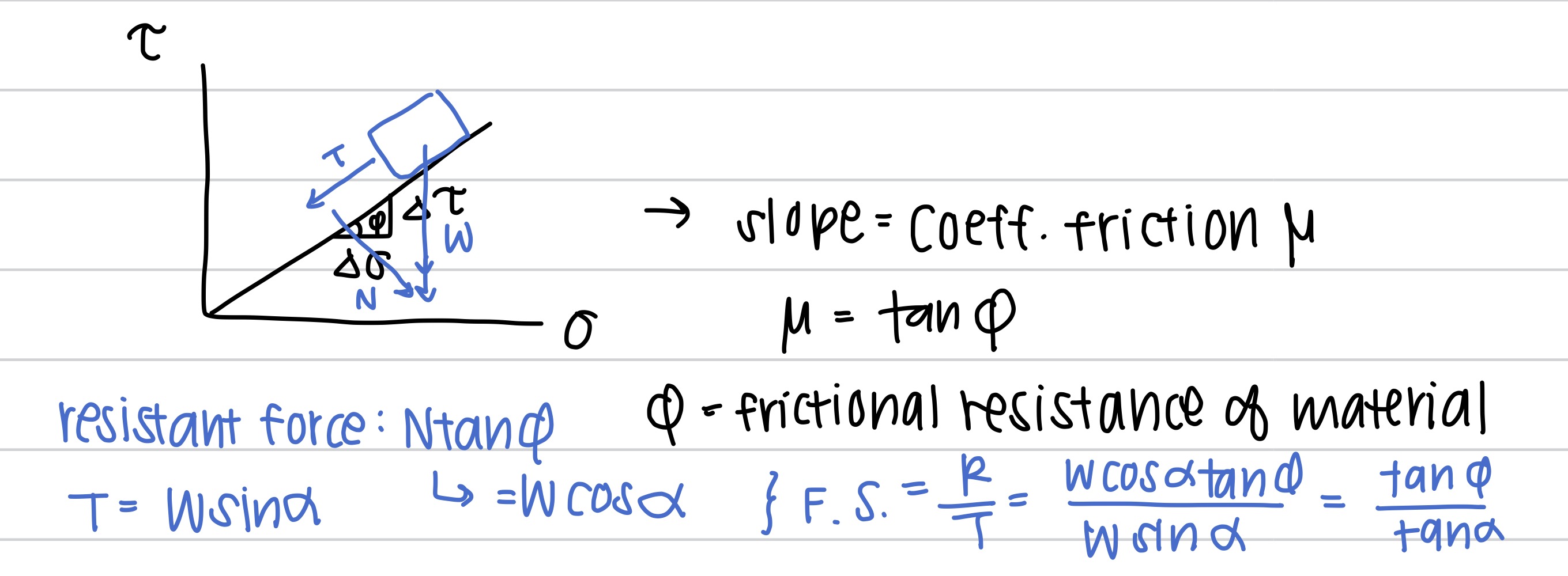
Write the basic formula for the factor of safety against sliding and explain how water pressure influences slope stability, i.e. lowers the factor of safety.
factor of safety: if tan(friction angle)/tan(angle of repose) > 1 or force of friction/driving force and water pressure influences slope stability because it reduces the soil resistance
36
New cards
What is an aquifer? an aquitard?
An aquifer is a water-saturated geologiv unit (layer/ bed or series of layers/beds) that can provide the necessary water to a well easily and an aquitard is an aquifer that doesn't transmit water for practical purposes.
37
New cards
What is an artesian aquifer?
aka confined aquifer is when the water level rises above the abse of confining layer (aquitard) in an open standpipe
38
New cards
What is the water table?
The water table is the position in which water leveel rises in an open well
39
New cards
What determines groundwater quality?
Water quality is determined by the mineralogy/chemistry of the aquifer, source of recharge and residence time
40
New cards
What are common soluble ions in groundwater?
Ca2+, Mg2+, some carbonate (CO3 which and H), iron oxides
41
New cards
What characteristics of clay rich rocks make them susceptible to landslides?
Clay minerals swell when exposed to water and as a result the rock lose strength on wetting, and they also have a low friction angle so they slide easily and the presence of bedding are planes of weakness
42
New cards
What is the role of water in landsliding?
Alters pressure w/in slope, gravity pulls down, landslides (google). It decreases the Factor of Safety as it adds upward and forward force on the rock, reducing normal force(which controls the resisting force/friction and increasing the driving force).
43
New cards
Describe the differences between a soil/rock avalanche, an earth flow, and a landslide?
"soil/rock avalanche: downslope mass movement of snow (but geologists/engineers apply this to mass movement that moves like a turbulent cloud)
Earth flow: a downslope viscous flow of fine-grained materials that have been saturated with water and moves under the pull of gravity
Landslide: mass movement of rock and/or regolith (soil and unconsolidated sediment) down a slope. Geologists/engineers classify based on 1. Type of material involved (rock or regolith) 2. Velocity of movement (slow/intermediate/fast) 3. Character of the moving mass (coherent, chaotic or slurry) 4. Environment where movement takes place (subaerial or submarine) "
44
New cards
How can landslides be stabilized?
Drainage, Addition of support at toe (bottom), Rock bolts and other rock/soil mass strengthening measures, Removal of driving mass, Build a retaining wall, Cover with an impermeable membrane, wire mesh and wire fencing, Terraces, Vegetation
45
New cards
Explain the process which forms desert pavement.
"Desert pavement is formed when fine particles are removed by wind (Lecture 16 Slide 8)
Explanation of process from textbook below (pg. 787):
First, loose pebbles and cobbles collect at the surface. Dust settles among the stones and builds up a soil layer below. Eventually, the stones crack into smaller pieces and settle to form a mosaic-like pavement."
Explanation of process from textbook below (pg. 787):
First, loose pebbles and cobbles collect at the surface. Dust settles among the stones and builds up a soil layer below. Eventually, the stones crack into smaller pieces and settle to form a mosaic-like pavement."
46
New cards
Explain why the climate varies east and west of the Sierra Nevada Mountains.
One side of the mountain gets way more precipitation than the Nevada side, little humidity is left for rain/snow east of the Nevada Mountains as the result of the orographic effect.
47
New cards
Describe a typical beach profile in summer? in winter?
In the summer, the beach widens as a result of lower waves which deposits more sand onto the beach, and in the winter, higher, more energetic waves move sand offshore and narrow the beach (erodes them to the underlying cobbles or bedrock/deposit). The typical beach profiles in either season can be explained by the seasonal cycle of wave energy.
48
New cards
What impact do longshore currents have on beaches?
Waves break at the longshore bar when they feel the surface at the bottom. The bar moves seasonally. In the winter, the longshore bar is further from the beach, and in the summer, it’s closer. If the longshore bar is further, the wave crests approach from deeper water where they travel faster (big waves=erosion of beach). If the longshore bar is closer, waves approach from shallower water where they move more slowly (smaller waves=more sand).
49
New cards
What are potential engineering problems for coastal developments?
"coastal sea level rise, typhoons/hurricanes, salt water intrusion
"
"
50
New cards
How will a seawall affect the beach profiles on either side?
On the interior side, the seawall protects the sand from getting eroded, while on the exterior side, sand is eroded more quickly and the beach becomes shorter because the wall disrupts the natural replenishment of sand
51
New cards
What are the main types of glacial deposits?
Moraine is a glacial ice deposit composed of unstratified soil and rock, till. Moraines are given names by the location under or next to ice where they formed: ground moraine – under the glacier, lateral moraine on the lateral margins, end moraine – furthest advance
Till(unstratified): sediment transported by ice, deposited beneath/on the side of/ at the toe of
Glacial outwash: Till deposited by a glacier at its toe may be picked up and transported by meltwater streams that sort the sediment.
Loess: warmer air above ice-free land rises, cold dense glacier air takes its place, which makes WIND. this wind picks up fine clay and silt and transports it from glacier’s toe. When the wind dies down, sediment settles and forms a this layer
Glacial lake bed sediment: streams transport fine material away from glaciers into meltwater lakes (forming a thick layer of glacial lake-bed sediment)"
52
New cards
How is till formed?
"Till: unsorted sediment transported by ice and deposited beneath or at the sides of glaciers after the glacier retreats/melts.
Formed bc glaciers can carry sediment/boulders of any size and transport it in direction of flow
Basically bottom of glacier scrapes against the ground which picks up lil rock
GLACIER ONLY"
Formed bc glaciers can carry sediment/boulders of any size and transport it in direction of flow
Basically bottom of glacier scrapes against the ground which picks up lil rock
GLACIER ONLY"
53
New cards
What is an esker?
A ridge or sorted sand and gravel that snakes across ground moraine - sediment of an esker was deposited in subglacial meltwater tunnels
54
New cards
What is a fault? Name the different types of faults.
"Fault - a fracture on which one body of rock slides past another
Also types of faults:
Normal - hanging wall moves down parallel to the dip direction - caused by extension
Reverse - hanging wall moves up - caused by compression
Oblique - hanging wall moves down and diagonally - caused by shortening
Thrust - hanging wall moves up at a smaller angle
Strike Slip - blocks slide past each other "
55
New cards
What is the difference between folding and faulting?
Folds are formed when heat and pressure are applied to the rock, while faults are formed by the displacement of rock that was once connected along a fault line. Faults don’t have to be groundwater barriers - can even be the opposite (places groundwater is more conductive)
56
New cards
What is the difference between an anticline and a syncline?
"Anticline = bulge up, Oldest rock in middle, youngest rock on edges
Syncline = bulge down, Youngest rock in middle"
Syncline = bulge down, Youngest rock in middle"
57
New cards
How do you determine if a fault is active or inactive?
Active faults are identified by current or historic seismicity, evidence of faulting (offset drainage, offset in most recent geologic units/soil horizon, long scarps (steep banks/slopes) or valleys, creep (rare, but seen in CA). Inactive faults can be identified by offset of geologic units.
58
New cards
What is strike and dip?
"Strike and dip are used to measure the orientation of planar structures, like tilted beds
Strike connects the topological contours with the same number in a straight line. It is the angle from north that represents where a plane intersects the horizontal.
Dip is the angle between the plane and horizontal, and it is perpendicular to the strike."
Strike connects the topological contours with the same number in a straight line. It is the angle from north that represents where a plane intersects the horizontal.
Dip is the angle between the plane and horizontal, and it is perpendicular to the strike."
59
New cards
What information is needed to determine the strike and dip of a given bed or contact plane?
"outcrop line, strike or dip and 2 outcrop points, 3 outcrop points
"
"
60
New cards
What is apparent dip?
"Apparent dip = angle that a plane appears to be dipping based on orientation
tan(apparent dip angle) = tan(actual dip, denoted as theta) * tan(angle between strike of plane and trend of apparent dip, denoted as delta)"
tan(apparent dip angle) = tan(actual dip, denoted as theta) * tan(angle between strike of plane and trend of apparent dip, denoted as delta)"
61
New cards
What is the effect of an earthquake on deep sediments like those along the margins of the San Francisco Bay?
The deeper the sediment layer above bedrock, the more soft soil there is for seismic waves to travel through. Deep soft deposits amplify responses (long period, low frequency ground motions) (large earthquakes!), whereas thin stiff deposits and bedrock amplify short period, high frequency ground motions.
62
New cards
How do we use a response spectrum to estimate the response of a structure?
use the natural period of a building and estimate using the graph of the response spectrum
63
New cards
What is the natural period of a 5-story building?
0.5 seconds
64
New cards
Why will a tall structure respond more to an earthquake motion on top of a deep sediment deposit?
A tall structure means that the natural period of vibration is greater (T=# of stories/10), and deep sediments imply that there is soft soil beneath the structure. This would amplify its response to an earthquake, since structural response is a function of the structure’s natural period and the natural period of the foundation deposits.
65
New cards
What is liquefaction?
"When loose, water saturated soil loses strength due to ground shaking (earthquakes)
- saturated and unconsolidated sediment turns into a liquid and flows like a fluid during an earthquake"
- saturated and unconsolidated sediment turns into a liquid and flows like a fluid during an earthquake"
66
New cards
Which soil is the most susceptible to liquefaction and how can liquefaction be prevented?
"Soil Type E, which includes water-saturated mud, sand, and artificial fill
Liquefaction can be prevented by increasing foundation support by injecting stabilizing materials (i.e. Treasure Island -- rig that injects cement and mixes the soil as it goes, allowing an increase in strength + ground won’t liquefy), or by inserting vibrating probes deep into the soil to compress loose soil particles and decrease the number of air pockets where water can settle "
Liquefaction can be prevented by increasing foundation support by injecting stabilizing materials (i.e. Treasure Island -- rig that injects cement and mixes the soil as it goes, allowing an increase in strength + ground won’t liquefy), or by inserting vibrating probes deep into the soil to compress loose soil particles and decrease the number of air pockets where water can settle "
67
New cards
What are the important earthquake characteristics from an engineering point of view?
amplitude of motion (peak ground acceleration), duration, dominant period/frequency
68
New cards
What is the return period of an earthquake?
"The return period of an earthquake is the average time between earthquakes.
Use equation below to calculate return period R given the probability of exceedance."
Use equation below to calculate return period R given the probability of exceedance."
69
New cards
Which earthquake is larger: one with 2% probability in 50 years or one with 10% probability in 50 years?
2% probability in 50 years; smaller earthquakes happen more frequently, so they would have a higher probability. Therefore, a lower probability would indicate a larger earthquake.
70
New cards
What is the probability of an 2% in 50-year earthquake occurring in 30 years?
".02 = 1 - (1 - 1/ R)^50 F
R = 2475
Prob of exceedance = 1 - (1 - 1/2475)^30 = 1.2%"
R = 2475
Prob of exceedance = 1 - (1 - 1/2475)^30 = 1.2%"
71
New cards
What is the probability of 100-year flood occurring in any given year?
"Return period = 100
Probability = 1/R = 1/100"
Probability = 1/R = 1/100"
72
New cards
What is the probability that a 30-year flood will occur in 30 years?
"Return period R = 30, n = 30
Probability = 1 - (1-1/R)^n
Probability = 1 - (1 - 1/30)^30 = 0.6383"
Probability = 1 - (1-1/R)^n
Probability = 1 - (1 - 1/30)^30 = 0.6383"
73
New cards
What is the probability that a 100-year flood will occur in 30 years?
"Return period R = 100, n = 30
Probability = 1 - (1-1/R)^n
Probability = 1 - (1 - 1/100)^30 = 0.26"
Probability = 1 - (1-1/R)^n
Probability = 1 - (1 - 1/100)^30 = 0.26"
74
New cards
What are the main types of gravity dams?
"Gravity dams - the structure resists the force of water by the weight of the structure itself.
Types: Concrete, Earthfill, Rockfill, Roller Compacted Concrete (RCC)"
Types: Concrete, Earthfill, Rockfill, Roller Compacted Concrete (RCC)"
75
New cards
How do arch dams function?
"Arch dams - the structure resists the force of water by transmitting the force into the abutments, most suitable for narrow canyons with steep walls of stable rocks to support the structure and the stress
Concrete only because steel would be expensive, requires less material"
Concrete only because steel would be expensive, requires less material"
76
New cards
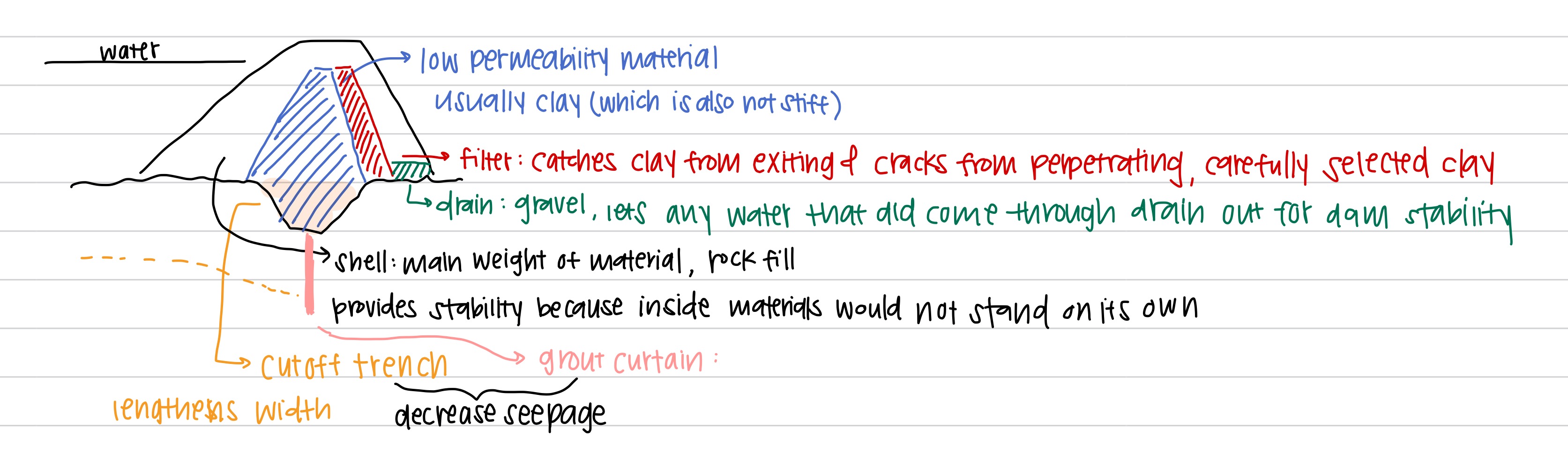
What is a zoned earth fill dam? ... What are its main elements?
**upstream slope is always flatter because stability is determined by water pressure on this side
core: clay, impervious element of dam
filter: fine sand, prevents internal erosion or piping of the core
drain - gravel, keeps the downstream shell of dam dry
shell - provides mass and stability, ideally highly permeable
core: clay, impervious element of dam
filter: fine sand, prevents internal erosion or piping of the core
drain - gravel, keeps the downstream shell of dam dry
shell - provides mass and stability, ideally highly permeable
77
New cards
What engineering geology issues need to be evaluated during the planning and design of a dam and/or reservoir?
"Foundation preparation: prevention of seepage along the dam-bedrock interface; prevention of uplift; maximizing resistance to sliding; minimizing changes in geometry
Proper structure design and preparation
Reservoir slope stability
Erosion protection"
Proper structure design and preparation
Reservoir slope stability
Erosion protection"
78
New cards
What are the main components of a tunnel support system in the adaptive tunneling method?
rock bolts, shotcrete, steel ribs
79
New cards
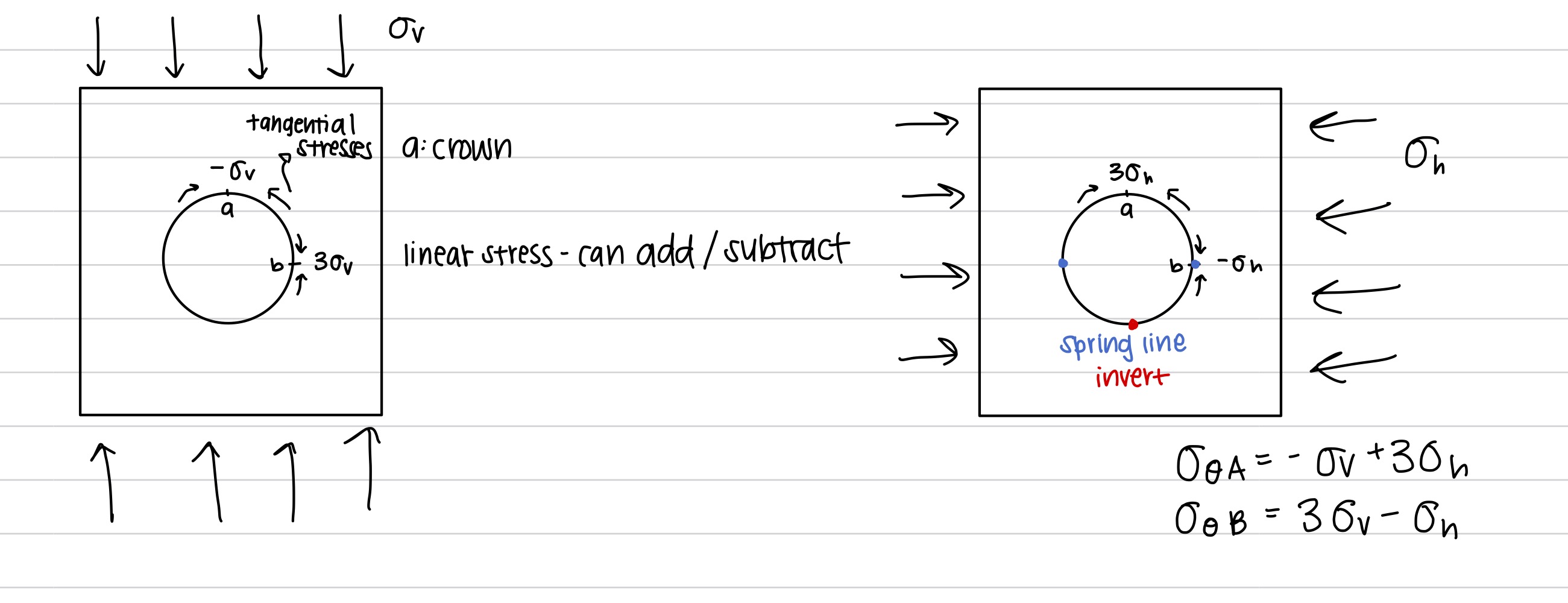
Assuming 1-D stress field, what are the stresses at the invert and at the spring line in a tunnel?
FOS = rock strength / rock load
80
New cards
What is the difference between primary and secondary tunnel liner?
Primary liners are the main supporting system installed as the tunnel is advanced while the secondary liner is the finished surface on the inside that helps with the flow of air/water moving through.
81
New cards
What are the most common explosive hazards in a coal mine?
methane and coal dust
82
New cards
What is the top-heading and bench method of tunneling and why is it used?
"Sequentially excavating top and then bottom (bench) to be able to manage the support (supporting the crown first and when that’s stable, support the bottom and then stabilize that).
Workers dig a smaller tunnel known as a heading, and then excavate below the floor of the heading (bench). "
Workers dig a smaller tunnel known as a heading, and then excavate below the floor of the heading (bench). "
83
New cards
What is hydraulic fracturing and what are its environmental hazards?
"- the injection of water, sand and surfactants in underground rock to extract oil and natural gas
- induces seismicity by opening fractures
- other impacts include high water consumption, groundwater contamination by fracking fluid leakage and methane emissions "
- induces seismicity by opening fractures
- other impacts include high water consumption, groundwater contamination by fracking fluid leakage and methane emissions "
84
New cards
What are the three main types of coal deposits? How do they form?
"Peat - compaction and partial decay of vegetation transforms to peat (50% carbon). Peat needs to be 4-10km underground to become coal.
Stages of coal production: lignite -> bituminous (100-200*C) -> anthracite (200-300*C)
Carbon content increases: 50% -> 70% -> 85% -> 95%"
Stages of coal production: lignite -> bituminous (100-200*C) -> anthracite (200-300*C)
Carbon content increases: 50% -> 70% -> 85% -> 95%"
85
New cards
What are coal seams? Describe how they are formed.
"- layered formations of coal
- usually buried under or in other sedimentary rock such as sandstone or shale. - Some of it can be mined
- formed by thick layers of plant debris being buried in sediment"
- usually buried under or in other sedimentary rock such as sandstone or shale. - Some of it can be mined
- formed by thick layers of plant debris being buried in sediment"
86
New cards
How do placer deposits of gold form?
"- placer deposits form as sediment is sorted by size and weight naturally during transport
- gold naturally accumulates as it is relatively heavier compared to other sediment, it’s more resistant to weathering"
- gold naturally accumulates as it is relatively heavier compared to other sediment, it’s more resistant to weathering"
87
New cards
What are the limitations if any of solar electricity generation?
solar energy rapidly ramps of up and rapidly ramps down
88
New cards
What is the significance of the Sacramento River delta with respect to California water supply?
"Big gulp saltwater intrusion - if levee fails, we take salt water into the delta (called big gulp), then that salt water further intrudes the delta, can disrupt all environmental services
Delta systems are dependent on sea level, seismicity, sedimentation, climate change, hydrology, land use, invasive species. They are constantly changing"
Delta systems are dependent on sea level, seismicity, sedimentation, climate change, hydrology, land use, invasive species. They are constantly changing"
89
New cards
What is the biggest threat to freshwater quality in the Sacramento River delta?
Levee failure + intrusion of salt water (could be caused by a large earthquake)
90
New cards
What are the environmental impacts of using fracking for oil and gas well development?
Fracking itself is not a problem [lol just according to him, but this is TOTAL bullshit], the re-injection of fluid/improper disposal practices lead to pollution / contaminates groundwater.
91
New cards
How do you find strike and dip on a map if you are given the outcrop line?
"- mark where the outcrop line intersects with topographic contours
- connect marks on the same contour lines with a line (this line is a structural contour)
- measure angle of line w.r.t. to north
- tan(dip) = vertical distance between 2 structural contours / horizontal distance between 2 structural contours"
- connect marks on the same contour lines with a line (this line is a structural contour)
- measure angle of line w.r.t. to north
- tan(dip) = vertical distance between 2 structural contours / horizontal distance between 2 structural contours"
92
New cards
How do you find strike and dip on a map if you are given three points?
"- connect 2 points with a line, find the distance between them and note their elevation
- find where the elevation of the third point must lie between the two points and mark the point on the line
- connect new point and 3rd point - this is a structural contour - measure its angle against north to get strike
- draw parallel lines to find a vertical and horizontal distance to find dip using tan(dip) = verical / horizontal"
93
New cards
Is the vertical thickness of a bed the same as the stratigraphic thickness?
"No, they’re different.
Vertical thickness = thickness of rock measured vertically at a point
Stratigraphic thickness = thickness of rock after correcting for dip"
Vertical thickness = thickness of rock measured vertically at a point
Stratigraphic thickness = thickness of rock after correcting for dip"
94
New cards
What are the environmental issues associated with extraction of geothermal energy?
"Changes in land use, noise/groundwater pollution, discharge,
System has ions dissolved in it that precipitate out when the temp is lowered
Idea: use a refrigerant (good for heat transfer) "
System has ions dissolved in it that precipitate out when the temp is lowered
Idea: use a refrigerant (good for heat transfer) "
95
New cards
What are the environmental issues associated with underground mining of minerals?
Acid mine drainage, Subsidence (mine collapses when done), Lowers water table, Emissions
96
New cards
What is the difference between a shape file and a dlg file in GIS?
"Shape file = geospatial vector data format = stores geometric location and placement information of geographic features
Dlg = digital line graph = vector files that depict information about geographic features (contour lines, roads, etc.)"
Dlg = digital line graph = vector files that depict information about geographic features (contour lines, roads, etc.)"
97
New cards
Which file type can be used to create contour data dlg or raster?
Raster (extraction) can create contours based on a dem file, dlg files can only store contour lines
98
New cards
What information do individual points have in laser point cloud?
Each point has an x,y,z